Anthropic’s Claude Agents gain AI daydreaming feature
▼ Summary
– Anthropic introduced “dreaming” for Claude Managed Agents, a process that reviews recent events to identify key information for storage in memory.
– Dreaming is currently in research preview and limited to Managed Agents, which are pre-built, configurable agent harnesses for multi-agent tasks.
– Managed Agents are designed for longer tasks, running over minutes or hours, as an alternative to the Messages API.
– Dreaming is a scheduled process that curates memories from sessions and memory stores to prevent information loss due to limited context windows.
– This memory curation is similar to compaction in chat models, which removes irrelevant details from the context window while retaining important information.
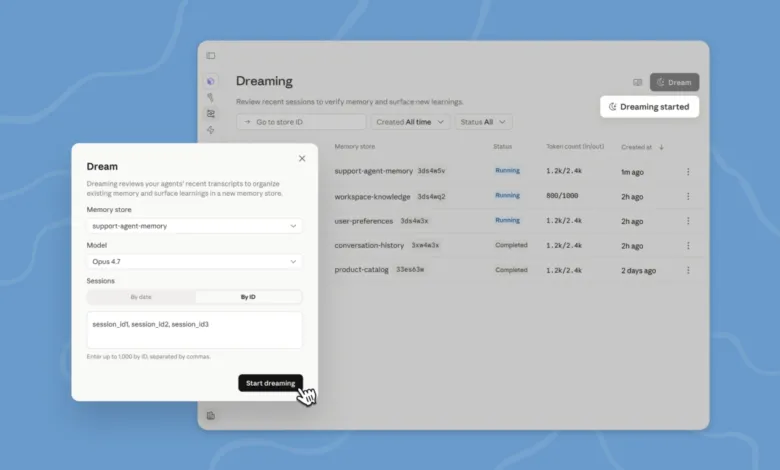
At its Code with Claude developers’ conference in San Francisco, Anthropic unveiled a new capability for its Claude Managed Agents called “dreaming.” This feature involves a structured review of recent interactions to pinpoint key information worth preserving in memory, enabling agents to draw on past experiences for future tasks.
Currently in research preview, dreaming is exclusive to Managed Agents on the Claude Platform. These agents offer a more integrated solution than building directly on the Messages API, functioning as a pre-configured, managed infrastructure designed for complex, multi-agent projects that may span several minutes to hours. The goal is to streamline collaboration toward a defined endpoint.
Anthropic frames dreaming as a scheduled process where both session logs and stored memories are examined, and relevant details are selectively curated. This addresses a core limitation of large language models: finite context windows. Without such curation, important information can slip away during lengthy workflows. On the chat side, a similar technique called compaction is already in use. There, models periodically analyze extended conversations, stripping out irrelevant data from the context window while retaining what matters most for the ongoing dialogue or project. Dreaming applies a comparable logic to agent-based tasks, ensuring that critical insights survive beyond a single session.
(Source: Ars Technica)