Toyota’s $10 billion utopia: inside the secret city
▼ Summary
– Toyota provided travel and accommodation for Ars to visit Woven City, but Ars does not accept paid editorial content.
– In 2020, Toyota CEO Akio Toyoda pledged to build a city of the future to transform the company into a mobility company.
– After spending an estimated $10 billion, the first 100 “Weavers” moved into Woven City six months ago.
– Toyota aims to become the world’s safest carmaker by using ubiquitous cameras to achieve zero accidents through vehicle-to-everything communications.
– The extensive camera surveillance at Woven City, including eight cameras at one intersection, raises privacy concerns.
At the 2020 Consumer Electronics Show, Toyota’s then-CEO Akio Toyoda unveiled an ambitious vision: a fully functioning city of tomorrow where researchers, engineers, and scientists could coexist and collaborate. The announcement signaled a strategic pivot for the world’s largest automaker, steering it toward becoming a comprehensive mobility company rather than just a car manufacturer.
Now, six months after pouring an estimated $10 billion into transforming a former factory site into an urban utopia, the first residents have moved in. A carefully selected group of 100 “Weavers” , chosen to enhance the technological credibility of this sensor-packed mini-metropolis , have begun settling into their new environment. Last week, I had the opportunity to explore this experimental community firsthand. Here are the key takeaways from walking the streets of Toyota’s vision of the future.
The future is safe
As part of its evolution into a true mobility enterprise, Toyota has set its sights on becoming the world’s safest carmaker. The company’s stated goal is to create a “society with zero accidents,” an audacious target given the massive number of Toyotas already on global roads.
“Statistically, the set of autonomous vehicles out there is nowhere close to the magnitude of vehicles that Toyota has in the world,” explained John Absmeier, Woven City’s CTO. While competitors like Waymo operate fleets of tens of thousands, Toyota’s eventual autonomous lineup will need to perform at a significantly higher standard, he noted.
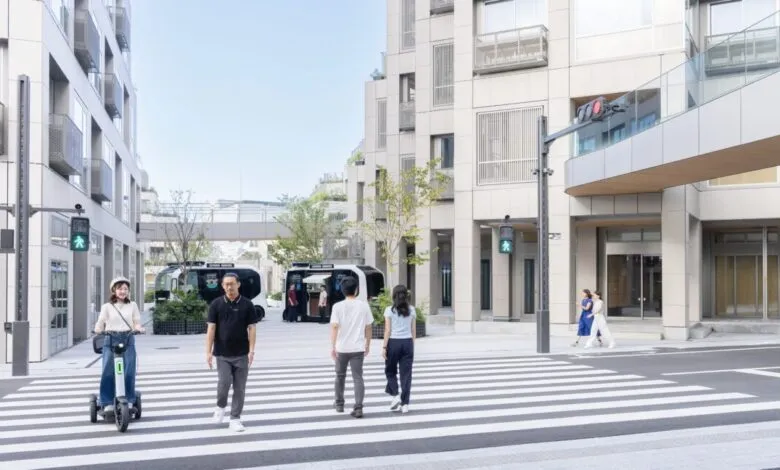
To achieve this, Absmeier argued that Toyota’s vehicles will require far greater awareness than onboard systems alone can provide , even with the most advanced lidar, radar, and imaging sensors available. For example, the only reliable way to detect a child suddenly running out from behind a truck is through cameras positioned on every street, monitoring for hazards and relaying warnings to approaching traffic. This concept builds on the long-standing promise of vehicle-to-everything (V2X) communications, and at Woven City, Toyota is actively testing that idea.
The future is a privacy nightmare
However, the prospect of ubiquitous cameras watching every move may unsettle many , and it certainly gave me pause. At a single intersection in Woven City, I counted eight separate cameras, with even more mounted on the ceilings of the buildings I toured. The modest on-site coffee shop alone had half a dozen cameras hanging overhead.
(Source: Ars Technica)