Touchable Holographic Display Appears in Mid Air
▼ Summary
– A University of Chicago team developed BloomBeacon, a touch-sensitive display using persistence-of-vision instead of standard LCD or OLED screens.
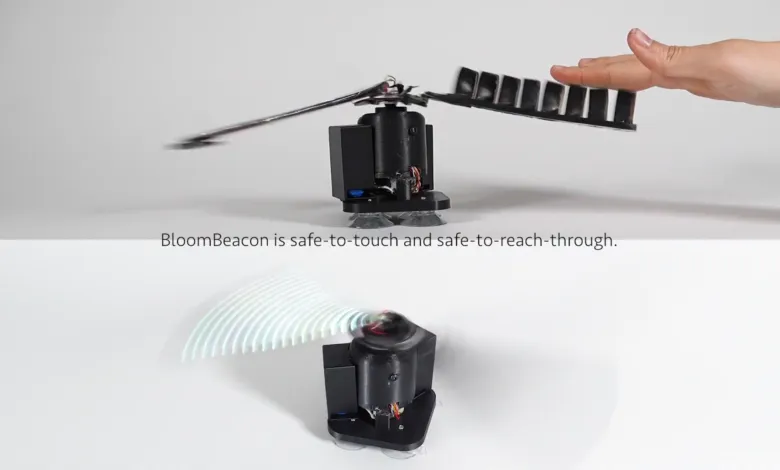
– The display consists of two spinning arms; one arm has LEDs to form a round image, and the other has capacitive pads for touch sensing.
– The arms are soft, flexible, and hinged, blooming upward as they spin, making physical interaction safe during operation.
– Users can touch user interface elements, like buttons, displayed in mid-air without injury, even if they put their hand through the spinning arms.
– The article notes BloomBeacon is a unique POV project, contrasting it with other volumetric displays previously featured.
We usually imagine touchscreens as glass or plastic panels layered with sensors over an LCD or OLED. But researchers at the University of Chicago have created something radically different: a touch-sensitive holographic display that floats in mid-air, using persistence-of-vision technology.
The project, called BloomBeacon, uses a pair of spinning arms to generate a stable, circular display that appears to hover in space. One arm is lined with LEDs for visuals, while the other carries capacitive touch pads for interaction. The clever engineering lies in the name: the arms are soft, flexible, and hinged. As the device spins up to speed, they “bloom” upward, making it safe to reach into the rotating assembly and touch the display directly. Users can see interactive elements like buttons and simply reach out to tap them in mid-air.
Conventional wisdom says to keep fingers away from spinning machinery. But BloomBeacon was built specifically to defy that rule. Even if you stick your hand right through the moving arms, the design ensures no injury occurs. It’s a striking example of how POV (persistence-of-vision) displays can evolve beyond novelty into practical, interactive tools. We’ve covered other impressive POV projects before, including a volumetric display that also pushed boundaries. Video demonstration follows.
(Source: Hackaday)