Living With a Brain-Computer Interface Implant
▼ Summary
– Scott Imbrie, paralyzed in a 1985 accident, controls a robotic arm and feels tactile feedback through a brain implant, part of a University of Chicago trial.
– A growing number of companies are developing brain-computer interfaces (BCIs) to move from labs to medical care, with some aiming for future consumer use.
– The BCI Pioneers Coalition, founded by user Ian Burkhart, advocates for trial participants to shape technology and provides crucial peer support.
– BCI users report profound emotional benefits from restored abilities, like handshakes or creative work, which often outweigh practical functions.
– Current BCI limitations include being largely lab-bound, requiring significant user training and recalibration, and facing durability and funding constraints.
The memory of that first handshake, transmitted through a robotic limb he controlled with his mind, remains vivid for Scott Imbrie. “I still get goosebumps,” he recalls. That profound moment was made possible by a brain-computer interface (BCI), an implanted array of electrodes that allows him to command a robotic arm and receive tactile feedback directly to his brain. His journey to that point spanned decades, beginning in 1985 when a car accident left him with a broken neck and a prognosis that he would never use his hands or legs again. Refusing to accept those limits, Imbrie gradually regained some mobility. Driven to help others, he spent years seeking the right research opportunity, finally joining a University of Chicago clinical trial in 2020.
Individuals like Imbrie belong to an exceptionally small group; fewer people have received these advanced brain implants than have traveled to space. Yet a surge of companies is now working to transition BCI technology from neuroscience laboratories into mainstream medical care, with the potential to assist millions living with paralysis and other neurological conditions. This crucial shift relies on the experiences of early users. Imbrie is part of the BCI Pioneers Coalition, an advocacy group founded by Ian Burkhart, the first quadriplegic to regain hand movement via a brain implant. The coalition ensures the voices of trial participants directly inform companies, clinicians, and regulators about what works in daily life.
This peer network also provides essential support, as receiving a brain implant carries significant risks beyond surgical complications. A considerable psychological toll can follow if the technology fails or if life-changing improvements are later withdrawn. Researchers are transparent about these challenges. John Downey, the lead on Imbrie’s trial, notes that for every person who ultimately participates, he speaks with ten to twenty others who are deterred.
Participants in these pioneering trials often have spinal cord injuries, stroke-induced paralysis, or conditions like ALS (amyotrophic lateral sclerosis). Implants from companies such as Blackrock Neurotech, Neuralink, and Synchron are being tested to restore limb function, control computers, or even restore speech. Many devices record signals from the brain’s motor cortex to move external devices, while others target the somatosensory cortex to recreate the sense of touch.
Mastering these systems demands immense effort. Users must train “decoder” software to translate their neural activity into commands, a process that requires regular recalibration to account for neural drift, the natural shift in brain signal patterns over time. For complex tasks like controlling a robotic arm, retraining before each session can take an hour. Austin Beggin, a participant in a trial at Case Western Reserve University, emphasizes the mental exertion involved. “The mental work of just trying to do something like shaking hands or feeding yourself is 100-fold,” he says. The commitment is also substantial, often involving lengthy travel and hours of daily work with researchers.
Despite the demands, participants find profound value in their roles. Beyond the hope of regaining personal function, many feel a moral duty to advance a technology that could help others. Beggin draws a parallel to early astronauts, pioneers laying the groundwork for future achievements.
Conversations with these early adopters reveal that the most significant benefits are frequently emotional rather than purely practical. While using a robotic arm to eat is clearly useful, many cherish the spontaneous, human moments the technology enables. Beggin treasures shaking his parents’ hands and petting his dog. Nathan Copeland, who holds the record for the longest functional brain implant, stresses that agency and freedom of expression often have the deepest impact. After sharing a video of himself playing a video game, he was criticized for not focusing on more “practical” tasks. He argues that reclaiming the ability to engage in leisure and self-expression is profoundly meaningful.
For some, the technology delivers dramatic practical change. Noland Arbaugh, Neuralink’s first recipient, found new independence. Previously reliant on a mouth-operated device that required constant caregiver help, his implant now allows him to perform countless tasks on his own. For climate activist Casey Harrell, diagnosed with ALS, a BCI designed to restore speech was transformative. Within 30 minutes of activation, he could communicate again, an overwhelming moment that allowed him to converse with his family and resume part-time work.
Significant hurdles remain before BCIs can be widely adopted. Many systems are confined to lab settings due to wired connections and bulky hardware. The academic focus of many trials can prioritize demonstrating peak performance on specific tasks over building versatile, reliable everyday systems. Users like Imbrie express frustration with constantly shifting experimental tasks and the fact that trials are often time-limited, sometimes ending even when the technology still functions. Ian Burkhart experienced this firsthand when his implant was removed after an infection, returning him to his pre-trial state.
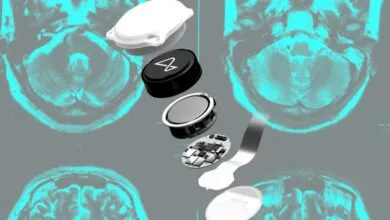
The push to commercialize BCIs is driving innovation toward more user-friendly designs. While traditional Utah Arrays require a wired skull pedestal, newer approaches are less invasive. Neuralink’s implant is a coin-sized unit with flexible threads inserted by a surgical robot, operating wirelessly. Synchron threads a stent-like implant through blood vessels to the brain. These companies are also developing adaptive decoders that use machine learning to adjust to neural drift automatically, minimizing recalibration.
True ease of use will require systems that understand user context, says Kurt Haggstrom of Synchron. This means interpreting mood, attention, and environment. Synchron recently paired its implant with an Apple Vision Pro headset, allowing a user to control smart home devices by looking at them. Another approach is to decode high-level intent, like the desire to send an email, rather than low-level motor commands.
Durability presents a tougher challenge. Current implants may last around a decade, not a lifetime, and replacement options in the brain are limited. This rapid technological evolution also creates a dilemma for potential users: adopt an available device now or wait for a more advanced model.
Some industry figures, most notably Neuralink’s Elon Musk, speculate about a future where BCIs become consumer technology, augmenting human capabilities. This vision elicits concern among current medical users. While hype can drive funding, it might divert focus from critical therapeutic needs. There are also serious questions about data privacy and ownership if neural data becomes widely collected.
Many developers maintain their primary focus is medical. Florian Solzbacher of Blackrock Neurotech believes they are building a “universal interface” that, while medically focused, should not offer users a bare-bones experience. Scott Imbrie agrees, arguing that consumer-driven innovation could ultimately enhance medical devices, making them more capable and affordable. He is determined to highlight the positive potential of BCIs, concerned that excessive focus on risks discourages volunteers. Remembering the dehumanizing feeling of complete dependence after his accident, he states a fundamental truth: “As humans, we want to be independent.”
(Source: Ieee.org)