Cosmic Bombardment Melted Earth’s First Crust 500 Million Years Ago
▼ Summary
– Earth is the only known planet with silica-rich continents, but geologists disagree on how they formed, with the oldest continental rock dating to about 4 billion years ago.
– Tim Johnson and colleagues argue that intense asteroid impacts kept the early crust hot and thin, enabling the formation of buoyant continents.
– Geological evidence of early continent formation is scarce, with the oldest continental rocks from around 4.03 billion years ago and few older samples.
– One theory suggests plate tectonics formed continents above subduction zones in the Hadean eon.
– Another theory proposes that a hot early Earth prevented rigid plates, so continents formed above mantle plumes rising from deep within the planet.
Geologists have long puzzled over a fundamental mystery: how did Earth’s silica-rich continental crust first emerge? Our planet remains the only known world with such buoyant landmasses, yet the precise timing and mechanism behind their formation have sparked fierce debate for decades. “The continents started appearing around about four billion years ago,that’s the oldest continental rock we know about,” explained Tim Johnson, a geologist at Curtin University in Perth, Australia. “The Earth is four and a half billion years old, so why they started appearing then is unknown, as is the mechanism to make that continental crust.”
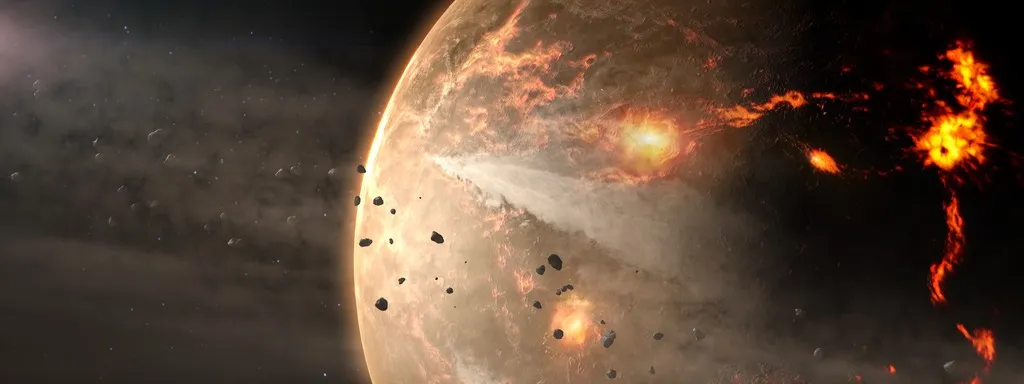
Now, Johnson and his research team are proposing a bold new answer: the formation of continents was driven largely by an intense, sustained barrage of asteroid impacts that kept the early crust hot and thin enough to allow buoyant landmasses to develop. In essence, the ground beneath our feet exists because of a violent, ancient bombardment from space.
A major hurdle in solving this puzzle is the scarcity of geological evidence from Earth’s infancy. The oldest known continental-type rocks crystallized roughly 4.03 billion years ago, near the end of the Hadean eon,the planet’s earliest era, spanning its first 500 million years. Rare basaltic rocks date back to about 4.2 billion years, and a handful of zircon crystals push the record to 4.4 billion years. Beyond that, the rock record is virtually blank. “There are huge debates about what was going on in the early Earth, because the data is so scarce,” Johnson noted.
Two main theories have dominated the discussion. One suggests that plate tectonics, much like the system operating today, was already active during the Hadean, with continental crust forming above subduction zones where tectonic plates collided. The other proposes that early Earth was simply too hot for rigid plates, and that crust instead formed above mantle plumes rising from deep within the planet,a process Johnson compares to wax blobs rising inside a lava lamp.
(Source: Ars Technica)