LiDAR Motion Trick Reveals Hidden Objects
▼ Summary
– The article references LiDAR technology used in Apple Vision Pro, as detailed by TechInsights in 2024.
– It cites Forbes (2020) coverage of the iPhone 12’s LiDAR scanner for depth sensing.
– The text includes a 2023 Sony press release on a SPAD depth sensor for smartphones with high photon detection efficiency.
– Multiple sources address non-line-of-sight (NLOS) imaging techniques, using methods like WiFi, Doppler radar, thermal, acoustic, and synthetic wavelength holography.
– Other cited works cover depth sensing advances, including SPAD image sensors, neural radiance fields (NeRF), and 6D object pose estimation.
A clever new technique is turning a well-known limitation of LiDAR technology into a powerful advantage: using deliberate motion to reveal objects that are otherwise hidden from view. This breakthrough, which builds on existing sensor hardware found in devices like the Apple Vision Pro and recent iPhones, promises to expand the capabilities of autonomous systems, robotics, and even everyday photography.
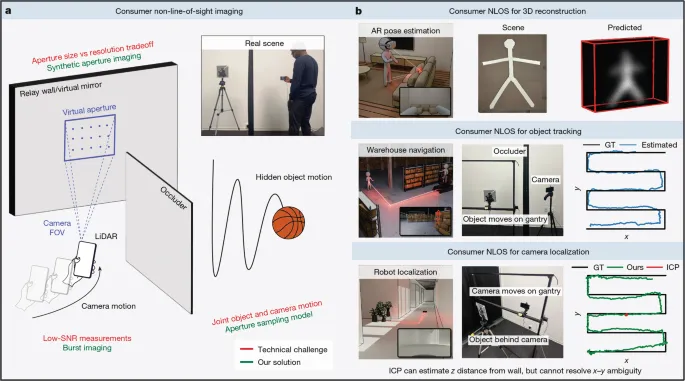
The core innovation lies in exploiting the “LiDAR motion trick.” Traditional time-of-flight sensors, which measure distance by bouncing laser pulses off surfaces, struggle with objects that are occluded or located around corners. However, by carefully analyzing the subtle changes in the returning light patterns as the sensor itself moves, researchers have developed algorithms that can reconstruct the shape and position of hidden objects. This approach effectively turns a moving sensor into a computational periscope, using the scattered light from visible surfaces to infer the geometry of unseen spaces.
This method builds on a rich history of non-line-of-sight (NLOS) imaging research. Early efforts relied on specialized, expensive equipment like femtosecond lasers and streak cameras to capture the faint echoes of light. More recent work has explored using Wi-Fi signals, Doppler radar, and even thermal cameras to “see” around corners. The key difference with the new motion-based LiDAR trick is its practicality. By leveraging the compact, digital LiDAR sensors already being mass-produced for consumer electronics, the technique avoids the need for bulky, custom hardware. Sony’s recent development of SPAD depth sensors with industry-leading photon detection efficiency for smartphones further underscores the potential for widespread adoption.
The underlying physics is surprisingly intuitive. When a LiDAR sensor moves, the paths that light takes to reach hidden objects and bounce back to the sensor change in predictable ways. By correlating these changes across multiple frames, a process akin to synthetic aperture radar (SAR) or burst photography, the system can computationally untangle the signal from the noise. This allows it to distinguish between light bouncing off a visible wall and light that has taken a longer, indirect path around an obstacle. The result is a real-time, or near-real-time, ability to track moving objects and even reconstruct static scenes that are completely out of the direct line of sight.
The implications are far-reaching. For autonomous vehicles, this could mean detecting pedestrians or cyclists hidden behind a parked truck or a building corner, well before they become visible. In robotics, it could enable safer navigation in cluttered environments. Even in consumer applications, future smartphones might use this technique to frame a shot perfectly, even when the subject is partially obscured. The work builds on foundational algorithms for 3D shape reconstruction, pose estimation, and neural radiance fields (NeRF), adapting them for the unique challenges of hidden-scene geometry.
While challenges remain, such as computational cost and performance in highly scattering environments, the LiDAR motion trick represents a significant step. It transforms a sensor’s own movement from a potential source of error into a deliberate tool for discovery, bringing the science fiction of seeing around corners closer to everyday reality.
(Source: Nature.com)