I tried Android XR glasses at Google I/O and now I’m sold on smart displays

▼ Summary
– Xreal’s Project Aura glasses feature dual OLED displays, a separate puck for battery and compute, and support gesture controls and electrochromic dimming with five levels.
– The author found Xreal glasses’ visuals impressive, with legible text, vibrant colors, and responsive performance, including a demo where video looked crisp after adjusting dimming.
– Google’s prototype monocular display glasses, a reference for Samsung’s upcoming model, include new widgets like Translate, which provides real-time translation even during pauses.
– The monocular glasses also support Google Maps, showing directions in the user’s line of sight and a map section when tilting the head down.
– Both Xreal and Samsung are expected to launch their glasses later this year, though pricing remains a concern.
Google I/O is in full swing, and while the keynote had its share of highs and lows, the real highlight for me came afterward. I got hands-on time with upcoming Android XR glasses from Xreal and a Google prototype that serves as a blueprint for Samsung’s next-generation smart eyewear. These demos completely shifted my perspective on what smart displays can do.
Samsung originally planned to launch its Galaxy XR last year, but that device was bulky and impractical for daily wear. This time, the focus has shifted to sleeker, everyday glasses. I tried both the Xreal glasses and Google’s reference model, and while I still have a soft spot for audio-only glasses, I’m now genuinely excited about what’s coming in the display glasses category.
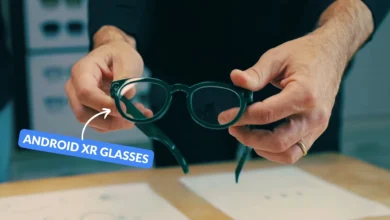
Xreal’s Project Aura was the first and most intriguing demo. These glasses, teased last year, feature two OLED displays,one for each eye,embedded behind the lenses. The design is chunky, sitting slightly farther from the face than typical frames, but once on, you barely notice. Two cameras on the lenses handle perception and tracking, while a central camera captures photos and video. On one temple, you’ll find a volume rocker, a Home/Gemini button, and a dimming control for the electrochromic lenses.
A separate puck houses the Snapdragon-powered compute and battery, connecting to the glasses via cable. Battery life wasn’t disclosed, but I’m told it can handle a full movie. The puck also includes a touch panel for control, and you can plug in laptops or phones to mirror apps and windows,a classic Xreal feature.
The visual experience exceeded my expectations. Text is crisp, colors are vibrant, and everything feels responsive. Gesture controls work like the Quest 3: pinch and drag to select, move, or resize objects. I opened a Spider-Man 2 trailer, which initially looked washed out. But after adjusting the dimming across five levels, the video became sharp and vivid, comparable to an OLED laptop display. It even stayed anchored to a wall as I moved around.
I also tested an app using Antigravity to paint in 3D space by pinching my fingers. I could change color and adjust line thickness by twisting my wrist, and the creation stayed locked in place as I walked around. It was genuinely impressive.
Xreal describes Project Aura as a middle ground between the power of the Galaxy XR and the compactness of the Meta Ray-Ban Display Glasses. I never used the Galaxy XR, but this demo made me far more enthusiastic about display glasses than I ever expected.
Google’s monocular display prototype was equally compelling. This model, which serves as a reference for Samsung’s upcoming glasses, includes new widgets accessed by swiping on a touch panel. One standout is the Translate widget: I tapped it to translate spoken Korean, and it kept up even when the speaker paused mid-sentence. It felt like a small but powerful utility.
I also used Gemini to take a photo of myself, then asked it to place me in space with Neptune in the background. The generation took a while due to network congestion, but a preview appeared on both the glasses and a paired Pixel phone. Even previously announced features like Google Maps integration impressed me: simple directions appear in your line of sight, and tilting your head down reveals a map section so you can visualize your route. This feels far more useful than audio-only navigation.
The single display on the right lens takes a moment to adjust to, but your eyes adapt quickly. Unlike dual-display glasses like Project Aura, information is presented simply, avoiding overwhelm. This feels like a sweet spot between audio glasses and full XR headsets.
I still think audio glasses are my go-to, but my time at Google I/O has made me far more open to display glasses. Both Xreal and Samsung are expected to launch their devices later this year. Here’s hoping the price tags won’t be out of reach.
(Source: Android Central)