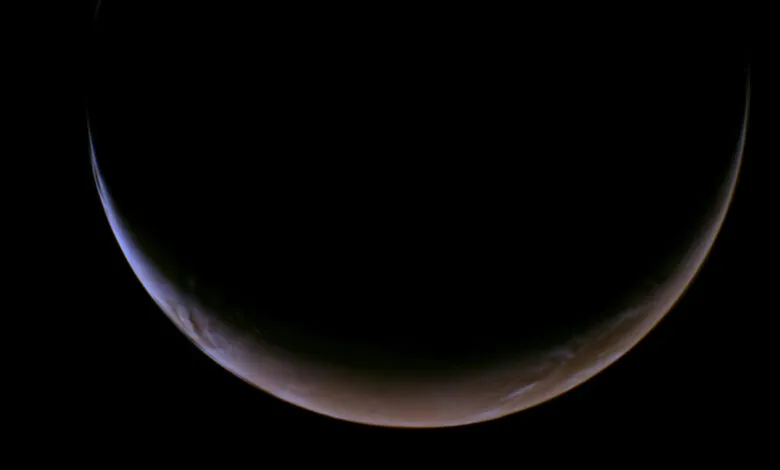
NASA’s Psyche Spacecraft Captures Unfamiliar Views of Mars
▼ Summary
– The Psyche spacecraft, launched in October 2023, used a Mars flyby on its way to the metal asteroid Psyche, which it will reach in 2029.
– The flyby gave the spacecraft a 1,000-mile-per-hour speed boost and shifted its orbital plane by about 1 degree, putting it on course for its target.
– The gravity assist was the primary goal, but the encounter also served as a dress rehearsal for the spacecraft’s science instruments.
– The three instruments tested were a multispectral imager, a gamma-ray and neutron spectrometer, and a magnetometer.
– Scientists used the Mars flyby as a practice run for when the instruments will study the asteroid Psyche.
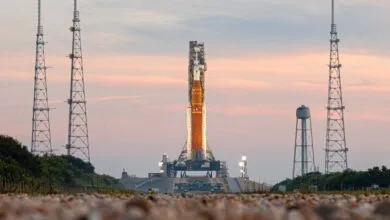
A NASA spacecraft that launched more than two-and-a-half years ago is now a little closer to its final destination after using Mars for a critical speed boost. The Psyche mission, which departed from Kennedy Space Center in Florida in October 2023 aboard a SpaceX Falcon Heavy rocket, is roughly halfway through a 2.2 billion-mile (3.6 billion km) trek to explore the asteroid belt’s largest metal-rich body, also named Psyche. The probe relies on plasma engines to gradually build momentum, but last week’s close pass by Mars provided its most significant velocity increase since liftoff.
Navigators at NASA’s Jet Propulsion Laboratory in California orchestrated the flyby to bring the spacecraft within 2,864 miles (4,609 km) of the Martian surface , safely above the planet’s thin atmosphere. Using the Red Planet’s gravity like a slingshot, Psyche gained enough energy to reshape its trajectory around the Sun, setting it on a direct intercept course for its target asteroid in the main belt between Mars and Jupiter.
“Although we were confident in our calculations and flight plan, monitoring the DSN’s (Deep Space Network’s) Doppler signal in real time during the flyby was still exciting,” said Don Han, Psyche’s navigation lead at JPL, in a statement. “We’ve confirmed that Mars gave the spacecraft a 1,000-mile-per-hour boost and shifted its orbital plane by about 1 degree relative to the Sun. We are now on course for arrival at the asteroid Psyche in summer 2029.”
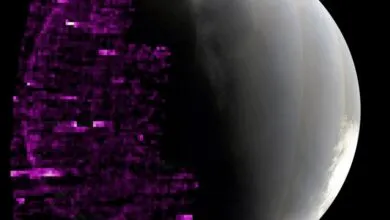
While the gravity assist was the primary objective, ground teams also used the encounter as a dress rehearsal for the mission’s science operations. Engineers activated Psyche’s three main instruments , a multispectral imager with two cameras, a gamma-ray and neutron spectrometer, and a magnetometer , to test their functionality during a real planetary flyby. Since similar sensors are already operating on other spacecraft permanently studying Mars, the real value came from giving scientists a practice run before the probe begins its primary investigation of the asteroid Psyche.
(Source: Ars Technica)