NASA Engineers Break Through in Rotor Technology at JPL
▼ Summary
– NASA engineers are designing next-generation Martian rotorcraft to carry heavier payloads longer distances, building on Ingenuity’s success.
– Ingenuity made 72 flights over three years, far exceeding its original goal of five flights in 30 days, before ending with a crash-landing in January 2024.
– NASA’s SkyFall mission plans to send three larger helicopters to Mars, potentially launching as late as 2028 aboard the nuclear-powered Space Reactor-1.
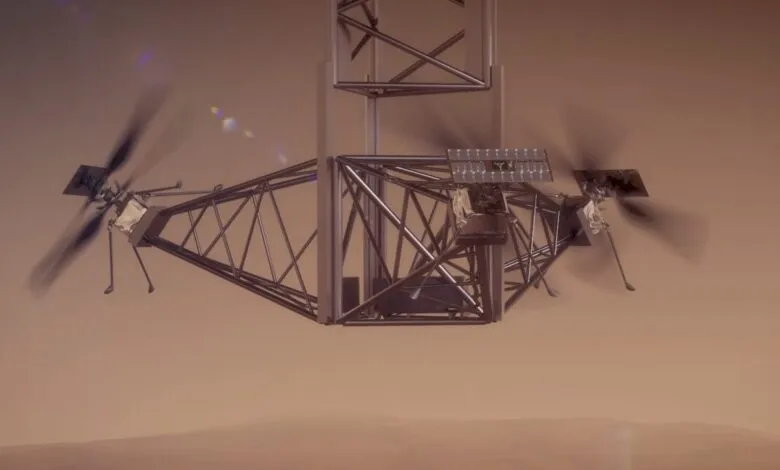
– The SkyFall helicopters will be larger and heavier than Ingenuity and must land themselves after entering Mars’ atmosphere inside a heat shield.
– Engineers at JPL and AeroVironment achieved a breakthrough by testing new, larger rotor blades designed for Mars’ low-density atmosphere.
Just over three years after NASA’s Ingenuity helicopter concluded its historic mission on Mars, engineers at the Jet Propulsion Laboratory in California are already advancing the next generation of Martian rotorcraft. These new designs aim to carry heavier payloads over greater distances through the planet’s exceptionally thin atmosphere.
Ingenuity proved to be a groundbreaking success. As the first flying vehicle to explore another world, this dual-bladed helicopter completed 72 flights. That far exceeded NASA’s original target of five flights over 30 days, after it was delivered to Mars by the Perseverance rover. When the mission ended with a crash-landing in January 2024, Ingenuity had fundamentally shifted how scientists approach planetary exploration. It demonstrated that aerial mobility could cover longer distances and reach terrain inaccessible to rovers.
Now, NASA is planning to send three more helicopters to Mars as part of the SkyFall mission, which could launch as early as late 2028. SkyFall will travel to the red planet aboard a nuclear-powered spacecraft called Space Reactor-1 (SR-1). This spacecraft is one of several technology demonstration initiatives announced earlier this year by NASA Administrator Jared Isaacman.
Ingenuity’s main body was roughly the size of a tissue box, with a mass of just 4 pounds (1.8 kilograms) and counter-rotating rotors spanning about 4 feet (1.2 meters). The SkyFall helicopters will be significantly larger and heavier. They will also rely on a novel landing maneuver, deploying themselves onto the Martian surface after entering the atmosphere inside a heat shield. That shift demands major innovations in rotorcraft design.
Breaking a barrier
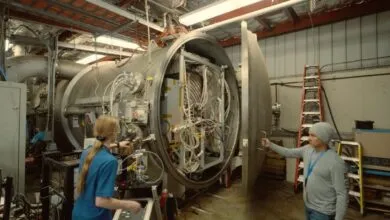
Engineers at JPL and AeroVironment, the same team that built Ingenuity, have recently achieved a breakthrough in the lab that brings the SkyFall mission closer to reality. Their tests focused on the new, larger rotor blades needed to propel these next-generation helicopters through the Martian atmosphere. The air density there is just 1 percent of what it is at sea level on Earth, making lift a formidable challenge.
(Source: Ars Technica)