UAE firm G42 leases 20MW in former Minneapolis office for AI data hub
▼ Summary
– Core42, an Abu Dhabi-based AI subsidiary, leased 20 megawatts in a converted Minneapolis office building, part of a pattern where AI-driven office vacancies create demand for data centers.
– G42 is building the Stargate UAE campus, a massive AI facility in Abu Dhabi with a 200-megawatt first phase by 2026, part of a $500 billion joint venture with OpenAI, SoftBank, and Oracle.
– Core42’s U.S. expansion includes a 70-megawatt lease in New York, with options for more, and a $1 billion data center investment in Vietnam, alongside its new European headquarters in Dublin.
– The Minneapolis building was converted from office to data center use by Legacy Investing, which spent over $70 million, and later sold for $235 million, reflecting strong demand for such conversions.
– G42’s U.S. data center strategy provides sovereign cloud infrastructure within American borders, amid sensitive geopolitics after it severed Chinese ties and secured a $1.5 billion Microsoft investment.
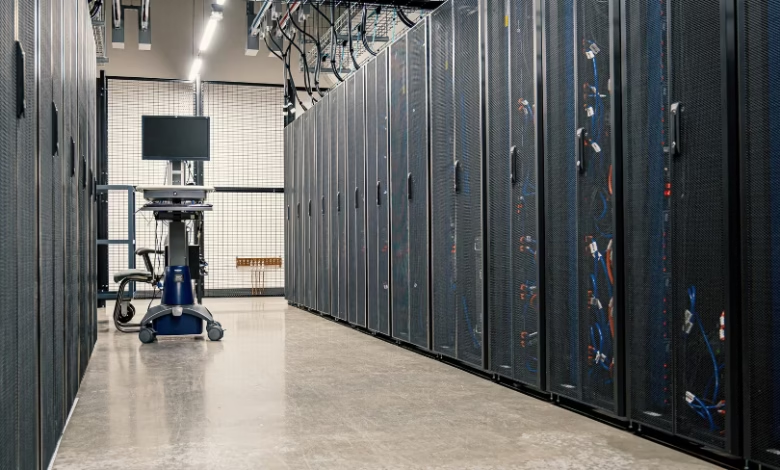
The building at 1001 Third Avenue South in downtown Minneapolis once housed white-collar workers. Today, it is a data centre, and its anchor tenant is not a Silicon Valley giant but Core42, the cloud and AI infrastructure arm of Abu Dhabi’s G42 Group. The lease, covering 20 megawatts of capacity, was reported by Bloomberg on Wednesday. The facility was converted from commercial office space by Legacy Investing, a Virginia-based developer that has poured more than $70 million into transforming the property. This deal represents a small yet telling piece of a much larger narrative: the UAE’s most ambitious AI company is building a network of American data centres while simultaneously constructing the largest AI compute facility outside the United States. The buildings it is filling were, until recently, home to the kind of workers whose jobs AI is designed to replace.
G42, led by CEO Peng Xiao and backed by Abu Dhabi’s national security adviser Sheikh Tahnoon bin Zayed Al Nahyan, has become the UAE’s primary vehicle for AI infrastructure investment. The company is building the Stargate UAE campus, the international flagship of the $500 billion Stargate joint venture between OpenAI, SoftBank, Oracle, and Abu Dhabi sovereign investment vehicle MGX. This campus spans approximately 19 square kilometres of desert south of Abu Dhabi. The first phase, a 200 megawatt compute cluster powered by Nvidia Grace Blackwell GB300 systems, is scheduled to come online by the end of 2026. Full build-out is designed to reach one gigawatt of capacity at a projected cost exceeding $30 billion. The project has already drawn geopolitical threats, with Iran warning of retaliatory strikes against Gulf infrastructure, including commercial data centres.
Core42’s US expansion extends well beyond Minneapolis. The company signed a ten-year lease with TeraWulf for more than 70 megawatts of data centre infrastructure at the Lake Mariner facility in upstate New York, with an option for an additional 135 megawatts. G42 has also announced a $1 billion data centre investment in Vietnam and established Core42’s European headquarters in Dublin. The Minneapolis lease adds a relatively modest 20 megawatts to a portfolio scaling globally. Its significance lies less in the capacity than in the location: a converted office building in the centre of an American city whose downtown vacancy rate, like those of most mid-sized US cities, has climbed steadily since the pandemic.
Legacy Investing acquired 1001 Third Avenue South in 2019 and has since invested heavily in converting the six-storey property from office to data centre use. The company spent more than $70 million on improvements in 2025 alone, expanding the building’s capacity from approximately two megawatts to 21 megawatts. In January 2026, Cloud Capital and Bahrain-based asset manager Arcapita acquired the property for $235 million through a joint venture, reflecting the premium that data centre conversions now command over traditional office valuations.
The economics of office-to-data-centre conversion have become compelling enough to reshape urban real estate markets. US utilities plan to spend $1.4 trillion by 2030 to power the AI boom, and demand for data centre capacity has outstripped the supply of purpose-built facilities. Converting existing office buildings offers developers a faster path to market than ground-up construction, provided the building’s structural load capacity, power infrastructure, and cooling systems can be upgraded to support the density of modern compute hardware. Not every office qualifies. The buildings that do, typically those with reinforced concrete construction, proximity to fibre networks, and access to sufficient electrical capacity, have become some of the most sought-after properties in commercial real estate.
G42’s American data centre strategy reflects a broader shift in how sovereign AI ambitions are materialising in the United States. The company is not simply building compute capacity abroad. It is establishing a physical presence inside the American power grid, the American fibre network, and American commercial real estate markets. The Minneapolis lease, the TeraWulf deal in New York, and facilities in California and Texas create a distributed infrastructure footprint that positions Core42 as a provider of what the company calls sovereign cloud and AI infrastructure: compute capacity that can serve both G42’s own AI workloads and those of its customers, including US-based companies that require data residency within American borders.
The race to secure data centre capacity has drawn startups, sovereign wealth funds, and hyperscalers into direct competition for the same constrained resources: power, land, cooling, and fibre connectivity. In Minneapolis, Legacy Investing’s conversion of an office building into a 21 megawatt facility illustrates how developers are working around those constraints by repurposing existing urban infrastructure rather than competing for greenfield sites in the exurban corridors where most large-scale data centres are built. The approach has limits. Twenty megawatts is a fraction of the capacity that a purpose-built hyperscale facility delivers, and the structural constraints of an existing building make future expansion difficult. But for a tenant like Core42, which needs distributed US presence rather than concentrated scale, the urban conversion model offers something that a greenfield campus in rural Virginia does not: proximity to enterprise customers and the network interconnection density of a major metropolitan area.
The geopolitics of UAE-linked AI infrastructure in the United States remain sensitive. G42 severed its ties with Chinese technology companies in 2024 under pressure from the US government, a prerequisite for receiving access to advanced American AI chips. Microsoft invested $1.5 billion in G42 as part of that realignment, and the company has since positioned itself as a bridge between American AI technology and Gulf capital. OpenAI’s decision to pause its Stargate UK project over energy costs and regulatory concerns has made the UAE’s willingness to build at scale and speed more strategically valuable. G42’s ability to secure chip imports for the Stargate UAE campus has been treated by the US government as a test case for whether AI infrastructure can be deployed in allied nations without compromising national security.
The financial dynamics of AI infrastructure investment have produced valuations and capital commitments that would have been inconceivable five years ago. Oracle’s stock fell 50 per cent despite a Wall Street buy consensus as concentration risk from its OpenAI dependency spooked investors. Alphabet raised its full-year 2026 capex estimate to between $180 and $190 billion. The International Energy Agency predicts that energy use from data centres will double by the end of 2026. Into this environment, a 20 megawatt lease in a converted Minneapolis office building registers as a footnote. But the tenant signing the lease is the company building the largest AI compute facility outside the United States, and the building it is moving into is one of hundreds of American offices being repurposed to house the infrastructure that is making the offices themselves obsolete. The conversion is not just architectural. It is economic. The same AI systems that emptied the office are now filling it with servers.
(Source: The Next Web)