Pope Leo urges humanity to stay ‘profoundly human’ in AI era
▼ Summary
– Pope Leo XIV’s first major papal document, *Magnifica Humanitas*, warns of risks from AI and unconstrained technological power, including AI-powered warfare and effects on labor.
– The encyclical compares the current AI era to the Tower of Babel, cautioning against “the idolatry of profit” and the reduction of human mystery to data.
– It calls for human dignity to guide decision-making, ensuring human intelligence and conscience steer technical innovations and their limits.
– Proposals include social criteria for automation, human control over lethal force, transparency in algorithmic hiring, support for responsible tech education, and sustainable AI development.
– The document advocates “disarming” AI to prevent domination by technical power, rejecting the idea that technological capability grants the right to govern.
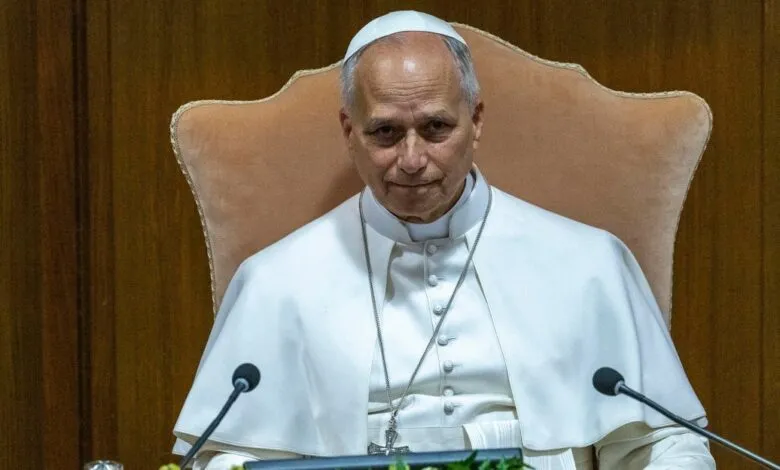
Pope Leo XIV issued his first major papal document on Monday, a sweeping encyclical titled Magnifica Humanitas that serves as a manifesto for safeguarding human dignity in the age of artificial intelligence. The pope warns of the profound risks posed by unconstrained technological power, addressing AI’s role in warfare, labor displacement, and the urgent need for new legal and ethical frameworks to govern these rapidly advancing tools.
In this open letter to the Catholic Church and the world, Pope Leo highlights the economic and social upheaval triggered by swift AI adoption, arguing that current protections for individuals are dangerously inadequate and threaten human dignity. He draws a striking parallel between today’s technological moment and the biblical Tower of Babel, cautioning society to “avoid the ‘Babel syndrome.’” This syndrome, he explains, manifests as “the idolatry of profit that sacrifices the weak, a uniformity that neutralizes differences, and the pretense that a single language , even a digital one , can translate everything, including the mystery of the person, into data and performance.”
The encyclical touches on several critical areas where AI has become deeply embedded: job loss and labor market disruption, AI-powered autonomous weapons, and the exposure of children to AI-generated content. At its core, the document insists that human dignity must remain central to all decision-making and governance surrounding technology. Pope Leo writes that the letter is a call for “moral and social discernment that safeguards the primacy of the human person, in order to ensure that it will always be human intelligence, with its conscience and freedom, that guides technical innovations and responsibly determines their use and limits.”
Spanning more than 42,000 words, the encyclical frames the push for prudence, rigorous evaluation, and even a slower pace in adopting AI as “an exercise of responsible care for the human family.” Among its key proposals are establishing social criteria for introducing automation, along with robust worker protections and retraining programs; ensuring that humans, not opaque algorithms, make decisions about lethal force; helping educators and students engage with AI in responsible, critical, and creative ways; demanding transparency and accountability when algorithms influence hiring or access to services; and developing AI technology that is more environmentally sustainable.
The impact of AI on humanity has been a defining theme for Pope Leo since his election. He chose his papal name in homage to Pope Leo XIII, who issued a landmark encyclical on protecting workers during the industrial revolution. The current pope has actively engaged with the tech industry: Anthropic co-founder Christopher Olah attended the document’s presentation on Monday, and Politico reported that representatives from Amazon, Meta, and Google have met with Vatican officials in recent months, seeking to influence the church’s stance. (A separate group has attempted to “AGI-pill” the pope, though Magnifica Humanitas does not explicitly address artificial general intelligence.)
Despite its warnings, the encyclical is not a blanket rejection of AI. Instead, Pope Leo calls for the “disarming” of the technology , not only in a military sense but also economically and socially. He argues that AI should not be used in a race to amass power or monopolize society. “To disarm means discrediting the assumption that technical power automatically confers the right to govern,” he writes. “To disarm does not mean rejecting technology, but preventing it from dominating humanity.”
(Source: The Verge)