Why SEO and Paid Media Are a Power Duo in the AI Search Era

▼ Summary
– Google’s AI Overviews are reducing clicks, disrupting ad placements, and limiting performance data for both SEO and paid search teams.
– Ad visibility and performance in AI Overviews are unclear, as Google Ads provides no breakdown of impressions or clicks by placement.
– SEO and paid media teams must collaborate closely to adapt strategies, share insights, and reallocate budgets effectively in response to AI-driven changes.
– SEOs can support paid teams by tracking AI Overview triggers, analyzing competitor mentions, and using AI-generated language to improve ad relevance.
– AI search is reshaping the marketing funnel by handling top and mid-funnel education, accelerating users toward purchase intent and requiring integrated efforts.
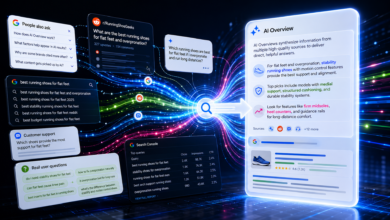
The rise of AI-driven search is fundamentally changing how brands achieve visibility online. With Google’s AI Overviews reshaping the search experience, both organic and paid strategies must evolve to stay effective. These AI-generated summaries are compressing search results, altering ad placements, and reducing click-through rates, making it essential for SEO and paid media teams to collaborate more closely than ever before.
One of the biggest challenges introduced by AI Overviews is the lack of transparency in performance tracking. Ads may appear above, within, or below these summaries, yet Google Ads provides no detailed breakdown of how these placements perform. Impressions, clicks, and conversions are all aggregated under broad categories like “Top Ads,” leaving marketers in the dark. This opacity makes it difficult to optimize bids, assess Quality Score impacts, or understand shifting user context, despite ads still being governed by the same auction rules.
The influence of AI Overviews extends beyond paid search, affecting the entire marketing funnel. Top-of-funnel queries, in particular, are experiencing significant click erosion as users find answers directly within search results. Features like featured snippets and People Also Ask have evolved into more comprehensive AI-generated responses, often reducing the need for clicks altogether. This shift means that both SEO and paid strategies must align to capture user intent at every stage, especially as buyers move more quickly toward conversion.
Industry experts emphasize that collaboration is no longer optional. As Crystal Carter, Head of SEO Communications at Wix, notes, the search journey has changed, with less top-of-funnel traffic and more emphasis on bottom-of-funnel pages that serve both organic and paid audiences. Similarly, Amanda Valle, Global Director of Organic Search at Liquid Web, highlights how AI Overviews are accelerating purchase decisions, making it crucial for teams to work together around intent, content, and spend allocation.
To thrive in this new environment, marketers can adopt several practical strategies:
First, track which keywords trigger AI Overviews and share this intelligence with paid teams. Using tools like Semrush or Ahrefs, SEOs can flag terms where visibility is dominated by AI summaries, enabling smarter budget reallocation and bid adjustments.
Second, analyze the language and tone used in AI Overviews to refine ad copy. If phrases like “fast-acting” or “budget-friendly” consistently appear, incorporating similar language can improve ad relevance and performance.
Third, identify zero-click queries early and share insights from Google Search Console. By highlighting terms with low click-through rates, teams can decide whether to pause spend on certain keywords or shift focus to higher-intent opportunities.
Finally, monitor competitor mentions within AI results. SEOs are well-positioned to spot new competitors or content trends, providing paid teams with valuable intelligence for conquest campaigns or positioning adjustments.
The convergence of SEO and paid media is becoming a necessity in the age of AI search. By combining organic insights with paid agility, teams can build more resilient and effective strategies. As Cassandra Gucwa, Founder and CEO of Menerva Digital, observes, brands are already reallocating budgets to optimize for AI search from both earned and paid perspectives. In this rapidly evolving landscape, collaboration isn’t just beneficial, it’s essential for sustained success.
(Source: Search Engine Land)