5 FAQ Sources to Boost Your AI Visibility
▼ Summary
– Over 80% of AI Overview queries are informational, and 82% have average monthly search volumes under 1,000, creating AI visibility opportunities from longer-tail, lower-volume queries.
– Google Search Console can be used to find FAQ opportunities by filtering for question-based queries and targeting those ranking in positions 4-20 with low click-through rates.
– People Also Ask data reveals how audience questions relate and cluster, with recurring questions being high-signal candidates for AI citations.
– Internal sources like customer service teams and site search data provide direct customer questions, which are valuable for bottom-of-funnel FAQ content.
– Reddit and AI prompt volume data uncover conversational and specific questions that traditional keyword tools miss, improving topical depth for AI models.
Frequently asked questions have moved far beyond their traditional role as static support page fillers. Today, a well-crafted FAQ strategy is a direct driver of visibility in AI Overviews, People Also Ask boxes, and the growing ecosystem of AI-powered search engines that prioritize concise, direct answers.
According to research from Semrush, over 80% of AI Overview queries are informational in nature, and a striking 82% of them have an average monthly search volume of under 1,000. This shift means that longer-tail, lower-volume queries are becoming the primary battleground for AI visibility. As search behavior grows more conversational, the strength of your FAQ content hinges entirely on the quality of the questions you choose to answer.
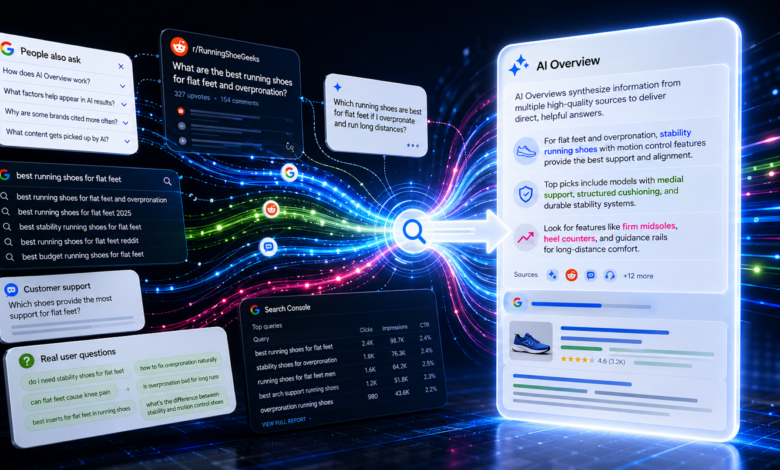
The challenge for many brands is that they continue to rely on the same tired, limited sources for FAQ ideas, even as the search landscape transforms. The most powerful opportunities are hiding in plain sight, in the places where your customers are already asking questions naturally. Here are five sources to unearth and prioritize those high-impact FAQ topics.
1. Google Search Console Data
This might seem obvious, but it’s often the first thing overlooked. Before brainstorming new content, audit what is already working. Google Search Console (GSC) is an underutilized FAQ research tool because many SEOs filter for high-impression or high-click queries instead of high-intent ones.
To find intent-driven queries, filter your GSC data for question-based search patterns using a regex targeting words like “who,” “what,” “how,” and “why.” Then, cross-reference average position against click-through rate (CTR) . Queries ranking from the middle of page one to the bottom of page two with a low CTR are prime candidates for dedicated FAQ content. Ranking too low suggests irrelevance, while ranking too high means you shouldn’t disrupt what’s working. Positions 4 through 20 are often the sweet spot.
From there, expand your search by filtering for long-tail queries of eight or more words. If that’s too restrictive, lower the threshold to five or seven words. This tactic can uncover a goldmine of FAQ opportunities from your existing traffic that you may have been missing.
2. People Also Ask Data
The People Also Ask (PAA) SERP feature is a direct signal of how your audience’s questions relate and evolve. It’s one of the few public windows into Google’s understanding of search intent.
Some PAA questions may warrant an entire page of their own, but they are also excellent for identifying related FAQs that can strengthen existing content. Tools like AnswerThePublic and AlsoAsked surface these branching question trees at scale. However, manual SERP research remains valuable. Search your target topics on Google and expand PAA results across five to ten priority terms. Look for recurring questions, as these are high-signal candidates reflecting broad, repeated user demand. They are also more likely to earn AI citations.
While it doesn’t surface PAA queries directly, Exploding Topics is another helpful tool for spotting rising topics before they peak, giving you a chance to build FAQ content ahead of the curve.
3. Customer-Facing Teams and Internal Data
The richest source for FAQ ideation is often sitting right under your nose: your own data. Your customer service team fields real questions from real people every day. These queries reveal genuine confusion, hesitation, and the specific language your audience uses. This is even more critical now because AI models are trained on natural, conversational language.
Getting this insight is simple. Create a shared Google Doc where support teams can drop questions, set up a dedicated Slack or Teams channel for customer queries, or periodically ask your team for the top new questions they are hearing. If calls are recorded and your policy allows, use AI to analyze them for recurring themes. Your internal site search data is another goldmine. Queries typed into your site’s search bar are direct signals of unsatisfied intent. Pull this data monthly and filter for question-based phrases or longer queries. These are especially useful for bottom-of-funnel content on product and support pages.
4. Reddit
Unlike keyword tools that aggregate behavior, Reddit shows you the raw, unfiltered phrasing of real questions and opinions. Search topics related to your products or services on RedditAnswers or Google to find the subreddits where your audience gathers. Then, search within those communities for your target keywords.
Sort results by Best, Top, and New, paying close attention to the questions asked in threads. Reddit is particularly valuable because it surfaces follow-up questions after an initial answer. These “OK, but what about…” layers of curiosity are often missed by PAA data and keyword tools. Building FAQ content around these secondary questions improves topical depth and strengthens the authority signals that AI models favor.
5. AI Prompt Volumes
One of the newest signals for understanding audience questions comes from prompt volume data within AI platforms themselves. While still imperfect, AI visibility tools like Writesonic and Profound surface aggregated data on what users type into AI tools. This provides insight into questions people ask before they turn to traditional search. Because AI searches are typically longer, more conversational, and more specific, this data can uncover FAQ opportunities that standard keyword research tools completely miss.
FAQs Are an Ongoing Process
Creating FAQs is not a one-and-done activity. The questions your audience asks will evolve as your products change, competitors shift, and the search environment transforms. A phone case company needs updated FAQs with every new iPhone launch. A SaaS brand revisits them with every product update. A plumber, in a more established field, may update them less frequently. Find a cadence that works for your business and revisit your research regularly. The brands winning search visibility are not the ones that created a perfect FAQ page once. They are the ones that keep showing up with the right answers as customer questions evolve.
(Source: Search Engine Land)