Z386: Open-Source 80386 With Original Microcode
▼ Summary
– The z386 project by [nand2mario] implements an Intel i386 CPU on an FPGA using original microcode for close hardware compatibility.
– This project is an extension of the earlier z8086 project for the Intel 8086, but the 80386’s microcode is significantly more complex due to a larger instruction set and features like memory management and protected mode.
– The z386 currently runs on FPGAs such as the Altera Cyclone V and Gowin GW5A, performing at roughly a 70 MHz i386 with slightly worse cycle efficiency due to a smaller 16 kB cache.
– Despite lower performance, the z386 can run software including games like DOOM.
– The project’s primary goal is archaeological reconstruction of the original hardware and its microcode interaction, not outperforming other cores like ao486.
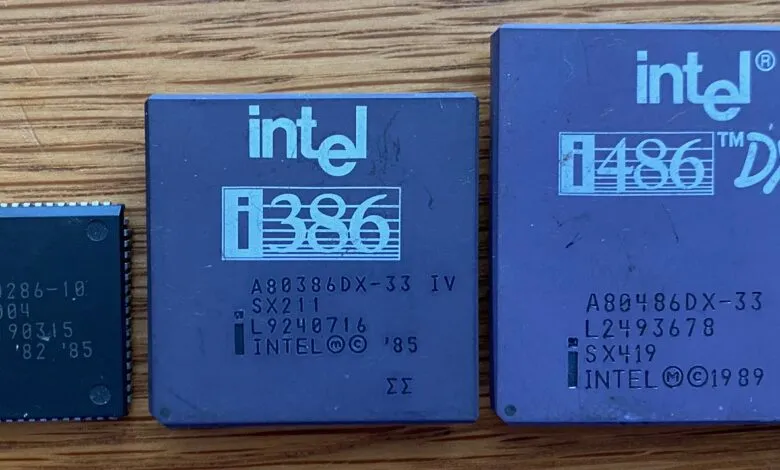
Recreating classic processors on modern FPGAs is a pursuit that blends historical preservation with technical ingenuity, and few approaches are as fascinating as running the original microcode. That is exactly what [nand2mario] has accomplished with the z386 project, an open-source implementation of the Intel 80386 that relies on the chip’s authentic internal instructions. A recent blog post details the progress made so far.
This effort builds on the earlier z8086 project, which applied the same concept to the Intel 8086. Executing the original microcode is a powerful strategy because it ensures close compatibility with the actual hardware , every quirky behavior and undocumented operation is faithfully reproduced. The jump from an 8086 to an 80386, however, is enormous in scope. The 386’s instruction set is far larger, and its internal state machine is vastly more complex, having to manage features like memory management, paging, register debugging, and the protected mode extensions first introduced with the i286.
The z386 currently runs on several FPGA platforms, including the Altera Cyclone V and Gowin GW5A. Performance is roughly equivalent to a 70 MHz i386, though with slightly worse cycle efficiency. This is partly due to a limited 16 kB cache, compared to the 32 kB or more found in the fastest original 386 chips. Still, that is more than enough horsepower to run classic software, including games like DOOM.
It is important to understand that the project’s goal is not to outperform existing FPGA cores such as ao486. Instead, it serves as an archaeological reconstruction of the original hardware, shedding light on how the 80386’s microcode interacted with its internal logic. For enthusiasts of computing history, that is a far more valuable reward than raw speed.
(Source: Hackaday)