Build Custom SEO Reports with Claude Code and Search Console
▼ Summary
– AI coding agents like Claude Code can replace manual SEO reporting workflows, generating customized reports with polished visuals from Google Search Console data in minutes instead of hours.
– Claude Code is a terminal-based AI assistant that interacts directly with local files and datasets, unlike the standard Claude.ai chatbot, enabling it to process exported GSC CSV files and create structured deliverables.
– Initial setup of Claude Code involves installing Node.js, installing the tool via npm, and authenticating; this one-time process can take a couple of hours and has a learning curve for non-developers.
– Connecting Claude Code to live GSC data requires creating a Google Cloud Project, enabling the Search Console API, and generating OAuth credentials, though Claude can guide users through the setup interactively.
– After setup, users can generate dynamic reports on demand during meetings, such as top landing pages or CTR trends, allowing for flexible question answering without pre-building rigid dashboards.
For years, SEO reporting meant dashboards. When a meeting loomed, you’d spend the day exporting data from Google Search Console, cleaning it in spreadsheets, and layering charts into Data Studio. That workflow is now being upended by AI coding agents.
Instead of hours of manual labor, tools like Claude Code can surface customized data with polished visuals in just minutes. Here’s how to transform Google Search Console data into custom reports and accelerate your reporting process.
What Claude Code Can Do With GSC Data
Claude Code is not the same as using Claude in a browser tab. The standard Claude.ai interface functions as a regular chatbot. In contrast, Claude Code is Anthropic’s terminal-based AI coding assistant.
It still feels conversational, but it interacts directly with files, folders, spreadsheets, and scripts on your machine. It can read exported GSC CSV files, process large datasets locally, generate charts and summaries, analyze trends across pages and queries, and ultimately create structured deliverables from raw data.
Rather than simply generating text responses like a chatbot, Claude Code creates a local reporting environment that behaves like a lightweight software project.
There’s a Learning Curve
Before you can build beautiful, custom reports, you’ll need to set up Claude Code. If you’re not an engineer or developer, this process can feel overwhelming at first. There is a learning curve, but don’t give up.
Setup is actually the most time-intensive piece of the process, but it’s a one-time effort. Depending on your technical experience, the initial setup may take a couple of hours.
The “reports in minutes” concept really applies after the environment is configured. Once you’re past the initial setup and Claude is connected to GSC, you can run any custom SEO report you want in a matter of minutes.
If you’re in an enterprise environment, this setup process can go faster with help from the tech team. If you’re an agency or an SEO consultant, you can lean on the expertise of in-house developers, engineers, or an outside contractor.
Getting Started
If you don’t already have one, create an account at Claude.ai. You can sign up with Google, email/password, or enterprise SSO.
Most SEOs using Claude Code for reporting have a paid plan or use Anthropic API access. But you can use a free plan at the time of writing.
Install Node.js
Claude Code runs locally on your machine, so you’ll first need Node.js installed. You can also use it on a Chromebook by activating the Linux subsystem. For this tutorial, I used a Mac.
Download the current LTS (Long-Term Support) version. Once installed, you’ll have access to npm, which is used to install Claude Code.
To verify the installation, open Terminal (Mac/Linux) or PowerShell (Windows) and run:
`node -v` `npm -v`
If both commands return version numbers, you’re ready to continue.
Install Claude Code
Next, install Claude Code globally:
`npm install -g @anthropic-ai/claude-code`
Once the installation finishes, start Claude Code by running:
`claude`
The CLI will walk you through authentication and connect to your Anthropic account. After that, Claude Code can work directly with local project folders containing exported SEO data, scripts, spreadsheets, and reporting templates.
Establishing the Reporting Framework
At this point, you’ll be able to interact with Claude Code in the terminal using commands much like you would with an AI chatbot.
To kick off the workflow, I gave Claude a prompt: “I have a marketing meeting coming up, and I want to show our performance from Google Search Console.”
One benefit is that Claude now becomes an onboarding assistant. Claude will ask a handful of clarifying questions to get started. For example, during the setup process, Claude asked:
- Whether to use a service account or OAuth credentials to access the Google Search Console API.Claude also asked where the reporting project should live locally. (As an aside, we prefer to store it inside a dedicated code directory rather than a standard Documents folder because development projects can sometimes run into file permission or syncing issues when stored inside cloud-synced folders like Documents or Desktop.)Next, I established how the visuals will be built before connecting to GSC. We like using Observable Framework, an open-source framework for building data apps, dashboards, and reports.You don’t necessarily need to follow this exact structure. Claude Code is highly customizable, and you’ll settle into what works for you. And remember: if you’re unsure about any next steps, you can just ask Claude, and it will help guide the setup.
Connecting to GSC
Before Claude Code can start generating reports from live GSC data, you’ll need to connect it to the Search Console API. This is another technical part of the process, but the good news is that Claude can walk you through much of the setup interactively.
To establish the connection, you’ll need to create a Google Cloud Project (GCP) and configure API credentials. That setup process typically includes:
- Creating a Google Cloud project.In larger organizations, your IT or development team may already manage this infrastructure. If not, you can still configure it yourself using a standard Google account or Google Workspace account.
Generating Reports
Once you’ve finished connecting to GSC, congratulations! You made it through the hardest part. Once setup is complete, your reporting process changes entirely.
You can now focus on the reporting views you want to create, such as:
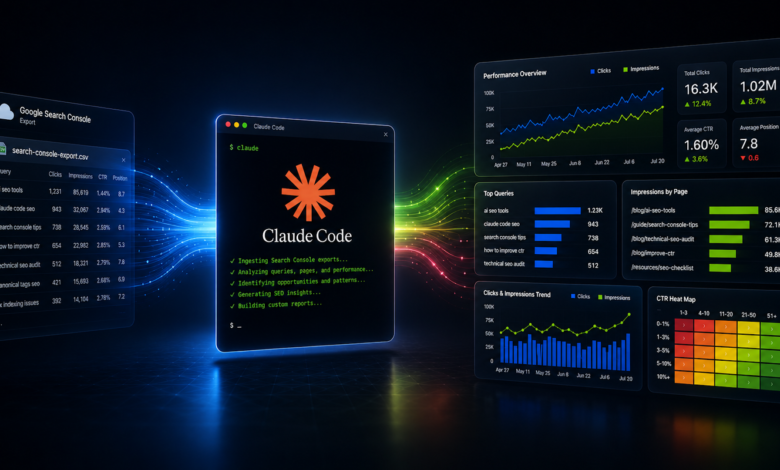
- “Show me the top 10 landing pages that gained traffic this month.”Claude is now like an on-demand reporting assistant. You simply open the project folder, launch Claude Code, and ask for the charts you need.In addition, you can be more dynamic in your meetings. Instead of building a rigid dashboard ahead of time and hoping stakeholders ask predictable questions, you can generate new views dynamically as questions come up. That means you can walk into a meeting, ask Claude for a completely new chart or segmentation, and generate it in minutes rather than rebuilding an entire dashboard manually.Now let’s look at some reports you might quickly run before your next meeting.Here’s an example of a custom SEO performance dashboard generated from Google Search Console data. While some of these metrics are available inside GSC, building your own report gives you much more flexibility in how trends, comparisons, and supporting metrics are visualized together.You could also generate a bar chart with YoY rankings, or a heat map of rankings for keywords by month. Both examples are below. What we like to include in our reporting is a combination of scorecards, time-series charts, year-over-year bar chart comparisons, and heat maps that break down the key drivers behind a metric.
Claude Code Completely Transforms SEO Reporting
SEO reporting has always been a push and pull between speed and flexibility. Dashboards are fast once they are built, but they are often rigid. Custom analysis is powerful but historically has been time-intensive.
Claude Code changes everything. Now you can interact with your GSC data more dynamically, explore new questions as they arise, and create reporting views that would have previously taken hours to build manually. Once the initial setup is complete, reporting becomes far more adaptable to the needs of you and your stakeholders.
(Source: Search Engine Land)