AI Overviews vs. AI Mode: How User Behavior Shifts
▼ Summary
– AI Overviews (AIO) turn the SERP into a comparison environment, with users scrolling backward 47.5% of the time (vs. 27% without AIO), mirroring a “Netflix browse” pattern of re-reading and reconsidering.
– AI Mode and AI Overviews drive opposite user behaviors: AI Mode acts as a closed loop where users accept the answer, while AI Overviews prompt evaluation and reverse scrolling before clicking.
– Search intent no longer predicts time-on-page when an AI Overview is present; the spread across intent types compresses from 20 points to just 6 points at 21 seconds.
– Brand-name searches have lost their shortcut effect; cursor scatter for navigational queries increases 40% with an AIO, and 45.8% of users are still active at 21 seconds (vs. 12% without AIO).
– The study analyzed 846,000 Google sessions and found that AI Overview optimization is a comparison problem on the SERP, distinct from AI Mode optimization, which is a visibility problem at the model layer.
The average Netflix subscriber spends 18 minutes scanning the home screen before settling on a show. They drift past thumbnails, pause for previews, backtrack to a title they almost chose, and then return to the row they started with. The act of browsing has become the experience itself.
Search has quietly evolved in the same direction. We simply lacked the data to confirm it until now.
This week brings four key behavioral shifts observed when an AI Overview appears on the page, drawn from 846,000 real Google sessions. We’ll also explore why brand-name searches no longer offer the shortcut they once did, and one finding that should reshape how you write title tags and meta descriptions this quarter.
Eric Van Buskirk of Clickstream Solutions examined anonymized clickstream data from Surfer SEO, covering roughly 846,000 U. S.-based Google search sessions collected in February and March 2026.
This marks the fifth user-behavior study focused on Google’s AI features in the past year. A 70-user UX study from May 2025 used think-aloud and screen recording. A 250-session AI Mode study from October 2025 captured behavior inside AI Mode itself. This latest study trades qualitative depth for the scale needed to reveal patterns the smaller studies missed.
For context, prior public Google SERP mouse-tracking studies measured only dozens of people. The largest involved a few thousand tasks. This study analyzed queries from a panel of tens of thousands of Google Search users.
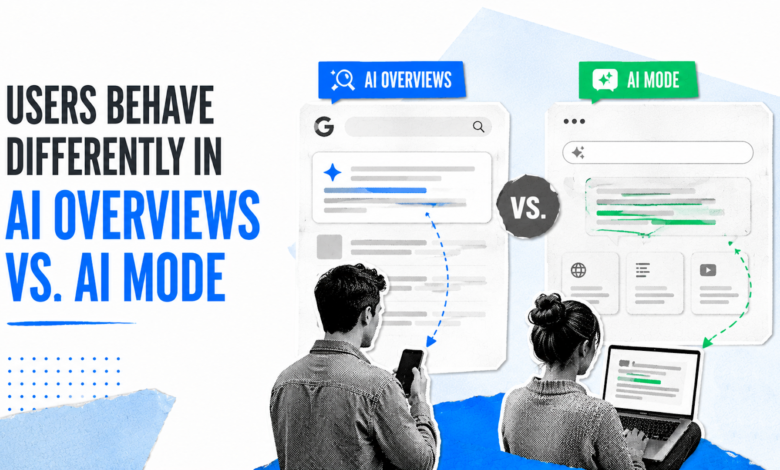
The most significant pattern: Users behave in opposite ways in AI Overviews and AI Mode. AI Mode is autoplay. AI Overviews are the Netflix browse.
This article covers four findings from the new study and what they mean for your 2026 SEO strategy.
1. Same user, opposite behaviors
In AI Mode, users often accept the answer while continuing to evaluate the SERP in AI Overviews.
The April 2026 study of 185 high-stakes purchases found that in 88% of AI Mode tasks, users took the AI’s shortlist as-is. 74% picked the item ranked first, and 64% clicked nothing at all. AI Mode behaves like a closed loop: read the answer, pick from inside it, and move on.
New cursor tracking data on AI Overviews reveals a different pattern. Cursor positions spread across 83% of a viewport, compared with 66% when no AI Overview appeared. Users kept their cursors still 44% of the time, versus 29% without an AIO. In the median session, reverse-direction scrolling accounted for nearly half of all scroll movement.
Taken together, this suggests AI Overviews turn the SERP into a comparison environment. Users read, pause, weigh options, return to earlier content, and reconsider before clicking.
The strategic implication: AI Mode optimization and AI Overview optimization are not the same job. Showing up in an AI Mode shortlist is a visibility problem at the model layer. Showing up in an AI Overview is a comparison problem on the SERP itself.
2. Half of all scrolling now goes backward
Among users who reverse direction on an AI Overview SERP, the median user spends 47.5% of total scrolling going back up the page. Without an AI Overview, that figure is 27%.
Scrolling is no longer a one-way trip. On AI Overview SERPs, it’s roughly a 50/50 split between going down and going back up. That’s the behavior of someone re-reading, not scanning.
The 70-user study from May 2025 found this pattern qualitatively. 38% of AI Overview sessions showed reassurance-seeking clicks where users opened a second link “just to be sure.” The new clickstream data shows that validation work has moved onto the SERP itself. Users used to leave Google to validate a result. Now they validate by reversing back over results they already saw.
This mirrors the Netflix browse pattern exactly. You hover on a tile, scroll past it, feel a pull, and scroll up to read the description again. The decision happens during the reversal, not the first pass.
For e-commerce and high-consideration decision categories, this is the most consequential finding. Your listing on an AI Overview SERP isn’t getting one impression anymore. It’s getting two or three, and the second impression is when comparison happens.
3. Search type no longer predicts behavior
For two decades, search intent has been the foundational segmentation framework in SEO. You could predict how long a user would stay on a Google SERP by knowing what kind of search they performed. The cursor data shows that’s no longer true when an AI Overview is on the page.
At 21 seconds into a session without an AIO, only 12% of navigational searchers are still on the page. 32% of local searchers are. In classic search, time-on-page always followed intent: navigational users leave fast, local users stay because the SERP is dense with maps and listings, informational users fall somewhere in between. That 20-point spread is what every SEO mental model is built around.
With an AI Overview present, the spread compresses to barely 6 points. All five intent types (informational, local, navigational, transactional, video) cluster between 41.9% and 48.5% time-on-page at 21 seconds. Intent stops predicting how long users will stay in the search results.
This is the most novel finding in the study. Nothing in prior research has shown that AI Overview collapses time-on-page differences between intent types into a single band. The 70-user UX study segmented by query risk, the 250-session AI Mode study by task type. Both showed intent matters for engagement. The new clickstream data says intent stops predicting how long users stay on the SERP once an AI Overview appears.
The scoping matters. This is a time-on-page finding, not a “behavior” finding. Scroll depth still varies by intent under AIO, and it actually reshuffles: local jumps from third deepest to first, video falls from first to third.
The practical implication is uncomfortable. Most SEO playbooks recommend different optimization patterns by intent. Local pages get one treatment, transactional pages another, informational pages a third. However, our time-on-page data suggests that when an AI Overview is on the SERP, users stay for similar amounts of time regardless of why they searched.
The main takeaway: intent-based segmentation still matters for what content you write, but it matters less for predicting how long users will stick around on the SERP itself.
4. Brand searches lost their shortcut
Cursor activity for navigational queries (someone typing a brand name into Google) increased 40% when an AI Overview is on the page. Even users who came knowing where they wanted to go are sweeping the page first.
Without an AIO, navigational searchers were the most focused group in the study. They scored 19.7 on the cursor scatter measure, the lowest of any intent type. Only 12% were still active at 21 seconds. They came to Google with a destination, found it, and left.
With an AI Overview present, that profile changes completely. Cursor scatter for navigational searchers jumps to 27.5. 45.8% are still active at 21 seconds. The brand-name shortcut, the fastest path through Google search for the past 20 years, no longer works the way it used to.
The 70-user study from May 2025 found that brand and authority is the first gate users apply when reading a SERP. They check who’s cited before they check what’s said. The new clickstream data shows that the gate now fires even when there’s nothing to gate against. A user who typed “Lenovo” is still doing the authority check on the AI Overview content first.
This is the same Netflix pattern again. You open a show you’ve already decided to watch, but you pause first to read the synopsis and check the rating. The brand recall got you to the page. The browse decides whether you click through.
The implication for branded search: Brand recall is no longer enough on its own. Even users who searched for you specifically are now evaluating what’s around you on the SERP before they click through.
(Source: Search Engine Land)