Randomness Amplification Tested in New Experiment
▼ Summary
– Imperfect quantum devices produce flawed random bits that must be enhanced via randomness amplification.
– The experiment implements a device-independent randomness amplification protocol, requiring a loophole-free Bell test with high violation and repetition rate.
– Theoretical advances and progress with superconducting circuits enabled the experimental demonstration in a realistic parameter regime.
– Randomness amplification is proven impossible by purely classical means.
– The experiment demonstrates a definitive quantum advantage by achieving a task unattainable with classical information processing.
Quantum information systems, even the most advanced ones, are never flawless. These imperfections introduce errors in computation and, just as critically, degrade the quality of random bits used for tasks like generating cryptographic keys. To be useful, those bits must be refined. That refinement process is called randomness amplification, and for the first time, researchers have successfully demonstrated it in a real-world experiment.
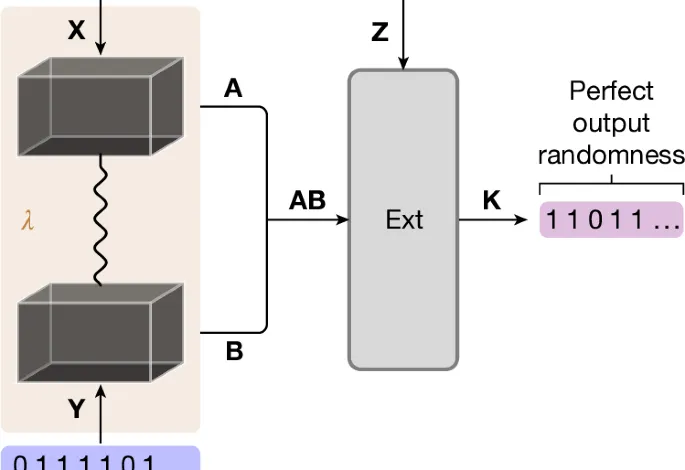
This protocol is device-independent, meaning it requires no assumptions about how the quantum hardware operates internally. Instead, it relies on a loophole-free Bell test, executed under a very specific set of conditions: a high Bell violation combined with a high repetition rate. Achieving both simultaneously has been a major hurdle, but recent theoretical breakthroughs have defined a parameter regime that is experimentally feasible. At the same time, advances in superconducting circuits have allowed researchers to reach that regime in practice.
A key point is that randomness amplification has been proven impossible using purely classical methods. This experiment therefore demonstrates a definitive quantum advantage,using quantum technology to perform a task that classical information processing simply cannot accomplish.
(Source: Nature.com)