Painted e-tattoos signal the next generation of wearable biosensors
▼ Summary
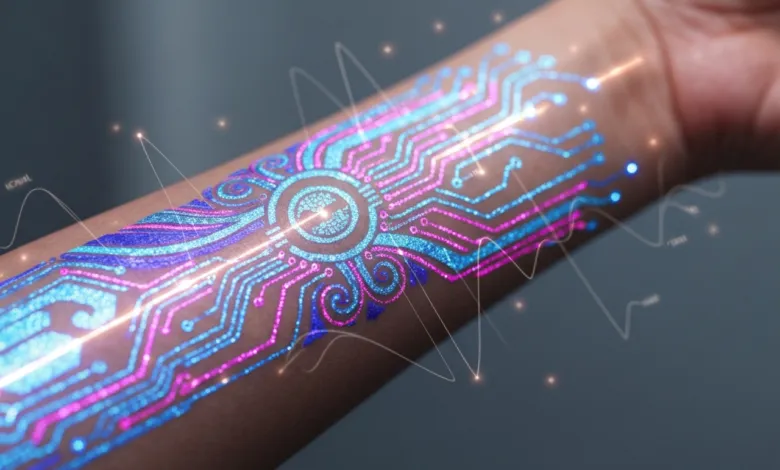
– Scientists at Pennsylvania State University developed a conductive ink that can be painted onto the skin in colorful designs and dries into a functional electrode for biomonitoring.
– Traditional e-tattoos struggle on curved or hairy skin and require custom placement for large areas, but this ink aims to overcome those limitations.
– The ink is made from a water-based solution containing polymers and acidic additives, including PEDOT:PSS for conductivity and DBSA as a plasticizer for flexibility.
– Rigid metal electrodes can dislodge during movement, while hydrogels degrade quickly; the new ink offers a stable, flexible alternative.
– The ink addresses accuracy issues caused by sweat or hair, which can create air gaps in prefabricated commercial electrodes when applied to skin.
A new wearable biosensor technology developed at Pennsylvania State University could make traditional medical electrodes a thing of the past. Researchers there have created a conductive ink that can be painted directly onto the skin in colorful, custom patterns, drying into a functional electrode for monitoring vital signs. The findings were recently published in the Proceedings of the National Academy of Sciences (PNAS).
Epidermal electronics attached via temporary tattoos, or e-tattoos, have been in development for over a decade. These devices bond to the skin without adhesives, are nearly invisible, and use ultra-thin polymers with embedded circuits to measure everything from temperature to strain. But they come with significant drawbacks: they struggle on curved or hairy surfaces and require custom placement to cover larger areas where biosignals are spread out.
That has pushed scientists to find more adaptable solutions. In 2024, for instance, a team developed polymer-based conductive inks that could be printed directly onto a person’s scalp to read brain waves, even through hair. That breakthrough hinted at the possibility of mobile EEG monitoring outside clinical settings.
Larry Cheng, a mechanical engineer at Penn State and co-author of the new PNAS paper, has spent more than a decade refining electrode designs for EEG, ECG, and EMG applications. Rigid materials like metals offer stability but fail when the wearer moves, especially during exercise. Hydrogels have emerged as a flexible alternative, capable of absorbing water and stretching with the skin. Yet they degrade quickly with extended use.
Sweat and hair further complicate accurate biosignal recording. Commercial electrodes are pre-made and applied to the skin, leaving an air gap that weakens sensor readings. Cheng and his team set out to solve that problem by formulating a new conductive ink. They combined several polymers and acidic additives in a water-based ethanol and polyvinyl alcohol solution. PEDOT:PSS provided electrical conductivity, while DBSA acted as both a plasticizer and a conductivity booster, giving the ink the flexibility it needs to move with the body.
The result is a material that goes on as easily as face paint and dries into a durable, skin-conforming sensor. This approach could revolutionize how we monitor health outside the clinic, making biomonitoring more accessible, comfortable, and reliable.
(Source: Ars Technica)