Pigeons Use Magnetic Fields to Navigate: Here’s How
▼ Summary
– A new study in *Science* suggests homing pigeons detect magnetic fields using iron-rich immune cells in their livers, which transmit this information to the brain.
– Three existing hypotheses for bird magnetoreception involve magnetic particles in the beak, ion channels in cells, or retinal pigments, but none fully explain the mechanism.
– The liver and spleen were suspected to have magnetic properties because they store iron from breaking down red blood cells.
– Researchers found the strongest magnetic response and iron concentration in pigeon liver tissue using vibrating sample magnetometry and magnetic cell separation.
– A homing experiment with 34 pigeons showed that depleting liver macrophages with clodronate liposomes affected navigation ability under overcast conditions.
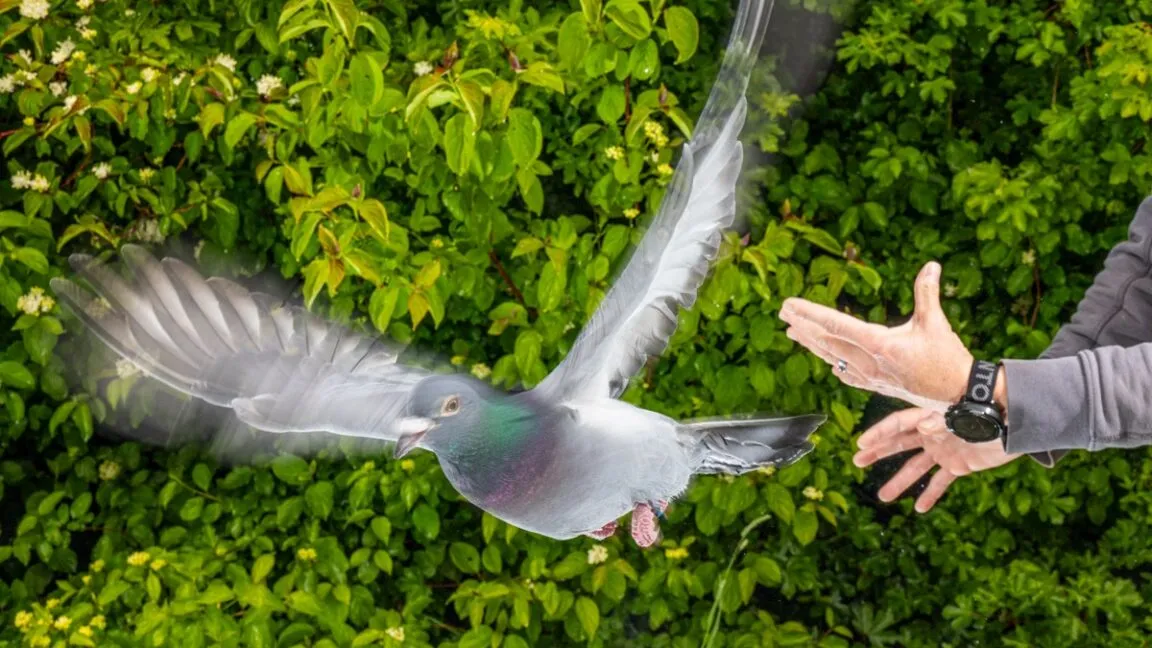
For decades, scientists have recognized that migratory birds and homing pigeons rely on the Earth’s magnetic fields to find their way, especially when darkness or thick clouds hide the sun and familiar landmarks. Yet the precise location of the body’s magnetic sensor and the biological mechanism driving it have remained fiercely contested. Now, a groundbreaking study in the journal Science reveals that homing pigeons may use iron-rich immune cells in their livers to detect geomagnetic signals and relay that information to the brain.
Three main theories have dominated the debate on how birds sense magnetic fields. One proposes a compass-like system in which magnetic particles in the bird’s upper beak respond to the Earth’s pull, sending directional cues through a large cranial nerve. Another theory involves cellular ion channels sensitive to voltage, allowing birds to detect magnetic field fluctuations biologically. A third suggests that physical effects on retinal pigments enable birds to perceive photons and transmit signals to the brain, though this mechanism only works in daylight.
None of these hypotheses fully account for how animals perceive magnetic fields. However, clues emerged from a 2015 study showing that red pulp macrophages in the spleens of mice and humans are intrinsically superparamagnetic, making them more responsive to magnetic fields. This raised the possibility that similar cells might play a role in avian navigation. “We had some clues that the liver and spleen have magnetic properties, because they break down red blood cells and so store much iron in the body,” explained co-author Clivia Lisowski of the University of Bonn and University Hospital Bonn.
To investigate, Lisowski and her team applied vibrating sample magnetometry and magnetic cell separation to liver and spleen tissue from homing pigeons. They stained samples with Prussian blue, a dye sensitive to ferritin,a byproduct of red blood cell degradation,and also examined tissue from the eyes, beak, and brain. The results were striking: the liver tissue contained the highest concentration of iron and produced the strongest magnetic response.
To test whether these iron-rich cells actually guide navigation, the researchers trained 34 pigeons to follow a west-to-east route spanning 19 kilometers (roughly 12 miles). The day before a forecast of overcast, sun-obscured weather, half the birds received injections of clodronate liposomes to deplete macrophages in the liver. The other half served as a control group. When released the next day, all pigeons faced the same challenging conditions,and the results offered compelling evidence that the liver’s immune cells function as an internal compass for magnetic sensing.
(Source: Ars Technica)