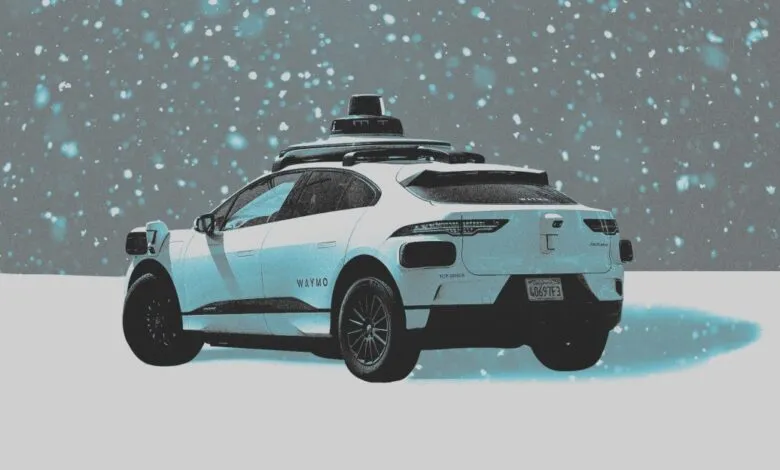
Can Waymo Conquer Winter Roads?
▼ Summary
– Waymo’s expansion to East Coast cities depends on its robotaxis safely handling winter weather conditions like snow.
– Snow presents unique challenges for autonomous vehicles by obscuring road markings and signs that machine learning systems struggle to interpret.
– Waymo is developing its sixth-generation system specifically to handle severe winter conditions using multi-sensor platforms and mechanical solutions like lidar wipers.
– The company faces data scarcity for snowy conditions, pushing it to use AI and simulation techniques to augment rare weather data.
– Waymo may pause service during extreme winter conditions when roads become unsafe, mirroring human travel patterns.
Navigating the complexities of winter weather presents a critical hurdle for autonomous vehicle companies aiming for widespread adoption. During a recent company-wide meeting, Waymo’s chief winter weather expert made it clear that for the company to successfully expand into new markets, its robotaxis must demonstrate safe and reliable performance in snowy conditions. So far, Waymo has primarily operated in cities with warmer, drier climates such as Phoenix, Los Angeles, Atlanta, and Austin. However, its ambitious plans for growth now include East Coast hubs like Boston, New York City, and Washington, DC, where handling adverse weather becomes a fundamental requirement.
Robert Chen, Waymo’s product lead for weather, acknowledged the significance of the coming months. When asked about validating the Waymo Driver for winter operation, he noted, “This winter season is going to be a really important season for us. I think that’s all I can probably say at this point.” The underlying message is clear: an inability to manage winter roads would severely limit the utility and growth potential of Waymo’s service. Unlike human-driven ride-hailing options that operate year-round, a fair-weather-only robotaxi service would struggle to compete. Chen emphasized the company’s goal to create a product people can depend on consistently, not just for part of the year.
Autonomous vehicles share some similarities with human drivers, performing best with clear visibility, dry pavement, and unobstructed sensors. Icy roads and accumulating snow introduce significant complications. While Waymo has confronted challenges ranging from flash floods to Phoenix dust storms, snow poses a uniquely difficult problem. Human drivers can infer information from partially visible road markings and signs, a skill that even advanced robots find challenging. According to Phil Koopman, an autonomous vehicle technology expert from Carnegie Mellon University, snow often obscures critical visual cues. “You may only see a third of the stop sign, but you know it’s a stop sign,” Koopman explained. “Machine learning can have trouble with that if it hasn’t been trained on partially obstructed stop signs.”
Koopman believes that Waymo’s multi-sensor approach, which incorporates lidar, radar, and cameras, should eventually prove capable of handling these conditions. He pointed out that camera-only systems, like those used by Tesla, could face greater difficulties. “It’s going to be easier for a multi-sensor platform because cameras are going to have a lot of trouble with blowing snow,” he said. “But for sure, radar’s going to really help you if there’s snow.”
Beyond the technical hurdles, there is a substantial data challenge. Snowy conditions represent a very small fraction of Waymo’s driving dataset, sometimes accounting for less than five percent or even a fraction of a percent of total data for rarer scenarios. This scarcity has prompted the company to employ innovative techniques, including advanced AI methods, to augment and analyze data for both development and validation. Waymo has conducted limited testing in snowy environments such as Truckee, California, Michigan, Upstate New York, Denver, and Seattle, but acknowledges that more work remains.
Chen reported that Waymo’s fifth-generation system can manage cold weather and light snow, while the upcoming sixth-generation Waymo Driver is being specifically engineered and tested for severe winter conditions. In addition to improving its data resources, Waymo is implementing physical solutions to aid navigation on slick, slushy streets. These include tiny mechanical wipers to clear snow from rooftop lidar sensors and more powerful heaters to defrost all sensor arrays. The current system is already trained to handle icy roads and challenges like black ice, a capability tested during sub-zero temperatures in Austin last winter. Each vehicle acts like a mobile weather station, collecting and sharing data with the fleet. “Let’s say the vehicle encounters a slippery patch,” Chen said. “It’ll actually send that information to the rest of the fleet and now other vehicles in the fleet know that that particular location is slippery.”
Service may be paused if conditions deteriorate to a point where roads become unsafe and public travel drops off. Such decisions are infrequent and vary by city; a light snowfall might paralyze one city while barely affecting traffic in another. Even after the snow melts, development continues virtually. Waymo uses advanced simulation models to replicate rare weather events, helping to address data scarcity. The company is integrating generative and foundational AI models into its systems, employing layered models that can differentiate between various snow types, wet, powdery, slushy, and feed this information back into training pipelines.
It may still be some time before Waymo’s customers take their first snowy robotaxi ride. The company plans to begin operations in Washington, DC next year but has not announced timelines for other East Coast cities. Future launches are also planned for London and Japan. As temperatures drop and snow begins to fall, Chen and his team are preparing for the challenge. “The self-driving problem… is really hard on its own,” he observed. “Now you add in these crazy weather conditions. It’s a pretty challenging task.”
(Source: The Verge)