Uber Launches Robotaxis in London, Beating Waymo
▼ Summary
– Uber has launched the first commercial robotaxi service in London, beating competitor Waymo to market by utilizing autonomous technology from UK startup Wayve.
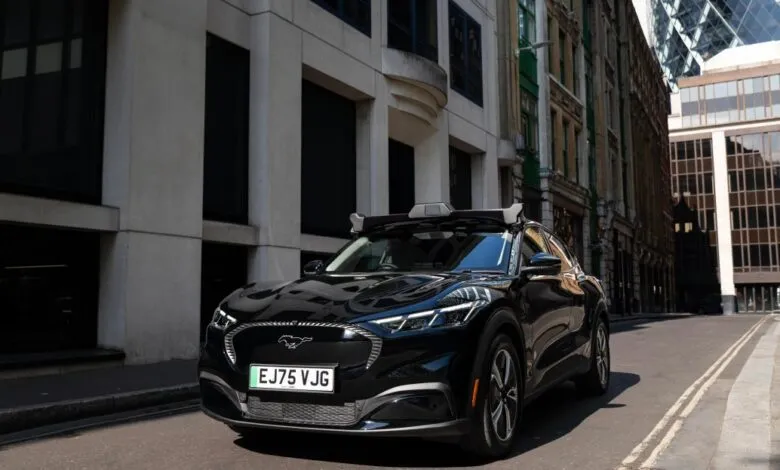
– The initial fleet consists of Ford Mustang Mach-Es and future Nissan Leafs equipped with Wayve’s AV2.0 system, which relies on cameras and radar rather than lidar sensors.
– Riders can opt into these autonomous vehicles through the Uber app, though safety drivers will initially monitor operations before being phased out for fully driverless cars.
– Unlike traditional systems, Wayve’s AI does not use geofencing or HD maps, allowing the vehicles to adapt to new environments and complex scenarios similarly to human drivers.
– This launch serves as a critical test for the global expansion of robotaxis beyond the US and China, with maintenance handled by Uber in partnership with Otto Car.
Uber has officially launched London’s first commercial robotaxi service, securing a significant victory over rival Waymo in the race to deploy autonomous vehicles in the UK capital. This milestone marks a strategic triumph for the ride-hailing giant, which has spent years cultivating its partnership with Wayve, a British artificial intelligence startup. By beating Waymo to the market, Uber is positioning itself to define the user experience for thousands of Londoners while testing the global appetite for driverless transport outside of dominant markets like the United States and China.
The new service relies on Wayve’s AV2.0 technology, a sophisticated autonomous driving system that distinguishes itself from traditional methods. Unlike competitors that depend on high-definition maps and rigid rule-based programming, Wayve’s approach utilizes a single, learned AI driver. This system is designed to perceive the world, anticipate risks, and adapt to complex scenarios much like a human operator. The vehicles are equipped with cameras and radar but notably exclude lidar, placing them in the same technological camp as Tesla rather than Waymo.
Customers can request these autonomous rides through the standard Uber app by selecting options such as UberX, Uber Comfort, or Uber Electric. While pairing with a Wayve vehicle is not guaranteed, those who opt in may find themselves traveling in a fleet primarily composed of Ford Mustang Mach-Es, with Nissan Leafs planned for future deployment. Initially, every vehicle will carry a safety driver seated in the front to monitor operations. These drivers hold licenses from Transport for London and are strictly prohibited from controlling the vehicle, though they serve as a critical oversight layer during this early phase. Uber intends to gradually remove them as the system proves its reliability.
A key differentiator for this launch is the absence of a geofence. Traditional autonomous systems often restrict operations to specific, pre-mapped zones, but Wayve claims its software allows for broader operational flexibility. Regarding the core philosophy behind their technology, Wayve states:
> “The traditional AV1.0 approach relies on hand-engineered stacks, HD maps and a rule-based approach – this limits scalability and the ability to rapidly generalize to new environments or complex scenarios. Wayve’s AV2.0 takes a different path – a single, learned AI driver trained to understand the world, anticipate risk, and adapt to new environments.”
To support this infrastructure, Uber has partnered with Otto Car, a UK-based fleet operator, to handle maintenance and servicing. Meanwhile, Wayve retains full control over the autonomous software stack. This collaboration is bolstered by substantial financial backing; earlier this year, Wayve secured a $1.2 billion investment from a consortium including Uber, Nvidia, Stellantis, Nissan, and Mercedes-Benz. The company emphasizes that its software is hardware-agnostic, meaning it can theoretically run on various sensor configurations, even if the current implementation avoids expensive lidar units.
This move intensifies the competitive landscape in London. Waymo has announced plans to launch its own robotaxi service in the city before the end of the year, while Lyft is collaborating with China’s Baidu to introduce services starting in the Brent neighborhood. These developments highlight a growing schism between industry leaders. Uber advocates for a hybrid model combining human and autonomous drivers, whereas Waymo pushes for a fully driverless ecosystem. Although the two companies have collaborated in cities like Austin and Atlanta, their diverging strategies have fueled rumors of a potential split.
Uber’s aggressive expansion into autonomy is part of a broader strategy to spend upwards of $10 billion on building out its self-driving capabilities. Beyond Wayve, the company has established relationships with numerous other autonomous vehicle developers, including Zoox, Avride, Nuro, Motional, and Waabi. By diversifying its partnerships and launching in Europe, Uber aims to solidify its position as a leader in the next generation of transportation, challenging the dominance of US-centric tech giants in the emerging robotaxi market.
(Source: The Verge)