Google Launches Meridian GeoX Worldwide
▼ Summary
– Google has globally launched Meridian GeoX, moving it from beta to general availability for geographic incrementality experiments.
– The new tool allows marketers to estimate the incremental impact of advertising across various platforms and channels beyond single-platform attribution.
– GeoX results can be incorporated into Marketing Mix Modeling (MMM) to improve accuracy by providing causal evidence alongside historical data analysis.
– Geographic testing offers an alternative to user-level experiments by creating treatment and control areas without relying on individual user tracking.
– Google is introducing agentic capabilities within Meridian to assist with real-time model building, data quality auditing, and error resolution.
Google has officially expanded its Meridian marketing mix modeling (MMM) toolkit with a significant emphasis on incrementality and causal measurement. The centerpiece of this update is the global general availability of Meridian GeoX, a tool that previously operated in beta. Alongside this launch, Google is introducing features designed to help advertisers model longer-term brand effects and measure media contributions beyond the limitations of standard platform attribution.
Global Availability of Meridian GeoX
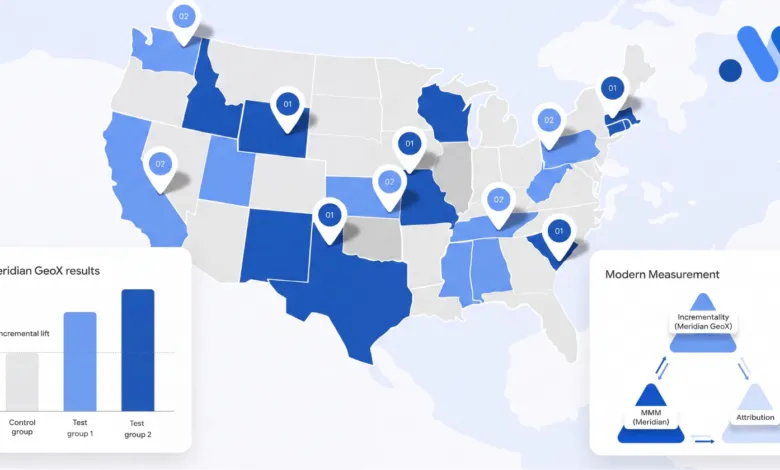
First previewed in May as an open-source solution for geographic incrementality experiments, GeoX is now accessible worldwide within the Meridian ecosystem. This tool enables marketers to conduct tests across specific geographic regions to isolate the incremental impact of advertising spend. By comparing outcomes in treated areas against control zones, advertisers can determine precisely how much of a business result was driven by their media investment rather than external factors.
Crucially, GeoX is not restricted to Google’s own ad products. It supports testing across multiple advertising platforms, allowing brands to evaluate campaigns running on third-party networks or integrated multi-channel strategies. This cross-platform capability provides a more holistic view of performance, helping teams understand how different parts of their media mix contribute to overall success.
Integrating Experimental Data into Modeling
The integration of GeoX results directly enhances the accuracy of Meridian’s MMM capabilities. Marketing mix models typically rely on historical data to estimate the contribution of various investments, but these estimates can become ambiguous when multiple channels shift simultaneously or when outside variables influence performance. Geo experiments provide causal evidence that can be incorporated into the model, adding confidence to specific investment decisions.
This connection between modeling and experimentation offers a robust alternative when user-level experiments are impractical. Geographic testing allows for the creation of treatment and control groups without relying on individual user tracking, which is increasingly difficult due to privacy restrictions. By bringing experimental data into Meridian, Google aims to bridge the gap between statistical modeling and real-world validation.
Agentic Tools and Backend Efficiency
To streamline the complex process of building and maintaining these models, Google is introducing agentic capabilities within Meridian. These new tools assist marketers in real-time by auditing data quality, resolving errors, and providing guidance during the model-building phase. This automation reduces the manual troubleshooting required to identify underlying data issues before analysis can proceed.
Behind the scenes, Google has optimized the backend infrastructure to run analyses faster and more efficiently. While the core inputs remain unchanged,requiring teams to define relevant business and media data,the technical execution is smoother. This focus on easing the technical burden allows marketers to work through the complexities of model construction with greater ease, especially as they incorporate additional signals from sources like GeoX.
Accounting for Long-Term Brand Effects
Meridian now supports the inclusion of relevant brand signals, such as Branded Google Query Volume, to capture the delayed impact of brand-building activities. Traditional metrics often miss the value of upper-funnel efforts, such as TV or out-of-home (OOH) campaigns, which may spark interest long before it converts into immediate sales. Branded search volume serves as a proxy for this latent demand, helping marketers see if interest shifted in response to media investment.
However, interpreting these signals requires caution. An uptick in branded searches does not automatically prove that a specific campaign drove future sales. Factors like competitor activity, seasonality, promotions, and news coverage can also influence search behavior. Meridian accounts for these brand signals alongside other business and media data, providing a richer dataset for evaluating investments whose impact unfolds over time. This addition broadens the scope of questions advertisers can address, moving beyond immediate campaign performance to assess long-term brand health.
Implications for Advertiser Strategy
For advertisers, the combination of Meridian and GeoX offers a more defensible approach to budget allocation. One of the persistent challenges with MMM is justifying major budget shifts based solely on statistical assumptions. GeoX provides experimental evidence that can corroborate model findings, making it easier to communicate recommendations to executives who may not be familiar with the underlying methodology. If a geo experiment aligns with what the model predicts for a specific channel, it adds a layer of credibility to the decision-making process.
Despite these advancements, there remains a significant barrier to entry. While Meridian is free and open source, successful implementation requires substantial resources in terms of personnel, data infrastructure, and compute power. Google recommends GPU resources due to the intensive nature of the modeling. Additionally, GeoX demands high-quality daily time-series data and sufficient geographic variation to design reliable experiments. The cost of experimentation itself must also be considered, as creating valid test conditions may require altering spend levels across selected markets.
Future Directions for Measurement
As more advertisers adopt GeoX, the tool will likely reshape how internal teams utilize MMM. Instead of treating modeled results as definitive answers, organizations can use experiments to validate areas where they seek greater confidence before committing to large-scale investments. When models and experiments diverge, those discrepancies can be equally valuable, prompting deeper inquiries into channel valuation or underlying assumptions.
The synergy between causal measurement and predictive modeling represents a maturation in digital marketing analytics. By offering a way to test hypotheses generated by MMM with real-world data, Google is providing advertisers with a more comprehensive framework for understanding performance. As the industry continues to navigate privacy changes and fragmented data environments, the ability to combine statistical inference with experimental rigor will become increasingly critical for optimizing media spend and demonstrating ROI.
(Source: Search Engine Journal)