SpaceX seeks $55bn Texas semiconductor plant
▼ Summary
– SpaceX has filed paperwork for a $55bn semiconductor fabrication facility called Terafab in rural Texas, which would be distinct from its existing Bastrop chip-packaging operation.
– The combined Bastrop expansion and Terafab project could total $119bn in investment, creating North America’s largest PCB and panel-level-packaging facility.
– Terafab is a full fabrication facility that produces silicon at process nodes, unlike Bastrop which only packages chips made elsewhere.
– Owning fabrication, packaging, and PCB manufacturing in one facility would remove third-party margins and give SpaceX control over supply timelines for Starlink components.
– SpaceX has not disclosed Terafab’s process technology or construction timeline, but the most likely focus is mature-node fabrication for Starlink-specific RF and ASIC components.
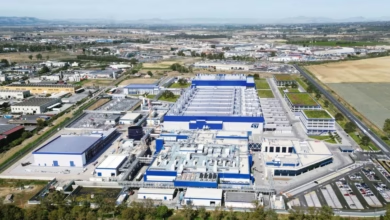
SpaceX has submitted regulatory paperwork for a major semiconductor fabrication facility in rural Texas, with a projected investment of roughly $55 billion. The project, code-named Terafab, would be built adjacent to the company’s existing chip-packaging operations in Bastrop. According to a Reuters report on Wednesday, the combined investment across both sites could reach a staggering $119 billion, positioning the region as a significant hub for domestic chip production.
The distinction between the two facilities is critical. The Bastrop operation, which began equipment installation in April 2026, is solely a packaging facility. It takes silicon dies manufactured elsewhere, packages them, and ships finished radio-frequency chips for use in Starlink user terminals. Terafab, by contrast, is a true fabrication plant. It is designed to produce silicon at process nodes, not merely package pre-made components. This shift moves SpaceX into a far more capital-intensive business. Fabrication requires cleanrooms, lithography tools costing hundreds of millions each, deep semiconductor expertise, and construction timelines that typically stretch five to seven years. The $55 billion figure aligns with that scale.
When fully built out, the combined Bastrop and Terafab complex will include silicon fabrication, advanced packaging (including panel-level packaging), printed circuit board manufacturing, and a semiconductor failure-analysis lab. Together, they would form the largest PCB and panel-level-packaging facility in North America.
The strategic motivation fits SpaceX’s broader pattern. Starlink ships hardware in volumes that make per-unit silicon cost a meaningful factor in the company’s economics. By owning the fab, packaging, and PCB manufacturing in a single integrated U. S. facility, SpaceX eliminates third-party supplier margins at every production step and gains direct control over the supply timeline for components that cannot be swapped late in the build cycle.
Texas Governor Greg Abbott’s office has actively supported the Bastrop expansion. A March 2026 announcement confirmed a Texas Semiconductor Innovation Fund grant to SpaceX. For Terafab, additional state-level incentives are likely available, along with any federal CHIPS Act funding that survives the current administration’s review.
The headline figures break down clearly. Terafab itself accounts for approximately $55 billion. The Bastrop expansion, including a million-square-foot footprint increase over three years, plus planned PCB operations, panel-level packaging, and the failure-analysis lab, adds roughly $64 billion. Combined, the total is $119 billion.
Two key questions remain unanswered publicly. First, which specific process technology Terafab will run. SpaceX has not disclosed this, and the most advanced leading-edge nodes would require licensing or a partnership with an existing process-IP holder. The most likely initial focus is on advanced packaging and mature-node fabrication for Starlink-specific RF and ASIC components, rather than competing directly with TSMC at the cutting edge. Second, the timeline remains unclear. SpaceX has not committed to a construction start or operational date for Terafab, only to the filing.
The geographic logic fits a wider U. S. trend. Apple’s recent foundry-diversification talks with Intel and Samsung represent the demand side. Intel’s hiring of a senior Qualcomm executive to lead its new Client Computing and Physical AI Group is the design-side complement. Texas is attracting AI-infrastructure commitments at scale: Hut 8’s $9.8 billion Beacon Point lease in Nueces County is a parallel data-center investment in the same state.
What is no longer in doubt is SpaceX’s intent. With Wednesday’s filing, the company has committed to manufacturing its own silicon at Tier-1 fab scale. Whether the timeline holds, whether the process technology question is resolved through partnership or in-house development, and whether the combined $119 billion capital program survives competing demands on SpaceX’s balance sheet are the open questions. The filing itself is the news.
(Source: The Next Web)