STMicroelectronics Targets $3B+ in Space Revenue
▼ Summary
– STMicroelectronics targets over $3 billion in cumulative revenue from its space semiconductor business between 2026 and 2028, driven by commercial constellation operators like SpaceX’s Starlink.
– The company has shipped over 5 billion RF antenna chips to Starlink and projects this figure could double to 10 billion by 2027.
– STMicro supplies components for European sovereign projects like the Iris² constellation and inter-satellite laser links for SpaceX, balancing commercial and strategic contracts.
– The shift from government-led programs to New Space, including cost-effective rad-hard chips in plastic packaging, has fueled a revenue jump from $175 million in 2021 to nearly $1 billion by 2026.
– Risks include heavy dependence on Starlink, qualification timelines for new products, and potential geopolitical impacts from US-China semiconductor export controls.
When STMicroelectronics first qualified its chips for the European Space Agency back in 1977, the satellite business was a fundamentally different world. Programs were driven by governments, hardware was custom-built, and the tiny slice of the semiconductor market that made it into orbit was designed for one-off missions, not mass production.
Nearly half a century later, the Geneva-based chipmaker is now navigating what its own roadmap describes as an era of explosive growth in that very business. On Monday, the company laid out just how explosive that growth could be for investors.
STMicroelectronics is targeting more than $3 billion in cumulative revenue from its space semiconductor business between 2026 and 2028, according to details shared on a dedicated investor call. The implied trajectory is remarkably steep. The company’s low-Earth-orbit (LEO) revenue, which it reports separately, stood at roughly $175 million in 2021. By 2025, that figure had climbed to approximately $600 million. By the end of 2026, ST expects it to approach $1 billion. In that context, the $3 billion cumulative target looks less like an ambitious stretch and more like a natural extension of existing momentum.
The primary driver, as ST executives have explained, is a structural shift from government-led space programs to commercial constellation operators. SpaceX’s Starlink dominates the customer base. ST has shipped more than five billion RF antenna chips to Starlink user terminals over the past decade, and executives have publicly forecast that number could double to roughly 10 billion by 2027 as the constellation expands. Other commercial operators, including Amazon’s Kuiper and OneWeb, trail behind Starlink in terms of volume.
Beyond the headline numbers, ST also highlighted strategically important European contracts. The company is supplying components for inter-satellite laser communication links on future SpaceX platforms and is collaborating with Thales and Eutelsat on the European Union’s planned Iris² sovereign satellite constellation. That project, expected to come online toward the end of the decade, is a key vehicle for European technological sovereignty policy. The same engineering capability that wins ST its Starlink volume also earns it qualifications for Iris².
ST’s space business extends well beyond RF antenna chips. The company’s product portfolio includes radiation-hardened logic, voltage regulators, mixed-signal ASICs, and rad-hard discrete components for satellite platforms. The economics vary across customers, but building chips that function reliably in vacuum, extreme thermal cycles, and sustained radiation is one of the higher-margin specializations in semiconductor manufacturing.
What fundamentally changed the math, in ST’s view, was the arrival of New Space. Until roughly 2018, a standard radiation-hardened chip for a satellite was a custom part priced for a single, $200 million geosynchronous satellite. Constellation operators, building hundreds or thousands of identical low-cost satellites, needed something different: rad-hard parts in plastic packages, at volume, with prices that didn’t destroy the unit economics of a 1,200-spacecraft constellation. ST released its first economical rad-hard line for New Space in 2022, using cost-effective plastic packaging across power, analog, and logic categories. Four years later, that early commitment appears remarkably well-timed.
The wider market context supports the trajectory. Independent estimates size the global space semiconductor sector at somewhere between $5 billion and $7 billion currently, with mid-single-digit annual growth across most forecasts. ST’s own LEO revenue trajectory implies it is capturing a disproportionate share of that growth. The $3 billion cumulative target, spread over three years, is consistent with the company holding roughly a quarter of global space-semiconductor revenue at its peak.
ST executives also identified orbital data centers as a possible future market but emphasized they have not included any related revenue in the current 2026–2028 target. That hedging is prudent. SpaceX’s own pre-IPO disclosures warned investors that orbital AI data centers rely on “unproven technologies” and may never achieve commercial viability. The thermal economics are particularly unforgiving: radiating one megawatt of heat at 20°C in orbit requires roughly 1,200 square meters of radiator surface, the area of four tennis courts. ST’s approach, acknowledging the optionality without pricing it, is the right one for an established public company. Investors want to know the potential exists, but they don’t, on current evidence, want it priced in.
Monday’s announcement comes against a wider backdrop where Europe has struggled to articulate a coherent commercial space strategy. Fragmented funding, slow procurement, and dependence on US launch infrastructure have been the dominant themes. Inside that frame, ST’s announcement is a notable counterpoint. A European semiconductor company, headquartered in Geneva and listed in Paris and Milan, is now one of the most consequential commercial suppliers to Elon Musk’s Starlink and to Europe’s own sovereign constellation program simultaneously. That is the kind of dual-track win European tech-sovereignty policy has been seeking, and not consistently achieving.
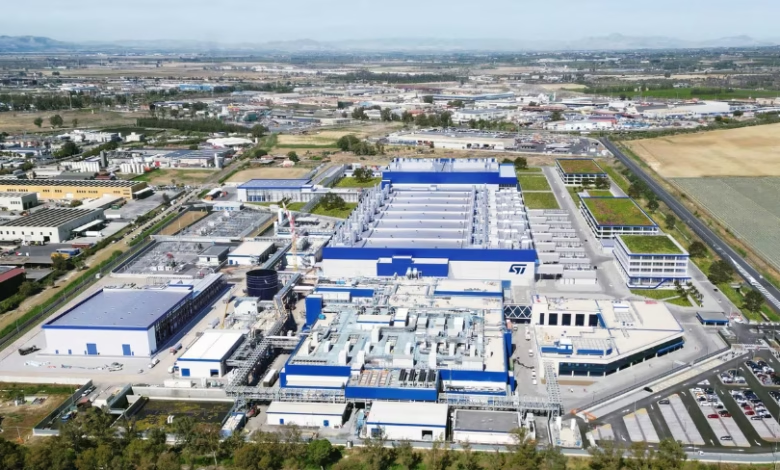
The space business also matters at the company level. STMicro is in the middle of a difficult guidance reset, having pushed its $20 billion-plus revenue ambition from an earlier target to 2030. Q1 2026 revenue came in at $3.10 billion, beating consensus, but the broader auto-and-industrial cycle has been less generous than once expected. ST’s separate €5 billion Italian EV-chip fab investment represents its bet on the next phase of automotive electrification. The space business, in contrast, is one of the rare lines that is unambiguously growing and unambiguously high-margin.
The risks behind the target are real. The first is customer concentration. With more than five billion chips already shipped to a single Starlink program and another five billion projected by 2027, ST’s space revenue depends unusually heavily on SpaceX’s continued constellation expansion, the durability of Starlink’s commercial economics, and SpaceX’s willingness to maintain a single supplier at this scale. The alternative customer set, even combined, does not match Starlink’s chip demand.
The second risk is qualification timelines. New Space rad-hard products move faster than legacy government programs, but they still require flight heritage, certification with launch and operator partners, and acceptance into bills of materials that take quarters to update. Slippage anywhere in that chain compresses the achievable run-rate.
The third is geopolitical exposure. STMicro’s European listing and Geneva headquarters insulate it, in part, from the US-China semiconductor export-control regime, but a meaningful share of its supply chain and customer base sits inside that regime. Any tightening that affects rad-hard or RF antenna components specifically would change the trajectory. The exposure is manageable but not zero.
Three indicators will signal whether the $3 billion target lands or slips. The first is Starlink shipment volumes through 2026 and 2027, which ST will disclose at quarterly checkpoints. The slope of the line will be visible quarter by quarter. The second is the cadence of Iris² procurement: when contracts firm up and shipments begin, the European side of ST’s space business moves from optionality to revenue. The third is whether the orbital data center market, on which ST is publicly noncommittal, develops a customer base that justifies retroactively pulling it into the revenue model. By the company’s own framing, three years is the soonest meaningful orbital-compute deployment becomes a real conversation.
What was confirmed on Monday is that one of Europe’s largest semiconductor companies has decided that LEO is no longer a side project. The company’s roadmap has, on the available evidence, the engineering and customer relationships to support that commitment. The wider question, whether a satellite-constellation boom can support multiple chip suppliers at this scale or whether Starlink’s near-monopoly customer position makes ST’s lead difficult for any rival to displace, is the one investors will be asking through the rest of the year.
For now, the figures speak clearly. From $175 million in 2021 to nearly $1 billion in 2026, with a $3 billion cumulative target through 2028, and an investor call hosted to detail the strategy. A 49-year-old space-chip business, in other words, has suddenly become one of the most interesting growth lines in European semiconductors.
(Source: The Next Web)