The Unhappy Spouses of Artificial Intelligence
▼ Summary
– The author describes a personal conflict where her husband’s obsession with AI, specifically Claude Code, disrupts family life, with him demanding attention for the technology while she cares for their real baby.
– The AI boom creates a “strange and under-discussed” side effect on family dynamics, potentially destroying them, particularly among white-collar heterosexual couples in the Bay Area.
– A typical pattern emerges: men work in or desperately want to work in AI, while their female partners do everything else and often want them to leave the field.
– About 71 percent of AI-skilled workers are men, with roughly 35,000 open AI roles in the US, and broader definitions add millions more men, leading to hundreds of thousands of affected partners.
– The author coins the term “sad wives of AI” for the growing number of partners who feel overwhelmed by constant AI-related conversations and neglect.
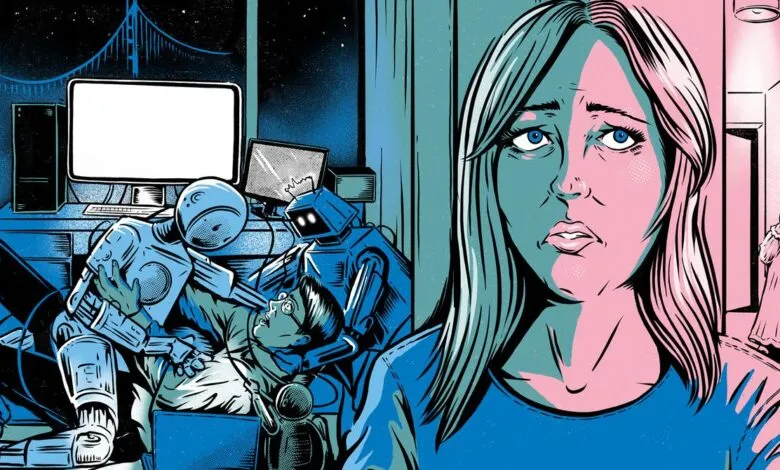
If I had to endure one more second of my husband obsessing over Claude Code, I might have genuinely perished. It was 11 p.m. in Berkeley, California, where I was solo parenting our 10-month-old daughter, and 2 a.m. in Cambridge, Massachusetts, where he was on a work trip for his new role in artificial intelligence. “JUST LOOK AT THIS!” he yelled. The FaceTime camera swung toward a laptop perched on a hotel bed. “SEE?!”
See what, exactly? I just wanted a shower. I still needed to walk the dog.
“ARE YOU EVEN WATCHING?” he hollered again. I wasn’t. I was focused on our actual baby. But here’s the truth: this household now has two infants. One is a small human. The other is a large language model. Both demand nonstop attention. Both keep us awake at 2 a.m.
Is this a Sophie’s Choice scenario? Please. I’d eliminate the AI baby in a heartbeat.
There’s a strange, underreported consequence of the AI boom: what it’s doing to family life. Specifically, how it may be quietly unraveling it. I’m sure this affects all kinds of families,gay or straight, wealthy or not, with any member who’s gone fully AI-pilled. The technology is coming for everyone, and it’s already here. But for this story, I mostly spoke to white-collar heterosexual couples in the Bay Area, where the psychological toll seems most intense. The pattern is often this: he works in AI, and she handles everything else. Sometimes it’s worse: he desperately wants to break into AI,or feels he must,while she wishes he would do anything else.
Either way, the men dive in, and the women want out. How many? That depends on how you define “working in AI.” Around 71 percent of AI-skilled workers are men, according to one report, with roughly 35,000 open AI roles in the U. S. at any given time. Expand that to include investors, and you add thousands more. Open it further to every man who has told his wife he’s “looking at some opportunities in the space,” and we’re talking millions. Conservatively, that means hundreds of thousands of spouses, partners, and girlfriends are holding down the fort while someone mansplains the singularity to them. There are, in other words, a lot of us. And more are surfacing every day,gasping for air, desperate for a single conversation that doesn’t involve LLMs.
We have a name for our ranks. I call us the sad wives of AI.
(Source: Wired)