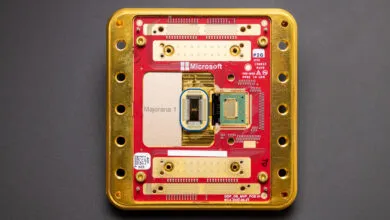
Microsoft, Atom Computing, EeroQ share new quantum advances

▼ Summary
– Microsoft is developing topological qubits using a superconducting wire on a semiconductor, based on theoretical predictions of unpaired electrons delocalizing to the wire’s ends.
– Early work on this approach faced setbacks, including retractions and skepticism due to noisy systems, but Microsoft has laid out a roadmap for building qubits from paired nanowires.
– Many companies are releasing incremental progress reports on quantum computing, with no major breakthroughs but essential steps toward general use.
– The article highlights that major successes in quantum computing will be built on a foundation of incremental progress, often obscured by focus on new technologies and landmarks.
– The steady flow of results from startups to tech giants aims to find a path to utility in quantum computing.
The steady march toward practical quantum computing rarely makes headlines, but the incremental steps behind the scenes are just as critical as the flashy breakthroughs. Over the past several weeks, multiple companies have published progress reports detailing their efforts to bring quantum technologies closer to everyday use. While none of these announcements qualify as a seismic shift, each represents the kind of essential groundwork that will eventually make large-scale utility possible. The real story here is the painstaking labor required to inch the field forward.
Microsoft’s material science push stands out because the company is pursuing topological qubits, a fundamentally different approach that relies on exotic physics arising when particles are confined. Their system uses a thin superconducting wire placed atop a semiconductor. In a superconductor, electrons typically pair up into Cooper pairs. But if the wire contains an odd number of conducting electrons,leaving one electron unpaired,that single electron becomes delocalized across both ends of the wire. (Quantum mechanics, as always, defies intuition.)
This behavior was initially a theoretical prediction. Before Microsoft could build qubits based on it, the company needed to confirm that the physics actually worked as described. The path was far from smooth. Some early results in this area were later retracted, and Microsoft’s subsequent demonstrations faced skepticism because the systems they showed were extremely noisy. Despite these setbacks, the company has laid out a roadmap centered on constructing qubits from pairs of these nanowires.
(Source: Ars Technica)