New Paper: Microsoft Exaggerated Its Quantum Claims a Year Ago
▼ Summary
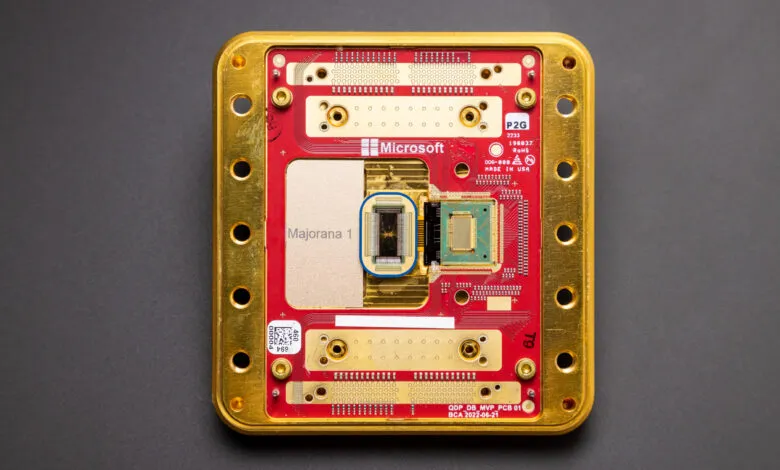
– Microsoft’s Majorana 1 quantum chip, unveiled in February 2025, uses a new technology called topological qubits.
– A critique in *Nature* by physicist Henry Legg reanalyzed Microsoft’s data and argues their evidence for the topological qubit is not conclusive.
– Microsoft announced the next-generation chip, Majorana 2, at its Build conference earlier this month.
– The critique calls the core technology behind the claimed breakthrough into question.
– The original article is published on The Verge.
A fresh peer-reviewed critique published Wednesday in the journal Nature casts serious doubt on the foundational technology behind Microsoft’s much-hyped quantum computing chip, the Majorana 1. When Microsoft unveiled the chip in February 2025, the company boasted that it introduced a revolutionary new approach called the topological qubit, which they framed as the essential “building blocks” for a future quantum computer. Just earlier this month at Build, Microsoft even announced its successor, the Majorana 2.
However, physicist Henry Legg from the University of St Andrews has now re-examined the original data from Microsoft’s experiments. In his analysis, Legg argues that the company’s research team did not actually provide conclusive evidence that they had successfully created a topological qubit. His findings challenge the very premise of Microsoft’s claims, suggesting the company may have overstated what it had achieved a year ago. This independent scrutiny puts pressure on Microsoft’s quantum roadmap, as the entire strategy hinges on the reliability and existence of this specific qubit technology.
(Source: The Verge)