Male bowerbirds use bright human objects to attract mates
▼ Summary
– Male bowerbirds build and decorate intricate twig structures called bowers to attract females during mating rituals.
– A new study by University of Exeter scientists found that urbanization has significantly changed bowerbird courtship behavior.
– Urban bowerbirds have greater access to brightly colored human-made items, which they prefer as decorations.
– Researchers monitored 61 male great bowerbirds in rural and urban sites in northern Queensland during the 2023 breeding season.
– The study photographed bower decorations in visible and UV light, as bowerbirds can see in the UV spectrum.
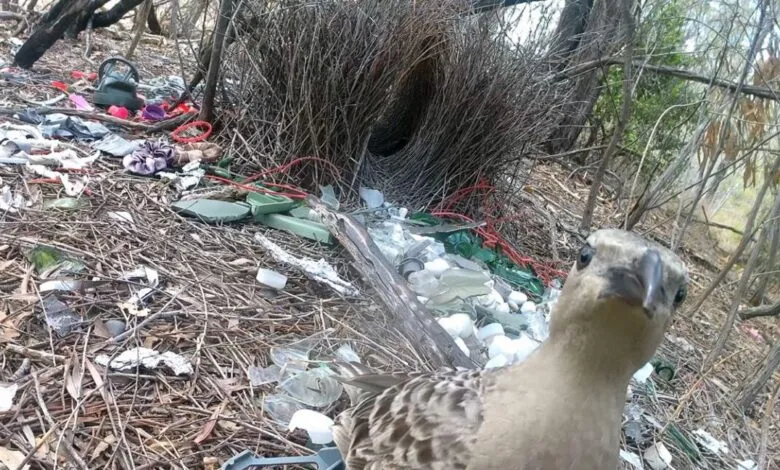
Male bowerbirds are already famous for their elaborate courtship displays, but a new study reveals that urbanization is reshaping how they woo potential mates. These birds construct intricate tunnel-like structures called bowers from twigs, then adorn them with colorful trinkets scavenged from their surroundings. When a female arrives to inspect the display, the male flings his brightest objects toward her while flaunting his plumage in a bid to secure a mate.
Research published in Royal Society Open Science by scientists at the University of Exeter shows that the growing availability of brightly colored human-made objects in urban areas is significantly altering courtship behavior in Australian male bowerbirds. The study highlights clear differences in decoration choices between bowerbirds living in urban versus rural settings. This disparity may stem from urban birds having easier access to such items, though birds in both environments demonstrate a strong preference for human objects over natural ones.
To investigate, the team monitored the bowers of 61 male great bowerbirds across two sites in northern Queensland, Australia: the rural Dreghorn Cattle Station and the urban Townsville City. Observations took place during the peak breeding season from September to December 2023. Researchers photographed the decorations in situ from above, capturing both visible and ultraviolet light since bowerbirds can see in the UV spectrum. They used an umbrella to create diffuse lighting for accurate imaging.
(Source: Ars Technica)