European Spacecraft Lost After Reaching Earth’s Atmosphere
▼ Summary
– The Exploration Company successfully launched and flew its “Mission Possible” spacecraft in orbit, completing a controlled reentry before losing contact minutes before ocean touchdown.
– The company described the test flight as a partial success and partial failure, acknowledging successful orbital power-up and reentry but an unresolved issue before landing.
– Communication was reestablished after reentry, suggesting the spacecraft survived the most thermally intense phase, but parachute deployment may have failed.
– The mission aimed to test orbital flight, reentry, navigation, and recovery, with only the recovery phase failing to meet objectives.
– The company provided transparent updates shortly after launch, noting the rapid, low-cost development likely contributed to technical challenges.
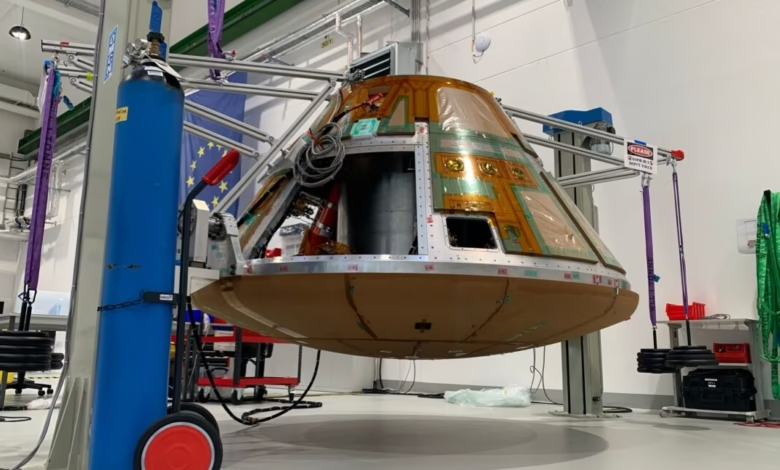
A European spacecraft designed for orbital cargo transport successfully completed key flight tests before losing contact during its final descent. The vehicle, developed by The Exploration Company, demonstrated critical capabilities during its “Mission Possible” demonstration flight, including powering payloads in orbit and surviving atmospheric reentry, before encountering an unexpected issue minutes before splashdown.
While the mission achieved several milestones, company officials confirmed the loss of communication occurred during the parachute deployment phase. Initial data suggests the capsule survived the intense heat of reentry, indicating its thermal protection systems performed as intended. The failure likely stemmed from complications with the drogue or main parachutes, supplied by Airborne Systems, a trusted provider for major spacecraft like SpaceX’s Dragon and Boeing’s Starliner.
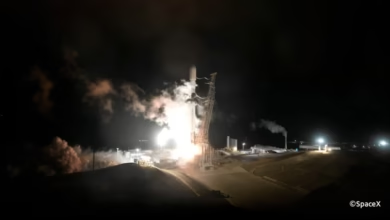
Launched aboard SpaceX’s Transporter 14 mission from California’s Vandenberg Space Force Base, the 2.5-meter-diameter capsule aimed to validate four core objectives: structural integrity in orbit, reentry survivability, autonomous navigation, and recovery operations. Despite the setback, the mission succeeded in three of these areas, falling short only in the final recovery phase.
The company’s swift and transparent response highlights its commitment to iterative development. Unlike traditional aerospace programs, this project moved quickly with a lean budget, making technical hurdles expected. By openly addressing the partial failure, The Exploration Company sets a precedent for accountability in the rapidly evolving commercial space sector.
Investigations into the root cause are ongoing, with updates promised soon. Customers who entrusted payloads to the flight were acknowledged, though the capsule’s loss means those experiments won’t be recovered. The mission’s mixed outcome underscores both the challenges and progress in developing affordable, reusable orbital vehicles.
(Source: Ars Technica)