Android Auto now adapts to any screen size
▼ Summary
– Google announced Android Auto updates including better screen sizing for unconventional displays, YouTube video streaming, widget support, and new Gemini AI features.
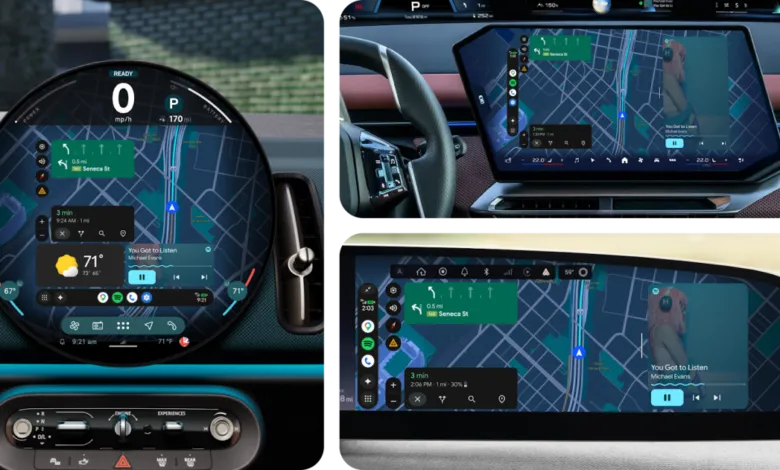
– The “full bleed” design lets apps like Google Maps fill any screen shape, such as curved, panoramic, or circular displays.
– YouTube video playback on Android Auto works only when parked, supports 4K and Dolby Atmos, and streams from the user’s phone.
– Widget support allows projection of personalized widgets, and Gemini AI can access them via natural language, plus “Magic Cue” suggests replies from analyzed messages.
– Gemini can now operate apps like Starbucks to place orders in the background, and Google Maps’ Immersive Navigation with 3D details is coming to Android Auto.
This week at Google I/O, the tech giant unveiled a sweeping set of upgrades for Android Auto, designed to tackle everything from oddly shaped car displays to in-car entertainment and deeper AI integration. The updates also extend to vehicles running Google’s native built-in software, where Gemini can now answer questions specific to the car you’re driving.
Let’s start with the most visual change: screen adaptability. In-car displays have moved far beyond the standard rectangle. We’re now seeing curved, panoramic, swooping, and even circular screens. Google is responding with an update that lets Android Auto dynamically tailor its interface to fit any display shape, no matter how unconventional.
Previously, phone projection systems acted like old widescreen videos, placing a rectangular interface in the middle of a larger screen with unused black space around it. That’s changing. Patrick Brady, Google’s VP of Android Automotive, pointed to the Lucid Air’s curved display and the MINI Cooper’s circular screen as examples of the new frontier. He even mentioned the upcoming BMW Neue Klasse, which features a trapezoidal shape. “I was like, man, I need to go back to geometry classes,” Brady joked in an interview. The new “full bleed” design will allow apps like Google Maps to fill the entire display, regardless of its geometry.
That full-screen capability will be especially noticeable when streaming YouTube through Android Auto, another update arriving later this year. While the vehicle is parked, users can watch videos in 4K at 60 frames per second with Dolby Atmos spatial audio. The content streams from the user’s phone, not the car’s embedded system. The vehicle simply tells the phone when it’s in park, unlocking video functionality. According to Brady, users have been clamoring for this feature to watch movies while charging their EV, waiting in parking lots, or sitting outside schools.
Google is also bringing its Material Three Expressive design language to Android Auto. My colleague Allison Johnson described it last year as a “youthful direction” for Android, “full of springy animations, bold fonts, and vibrant color absolutely everywhere.” Now, Android Auto will inherit personalization cues from the user’s phone, including wallpaper-based color palettes and themes, creating a more visually integrated and personalized experience.
Widget support is another major addition. Android users can now project their personalized widgets for sports scores, smart home controls, one-tap contact shortcuts, garage door openers, lighting controls, and more. And with Gemini, you can access those widgets using natural language. Ask for sports scores, upcoming schedules, or calendar information, and Gemini will generate the appropriate response within Android Auto.
A new feature called Magic Cue takes proactive assistance a step further. It analyzes incoming messages and surfaces useful information automatically. If someone texts you asking for an address or a phone number, Gemini can retrieve the relevant data from your phone and suggest a one-tap reply. Brady argues this will reduce the temptation to handle your phone while driving. “We test the heck out of everything,” he said, noting that Google conducts driver distraction studies in simulators.
Gemini is also becoming a more capable agentic assistant that can operate other apps on your phone. For example, drivers can now ask Gemini to place a pickup order through the Starbucks app. Instead of relying on special API integrations, Gemini can work with apps like Starbucks and DoorDash in the background to complete orders through Android Auto. Again, the goal is to minimize phone handling while driving.
The new Immersive Navigation view in Google Maps, announced earlier this year, is also coming to Android Auto. When you start a route, the map will feature refreshed colors, detailed 3D buildings, elevated roadways, realistic terrain, and greenery.
Brady argues that a smarter, better-fitting, more customizable Android Auto helps narrow the gap between phone projection and embedded software. Either way, Google typically wins. Even vehicles that don’t allow phone projection, like EVs from Rivian, Chevy, and Cadillac, ultimately use Google’s native Android Automotive and Google built-in systems as their foundation. And many Android Auto features eventually make their way into embedded systems, and vice versa.
That said, limitations remain. Android Auto users still can’t control their car’s HVAC system through phone projection. Other vehicle systems like drive modes, driver assist features, and radio settings also remain off-limits. But even those distinctions are fading, Brady said. Advanced features like Google Maps communicating directly with an EV’s powertrain to automatically add charging stops or precondition the battery used to require deeply embedded systems. Now, Google is working with automakers to enable those same results through Android Auto.
“I think these worlds are blending as the phones get more capable, the cars get more capable from a software perspective, and the integration between them improves,” Brady said.
(Source: The Verge)