Why You’ll Use Google AI Search, Even If You Hate AI

▼ Summary
– Google’s 2010 search quality meetings led to 550 algorithm changes, but in 2024 the company officially shifted from traditional search to AI-powered search with Gemini at its core.
– The new “AI Search” replaces the classic “10 blue links” with Gemini-generated summaries, personalized responses, and AI agents that forage for information, making the search box a portal to AI rather than the web.
– Google representatives at I/O wore “Ask Me Anything” T-shirts, emphasizing the conversational prompt style, where answers no longer necessarily result in clicks to websites.
– Despite public resistance to AI, Google views AI search as inevitable; the author admits it is better for many tasks, like finding a specific article when plain language prompts are used.
– Over a billion people per month now use AI Mode, a separate tab where links are peripheral, and queries in this mode are doubling every quarter.
It has been 17 years since I sat in on Google’s iconic weekly search quality meeting, held in the Ouagadougou conference room at the company’s Mountain View headquarters. That Thursday morning, roughly three dozen engineers, product managers, and executives gathered around a table or sprawled across the floor, dissecting why certain queries or categories fell short of a perfect result and brainstorming fixes. In 2010, those sessions prompted Google to implement 550 changes to its search algorithm , a number that felt monumental at the time.
That memory now feels as antiquated as a tintype. At this week’s Google I/O developer conference, head of search Liz Reid took the stage and effectively demoted traditional search to virtual irrelevance. This marked the culmination of a shift that began two years ago, when Google introduced “AI Overview,” the summary boxes that now sit atop search results, looming over the famous “10 blue links.” By then, those links had already been degraded, often burying the most relevant results beneath aggregators, spam, and Google’s own shopping and maps content. Now, in what Reid called the most significant change to the search box in company history, users are in direct conversation with the latest version of Google’s Gemini. Even the word “query” feels outdated, as human inputs now serve as conversation starters for the AI to collaborate on. The process can also tap into personal information Google holds about you , and that can be a lot. The answer to a search might be a custom presentation, possibly enhanced by AI agents that forage through digital backroads to unearth information. The transformation is complete.
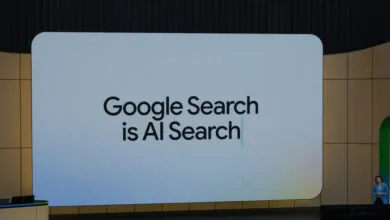
Onstage, Google made it explicit: “Google Search is AI Search.”
The search box was once a portal to the web. The new “intelligent” box is an invitation to order up a Gemini-powered, tailored response, sometimes generating a bespoke mini-publication on the fly, complete with charts, bullet points, and even animations. Google used to take pride in deciphering cryptic search terms to infer user intent. Now it encourages searchers to engage in a conversational prompt-a-thon with Gemini. To underscore the shift, Google representatives at the conference wore T-shirts reading “Ask Me Anything,” echoing the prompt Gemini offers. Just like the digital version, if you asked these smiling aides for directions, the answer didn’t lead to a website click.
Our digital lives currently teeter at an uncomfortable transition point. AI is driving nearly every business model, and giants like Google are embedding it into all their products and operations. At the same time, resistance and even disgust are rising as this powerful, unsettling technology worms its way into our routines. Just listen to the boos when commencement speakers mention AI. Yet Google sees AI search , if you still want to call it that , as an inevitability that even AI haters will eventually accept.
I was among those who recoiled at the launch of AI Overview in 2024. Now I admit that Overview , and the deeper “AI Mode” it encourages , is simply better for many tasks, whether checking if Saturday Night Live has a new episode, getting an explanation of an agentic harness, or even finding a specific link. When I searched for my WIRED article describing that Ouagadougou meeting, the blue links were nearly useless. But when I explained in plain language what I was looking for, I found it instantly.
So it’s working. Google reports that more than a billion people a month are searching with AI Mode, a separate tab on Google’s site where links are even more peripheral. And AI Mode queries are doubling every quarter.
(Source: Wired)