Why PPC AI agents fail without your business data
▼ Summary
– Many tools marketed as PPC agents are actually just AI assistants for tasks like writing ad copy, not true agents that analyze data and make account changes.
– True PPC agents fail when they only use Google Ads data because it creates a closed loop that optimizes for platform metrics like ROAS instead of business goals like profit.
– Performance Max campaigns set a dangerous precedent by operating as a black box, often chasing cheap conversions and high volume over high-margin products.
– To be effective, PPC agents need business data like CRM data for lead gen, product margin data for ecommerce, and operational data like fulfillment capacity.
– Building these data connections is often skipped because it is time-consuming, expensive, and requires buy-in from multiple departments, leading to automation that looks impressive but drifts toward wrong outcomes.
Every few weeks, a new article lands claiming that AI agents are about to take over Google Ads, SEO, or social media. On the surface, these agents look impressive. But when you look closer at what data they’re actually using, the story changes. Almost always, these agents rely solely on platform-native data , for Google Ads, that means impressions, clicks, conversions, and return on ad spend (ROAS).
This narrow focus is why PPC AI agents often fail at the input layer, before they’ve made a single decision. An agent that only sees platform data cannot truly manage your marketing.
Why many PPC agents are just AI assistants
Many tools marketed as PPC agents are really just AI assistants that generate ad copy. They handle tasks like creating 10 headline variations, describing a product image for a Responsive Search Ad (RSA), or drafting call-to-action options for a Performance Max (PMax) asset group. These are useful time-savers, but they aren’t agentic PPC. They’re generative AI tools with a Google Ads wrapper.
A true PPC agent acts on the ad account. It analyzes performance data, makes informed decisions, and implements changes such as budget shifts, bid adjustments, negative keyword additions, campaign structure modifications, and feed-level optimizations.
How AI agents for PPC create a closed loop
Google Ads has limited insight into your business data. When you build an AI agent that only considers Google Ads signals, you end up optimizing a closed loop. The agent focuses on hitting targets that often have nothing to do with actual business performance. In some cases, it can harm the business while improving its own reported metrics.
For example, Google Ads doesn’t know your average deal size, sales cycle length, or cash position this month. It lacks data on which product lines have margin worth defending. It doesn’t know that a campaign generating 40 leads per week is producing zero qualified opportunities, or that a campaign with a mediocre ROAS is your most profitable acquisition channel when you factor in customer lifetime value.
Performance Max set a dangerous precedent
This isn’t a new problem. PPC managers have navigated the ROAS-versus-profit tradeoff for years. Performance Max surfaced this issue long before AI agents entered the conversation. PMax campaigns operate as a black box. You provide Google with your budget, assets, and conversion goal, then let the algorithm decide where to spend.
Advertisers quickly discovered that without margin data, CRM signals, or conversion insights, PMax would enthusiastically optimize toward the wrong outcome. It would chase cheap conversions that would have happened anyway, deprioritize high-margin products for high-volume ones, and hit the ROAS target while missing the profit goal.
PPC agents risk misalignment without business data
AI agents for PPC amplify the speed and scale at which a misaligned optimization loop can cause damage. Before investing in an AI agent, consider this: PMax, built by the largest digital advertising company in the world and trained on more data than any independent agent ever will have, still can’t make good decisions without backend business data. Your agent is no different. Adding a large language model (LLM) doesn’t fix the underlying architecture problem. To optimize PPC campaigns toward business goals, your agent needs relevant business data.
Three types of business data for high-performing PPC AI agents
Three key categories of business data , CRM, product, and operational , are essential for improving PPC agent performance.
1. CRM data
For lead generation accounts, CRM data is the most critical missing layer. Without it, an agent targeting conversions bids on form fills with no idea what those outcomes are worth. There are two practical ways to close this gap.
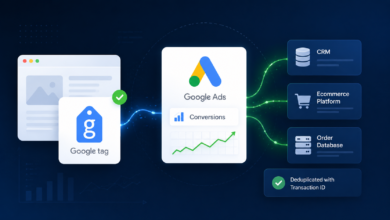
Offline conversion tracking (OCT) involves exporting qualified leads or closed deals from your CRM and pushing them back into Google Ads as offline conversion events, ideally with assigned values. This gives Smart Bidding a useful signal. With OCT, an AI agent analyzing conversion data from within Google Ads gets something that reflects business reality rather than just form volume. OCT is a lighter-touch option, especially for agencies managing multiple accounts. It doesn’t require direct CRM integration with the agent. The data flows into Google Ads on a delay (typically 24 to 72 hours), feeding revenue-weighted signals into the system the agent already reads.
Direct CRM access is the second path. Giving the agent direct CRM access allows it to query deal stages, average contract values by campaign source, win rates by lead type, and time to close by channel. This unlocks a more intelligent decision layer. No longer dependent on conversion data imports, the agent can assess pipeline health in real time. It might detect that a campaign is generating volume but leads are stalling at the proposal stage, then flag that for human review or adjust targets accordingly. Direct CRM access is harder to build and maintain than OCT, but it allows an agent to make business-aware decisions rather than relying on platform data alone.
2. Product margin data
Ecommerce accounts running Shopping or PMax campaigns with a product feed need access to product margin data. Yet these insights almost never exist natively inside Google Ads. Google Ads knows the product cost, conversion rate, and reported revenue for everything in the feed. But it doesn’t know that product A has a 55% gross margin while product B has a 12% margin after factoring in fulfillment and returns, despite having a higher ROAS. An agent optimizing for ROAS in this environment will naturally bid for product B conversions while starving product A.
A properly connected Shopping agent should have margin data at the product or category level, fed via a supplementary feed or accessible through a backend data connection. With this data, the agent can set differentiated target ROAS values by margin tier, suppress spend on structurally unprofitable SKUs, and prioritize budget toward the lines the business wants to grow. An agent that can read inventory levels and margin data can also dynamically adjust custom labels, pull products from active campaigns when stock is critically low, and reprioritize when a high-margin product returns to supply.
3. Operational data
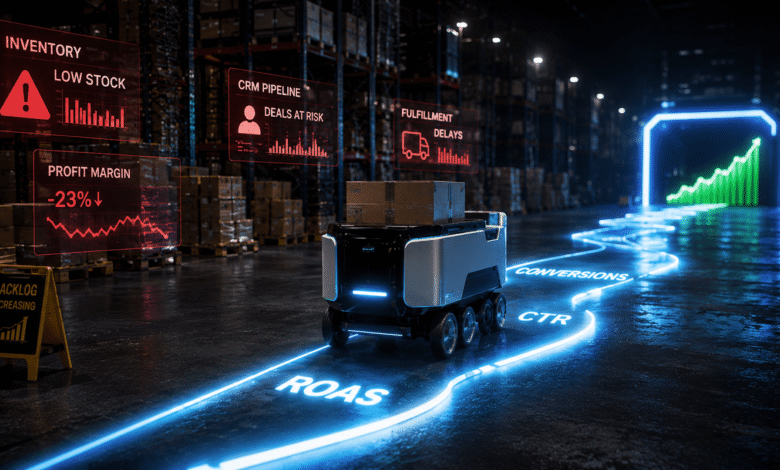
Operational signals , such as fulfillment capacity, seasonal staffing constraints, and promotional windows , also affect whether an agent’s decisions hold up in practice. Aggressively bidding into a product line you can’t fulfill burns budget and decreases customer satisfaction. For instance, your agent might scale campaign spend because performance looks strong, but the warehouse team is already at capacity and can’t fulfill orders in a timely manner. This decision seems optimal in theory but lacks context in practice.
Operational signals rarely come from a clean API. They’re stored in ERP systems, manual exports, and internal dashboards with no standard integrations. Extracting this data is challenging, and getting upstream coordination right is even harder. An agent is only as organized as the humans providing context. Marketing teams often struggle to coordinate promotions, sales pushes, and seasonal campaigns with other departments, agencies, and external partners. These initiatives happen constantly, with details communicated via email threads, Slack messages, and spreadsheets that no agent will ever see. Adding an autonomous system to this setup just accelerates the confusion. For many organizations, the first step is simplifying operational data.
Why PPC agent implementations often skip business data connections
Backend data connections are time-consuming to build and expensive to maintain. They often require syncing with a range of ecommerce, bookkeeping, inventory management, CRM, and ERP platforms. Every implementation is a custom job that often requires API connections or a data warehouse layer. It also requires buy-in from finance, operations, and sales teams that have their own systems, formats, and priorities.
As a result, agencies and in-house teams building AI agents for PPC often take the path of least resistance. They connect to the API, pull standard metrics, and build the automation without providing additional context. This approach is faster to ship and easier to demonstrate. It also avoids the internal politics of touching finance data. The result is a layer of automation that looks impressive but provides an incomplete picture of business reality, leading to performance that drifts in the wrong direction.
The current AI agent ecosystem doesn’t reward anyone for solving this problem. Agencies are paid to manage ad accounts, not to build data pipelines into client ERP systems. Tool vendors want you dependent on their connector layer, not on custom integrations you own. In-house teams rarely have the political capital to touch finance or operations systems. And even when they do, the procurement cycle alone can outlast the enthusiasm for the project. The incentive structure points everyone toward quickly shipping something that looks like an AI agent, rather than building something that works in real business conditions.
What to ask before you build an AI agent for PPC
Before investing time or budget in developing an AI agent for Google Ads, clarify what business data the agent needs to optimize performance. For lead generation accounts, the answer starts with OCT as a minimum viable data bridge, with direct CRM integration as the ideal architecture worth building toward. For Shopping and ecommerce, it starts with margin data at the SKU or category level and extends to inventory and fulfillment signals. For all campaign types, operational data is critical.
Creating a functional PPC agent is the easy part. Connecting it to reality is where you have to put in the work and where you extract genuine value.
(Source: Search Engine Land)