Tomb Raider Game Gets AI Disclaimer for Atlantis Content
▼ Summary
– Crystal Dynamics stated that AI tools were used to help teams iterate ideas faster, but all final content is human-crafted.
– The Steam page for *Tomb Raider: Legacy of Atlantis* includes a disclosure that AI-assisted tools were used for early exploration and temporary content, with AI assets later replaced or refined by humans.
– AI use disclosures are becoming more common on game store pages, as seen with *Crimson Desert*, which used generative AI for some 2D prop assets that were intended to be replaced.
– Tim Sweeney argued that disclosing AI use in game stores is unnecessary, as AI will be involved in nearly all future game production.
– *Legacy of Atlantis* is a remake of the original *Tomb Raider* and is now scheduled for release on February 12th, 2026, on multiple platforms.
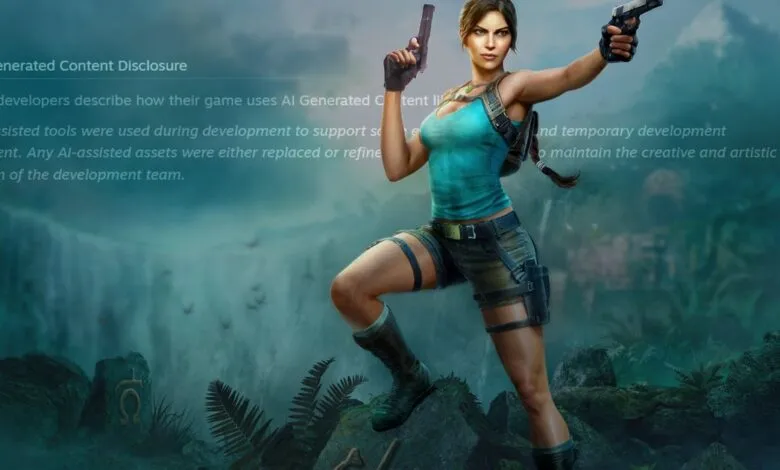
During last night’s PlayStation State of Play, developers Flying Wild Hog and Crystal Dynamics unveiled a new trailer for Legacy of Atlantis, a full remake of the original Tomb Raider. The game follows Lara Croft as she travels across the globe in pursuit of the Scion of Atlantis, facing a series of enemies and puzzles along the way.
Shortly after the trailer aired, an AI disclaimer appeared on the game’s Steam store page. It reads: “AI-assisted tools were used during development to support some early exploration and temporary development content. Any AI-assisted assets were either replaced or refined by humans in order to maintain the creative and artistic vision of the development team.”
These kinds of disclosures are becoming more common on digital storefronts as AI technology plays a larger role in game development. A recent example is Crimson Desert, whose own disclaimer stated that “generative AI technology is used in a supplementary capacity during the creation of some 2D prop assets.”
Developer Pearl Abyss insisted that AI-generated assets from development would be swapped out in the final version, but some still slipped into the released product, disappointing the Crimson Desert community. Players are now hoping Tomb Raider: Legacy of Atlantis avoids a similar outcome.
The debate over whether studios should disclose AI usage continues to intensify. In November last year, Epic Games CEO Tim Sweeney argued that requiring such disclosures “makes no sense,” comparing it to asking developers what shampoo they use. “The AI tag is relevant to art exhibits for authorship disclosure, and to digital content licensing marketplaces where buyers need to understand the rights situation,” Sweeney said. “It makes no sense for game stores, where AI will be involved in nearly all future production.”
Others disagree with the idea that AI will become so ubiquitous that disclosure becomes irrelevant. Konrad Tomaszkiewicz, game director of The Witcher 3 and co-director of Cyberpunk 2077, believes games made with AI will lack soul, though he acknowledges there are legitimate uses for AI during development. Similarly, Aloy actress Ashly Burch appreciates that AI can have its place, but insists it should never replace human creativity.
Originally slated for a 2026 release, Tomb Raider: Legacy of Atlantis is now scheduled to launch on February 12 of next year. It will be available on PlayStation 5, Xbox Series X/S, PC via Steam, and Nintendo Switch 2. Eurogamer has reached out to Crystal Dynamics and Flying Wild Hog for clarification on exactly how they used AI in development, and will update this story when more details emerge.
Update 5.31pm: Crystal Dynamics has since provided a statement to Eurogamer. While the studio did not specify exactly how the technology was employed, a representative said: “At Crystal Dynamics, we leverage AI tools to help our teams iterate on ideas faster and more efficiently, while ensuring that all finished content in the final product is human-crafted. Our goal is to empower the creativity and flexibility of our developers to deliver the highest-quality experiences for players everywhere.”
(Source: Eurogamer.net)