SEO in 2026: Prioritize Recognition Over Rankings
▼ Summary
– SEO’s traditional goal of ranking #1 is losing value as AI Overviews, LLM platforms, and zero-click searches reduce click-through rates and visibility.
– AI models choose brands based on recognition from training data, citations, and entity relationships, not solely on search engine rankings.
– Recognition requires brand presence across the wider internet (e.g., industry publications, reviews, forums), not just on your own website.
– Brands need entity clarity through consistent descriptions across platforms like Google Knowledge Panel, Wikipedia, and social media to be reliably identified by AI.
– Measuring recognition involves tracking branded search volume, unlinked mentions, and referral traffic, with a shift toward revenue and intent as primary metrics.
For nearly two decades, the SEO playbook was simple and universally accepted: get your brand to the top of the search results. The goal was clear, the metrics were agreed upon, and an entire ecosystem of tools, talent, and strategies was built around achieving that single objective. Rankings served as the scoreboard. Position one meant visibility. Traffic followed, and with it, a brand’s perceived value.
That core premise is now under serious renegotiation. The search landscape has shifted more in the past 18 months than in the previous decade combined. AI Overviews are absorbing queries that once generated clicks. AI and LLM platforms like ChatGPT, Perplexity, and Claude have become the first stop for research and decision-making. Zero-click searches are no longer a niche concern; they are increasingly becoming the default.
What’s needed now isn’t a new set of tactics. It’s a fundamental change in mindset. This is the SEO problem of 2026. It’s time to understand why recognition is your new goal and how to earn it.
The world changed faster than we did
SEO has always been a discipline that chases the algorithm. We reverse-engineered signals, built strategies around them, and scrambled to adapt when those signals shifted. There has always been the argument that if you create content for humans, you’ll typically perform well. Yet, obvious shifts have occurred in the types of content that resonate with the algorithm, dictated by Google’s core updates.
It was never a perfect system. Anyone who lived through the Panda and Penguin years knows the algorithm was always a moving target. But the fundamentals remained stable: aim to rank well, get found, and win. The shift we’re experiencing now isn’t a Google core update. It’s a structural change in how information is surfaced, interacted with, and ultimately trusted.
AI has fundamentally transformed what searchers see
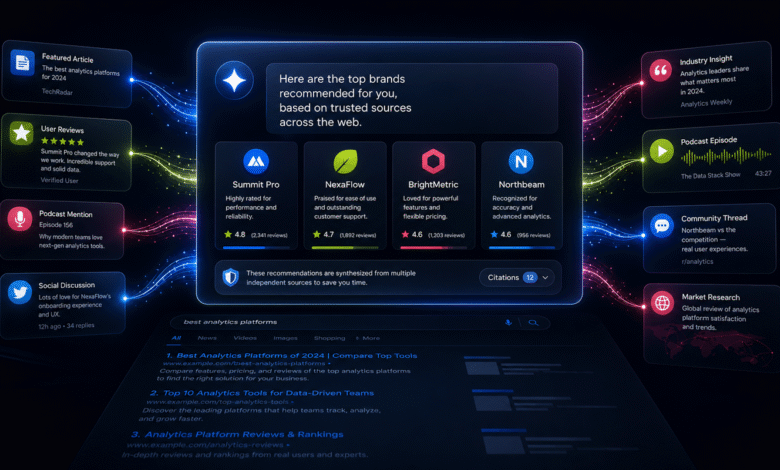
There’s a mental model baked into traditional SEO: if you’re at the top of the SERP, you’re visible. That model was accurate for a long time, but it isn’t now. AI and LLM platforms don’t crawl the SERP and pick from the top results. They build understanding from training data, citation patterns, entity relationships in knowledge graphs, and signals about who is genuinely considered authoritative on a given topic.
A high-ranking page can be largely invisible to these systems if the brand behind it hasn’t established recognition and preference,the quality of being known, cited, and trusted beyond its own domain.
Ranking no longer equals visibility
If your instinct is to treat this like another algorithm update, to find new signals or even game the system, you are missing how dramatically the search landscape has shifted. Consider this: a brand can rank number one for vital trophy keywords. Their domain authority is strong. Their technical SEO is clean. Their content team publishes weekly. Their link profile is healthy. By every traditional metric, this brand would be seen as winning. Yet, when potential customers ask an AI platform which brand solutions to consider, this brand doesn’t come up.
When Google’s AI Overview summarizes the landscape, it cites three competitors. When a journalist writes a roundup and asks an LLM for research, this brand is invisible. They rank, yet it’s as if they don’t exist,because ranking well doesn’t solve for recognition. Even if the dashboards still report rankings and the tools still track positions one through ten, optimizing for a metric that’s losing its meaning is no longer a viable strategy.
User behavior is also changing
A growing share of search journeys now end before a user ever clicks a result, because they get the information they need without clicking through. AI Overviews take the majority of the headlines, but there has also been a huge shift toward featured snippet expansions and LLM-powered assistants that surface direct answers outside the traditional search environment. Queries are increasingly conversational, with users asking AI tools questions the way they’d ask a trusted colleague, expecting thorough, contextualized answers rather than a list of blue links.
In this world, the question your SEO strategy needs to answer is no longer “how do I rank?” but “Is my brand the preferred option in the conversation?” These are fundamentally different questions requiring different answers.
How AI ‘chooses’ brands to recognize
Think about how an AI model decides what to say when someone asks, “What’s the best CRM for a small B2B team?” It doesn’t run a Google search and summarize the top result. It draws on patterns throughout its knowledge at its disposal: training data, industry publications, reviews, expert commentary, forum discussions, and solution comparisons. The brands that appear in that answer are the ones that have accumulated recognition across the broader landscape, not just the one that ranks.
This is becoming an invisible tax on brands that have focused exclusively on rankings. They may dominate the SERP today, but in the AI-mediated version of that same query, they’re absent. “Recognition” doesn’t have to be a vague brand concept. It has specific, measurable components.
Brand awareness across the search universe
This is the most basic layer. Does your brand name appear, in context, across the search universe? Not just on your own domain, but in industry publications, analyst reports, user reviews, forum discussions, podcast transcripts, and news coverage. You must also consider where audiences are spending time on social-search destinations, as AI and LLM platforms are increasingly trained on and drawing from the wider internet when answering questions. Certain domains are massively outperforming others in terms of citations from these platforms. If your brand is only present on your own website, you’re harder to find and aren’t in the platforms’ go-to sources.
Topical authority
This goes beyond keyword rankings. Topical authority means that when a given subject area comes up, your brand is consistently associated with it,not just by Google’s algorithms, but by writers, analysts, content creators, and communities. It’s the difference between a site that covers a topic and a brand that owns the conversation in people’s minds. The signal here isn’t domain authority; it’s authority, trust, and relevance,a.k.a. preference. Ask yourself, “Does our brand appear alongside the recognized leaders in our space?” and “When people discuss an essential topic, are we in the conversation?”
Entity clarity
This is the most technical layer and often overlooked. An entity in SEO terms is a clearly defined, consistently described “thing”,your company, product, key voice, or key topic. It’s something that knowledge systems can reliably identify and categorize. If your brand’s description varies across your site, Wikipedia page, Google Business Profile, Crunchbase entry, and LinkedIn page, you create ambiguity for every system. This is as confusing for your human audience as it is for the AI/LLM layer trying to understand who you are. Entity clarity means having a canonical, consistent answer to: What is this company? What does it do? Who does it serve? How is it different? Brands with strong entity clarity get pulled into knowledge graphs, get cited, and get recognized.
6 things to get you started on the path to recognition
True recognition cannot be built overnight. Instead, your focus is on engineering discovery that develops recognition over time. Here are six ways to begin the process.
1. Audit your entity presence. Go and look at how your brand is described in the places that matter: Google’s Knowledge Panel, Wikipedia, Wikidata, social media conversations, key person and business LinkedIn profiles, and your own “About” page. If your homepage describes you as “an AI-powered B2B sales platform” while your YouTube content says “CRM software for startups,” you have an entity problem.
2. Fix the inconsistencies. Write a canonical description of your company,one clear, accurate, jargon-free paragraph,and work to get it reflected everywhere. Then mold the content format to the needs of the various platforms you want to show up on. Decide which conversations are most important to your brand and consistently look to own these topics.
3. Create citable assets. There’s a difference between content that ranks on a SERP and content that gets cited. Ranking content is optimized around keywords and often homogenized to meet algorithm expectations. Citable content is original, specific, and useful enough that other people and AI/LLM platforms want to reference it. Think original research, clear frameworks, definitions that don’t yet exist, and data that journalists, analysts, and creators want to quote. If the only content on your site are search-optimized blog posts, ask yourself if there’s anything a writer at a key publication or a researcher at a relevant body would want to cite.
4. Build off-site recognition deliberately. This isn’t about traditional link building. It’s about building presence in the right conversations: industry publications, podcasts, analyst briefings, conference talks, social content, and community forums. Every time your brand name appears in a meaningful context outside your own domain, you’re building the recognition signal that AI and LLMs draw on. Prioritize quality of context over volume. A single substantive mention in a respected publication is worth more than fifty low-quality directory listings.
5. Optimize for clarity and intent. A keyword is a moment. Intent is a journey. Traditional SEO trained us to think in snapshots: a user types a query, we rank for it, we win. But a real buying journey in 2026 might start with a conversational AI query, move through a Reddit thread, surface a YouTube comparison, hit a review platform, and only then arrive at a branded search. What matters is whether your brand shows up meaningfully across the full arc of that journey. Start by mapping intent honestly. What is someone trying to understand? What does the journey from problem-aware to solution-decided look like? Then audit where your brand is present, absent, or ambiguous across it. The second part is clarity. As search becomes more conversational and AI-mediated, the brands that get surfaced are those that clearly communicate what they do, who they serve, and why they’re the right choice,consistently across every touchpoint. Vague positioning might survive a keyword-match algorithm, but it won’t survive a language model deciding whether your brand is the right answer to a specific human question.
6. Start measuring recognition. Your current reporting probably tracks keyword rankings, organic traffic, and backlinks. Continue that, but shift the importance of these metrics versus the following signals: brand search volume,are more people searching directly for you? Brand plus intent or keyword,are more people associating you with specific topics? Unlinked mentions,is your brand name appearing in content that doesn’t link to you? Then use these alongside increases in referral traffic, direct traffic, and quality of traffic measured in longer sessions, more pages viewed, and earlier purchases. This will allow you to look toward the most important SEO metric: revenue, especially average order value and lifetime value. When you begin to think about these considerations, the most important shift isn’t adding new metrics to your dashboard. It’s changing what you treat as the primary signal. Branded search volume, specifically branded search paired with intent, is one of the clearest indicators of genuine preference.
Someone searching for you by name combined with a buying signal isn’t discovering you; they’ve already decided you’re worth considering. That’s recognition doing its job. The goal is to grow that signal deliberately, and then make sure that when someone arrives with that intent, you meet it head on. A branded intent search that lands on a generic homepage is a wasted moment. Your job as an SEO in 2026 is to have already built the page, the answer, and the experience that closes the gap. The supporting metrics,unlinked mentions, referral traffic, direct traffic, AOV, LTV,all tell you whether recognition is compounding into something commercially meaningful. Recognition isn’t a brand vanity play; it’s a revenue strategy.
Get ready for a longer game with a bigger potential to win
Here’s the uncomfortable truth about the recognition-first approach: it’s slower. You can’t optimize your way to being well-known in the same way you can optimize your way to a ranking. That’s what’s most intimidating to SEOs. Recognition compounds over time, developed through consistent presence, genuine authoritativeness, relevance, and the slow accumulation of trustworthiness. But that’s also what makes it durable. Rankings fluctuate with every algorithm update, and the value of a number one ranking is shrinking with every update due to the increasing number of SERP features and AI/LLM integrations. Recognition, once established, is much harder to displace. To own AI-mediated search in the coming years, spend this period building something that AI systems,and the increasing number of humans utilizing them,genuinely recognize as authoritative. The number one ranking is a vanity metric if it ends up below the fold, stuck under a SERP of AI/LLM integrations and SERP features, ultimately ensuring nobody knows who you are. Start building recognition. Your appearance in those top-of-page SERP features and AI/LLM integrations will follow.
(Source: Search Engine Land)