Housemarque’s Saros redefines the next-gen game approach
▼ Summary
– Housemarque prioritizes stylized, gameplay-focused visuals over photorealism, using hardware to enhance arcade-style action rather than pursue realistic immersion.
– Saros and Returnal exemplify Housemarque’s philosophy of using visual fidelity to support gameplay and storytelling, not as an end in itself.
– Saros stars Arjun Devraj on planet Carcosa, where players must master arcade-like action to uncover a mystery through gameplay, not cutscenes.
– Housemarque aims for immersion through believable sensations and feelings, not realism, with cinematics posing questions that gameplay answers.
– Saros introduces “Corruption” upgrades that require player trade-offs, echoing Returnal’s parasites, to blend gameplay mechanics with character depth.
It’s easy to dismiss the importance of surface-level polish. Countless sayings warn against it: don’t judge a book by its cover, beauty is only skin deep, style over substance, and so on. Vanity carries a stigma. If too much effort goes into how something looks, the substance underneath might be called shallow. But in the realm of big-budget gaming? That’s often the winning formula.
Visual fidelity has become the shorthand for progress in video games. How realistically a mountain is rendered, how dynamically snow drifts, how a character’s hand touches a wall when you approach it just right. This pursuit can border on the absurd, like Rockstar Games’ infamous effort to animate horse testicles reacting to temperature in Red Dead Redemption 2 (2018). And yet, it often has little to do with what a player actually does. That’s where Housemarque breaks from the pack.
This Finnish developer is an outlier in the PlayStation Studios lineup. Acquired by Sony in 2021, Housemarque built its reputation on arcade titles like Super Stardust HD and Resogun. These are twin-stick shooters and shoot-’em-ups that use cutting-edge hardware to turn bullet hells into something closer to bullet heavens: explosions of fireworks and lasers, vibrantly rendered, but in service of games that trace their lineage back to Asteroids or Defender. They would be excellent even without the sharp visuals, but the visuals certainly don’t hurt.
Saros, the studio’s upcoming release, operates on the same philosophy. Like Returnal, Housemarque’s 2021 debut under the PlayStation banner, it reimagines a classic arcade-style game through the lens of Sony’s heavy hitters like God of War or Horizon. It aims for dramatic genre storytelling and lavish presentation, but without the obsessive pursuit of realism that often dominates conversations around those blockbusters.
“To me, realism is not interesting to pursue,” says Saros lead artist Simone Silvestri. “Saros is a stylized, realistic game, which makes sure that we can bend the world to the crazy gameplay that we have. The level of detail that we want is very intentional, very controlled, so that we can make canvases for the gameplay. I think that’s why we then get a lot more leeway to fall in love with the hardware as much as we do.”
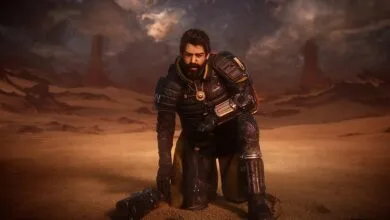
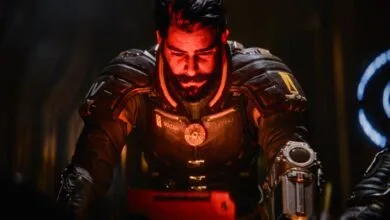
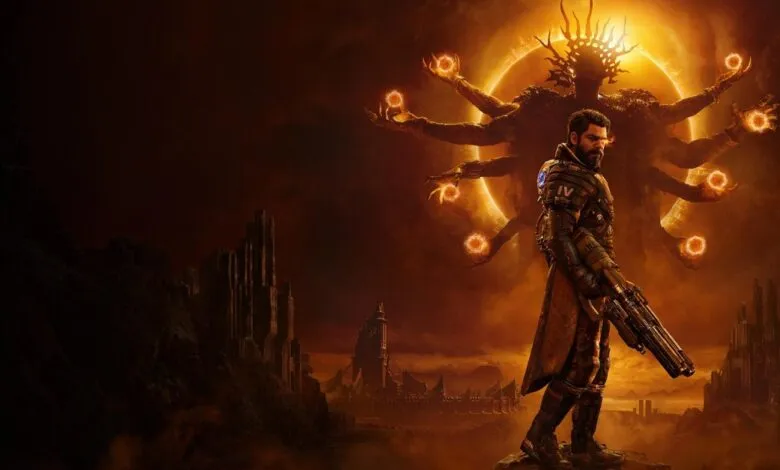
In Saros, players take on the role of Arjun Devraj, performed by actor Rahul Kohli. He is part of a team sent to the planet Carcosa to investigate the disappearance of mining colonists who were harvesting a miracle mineral called Lucenite. Something happened to them. Something is happening to Arjun. The game begins in this disoriented state, and before players can untangle the mystery, they must first master Housemarque’s signature, dexterous arcade-style action.
This approach echoes Returnal, an alternate universe where AAA games prioritize escalating gameplay and ludic athleticism over cinematic verisimilitude. Across these two titles, Housemarque proposes a different definition of “next-gen.” It’s not about photorealism; it’s about using the entire gameplay cow, so to speak.
“A lot of the time the cinematics are about setting things up or giving you questions to ask, and through the game experience, you answer them,” says Saros director and co-writer Gregory Louden. “The number one reference for our games are our own games. We are gonna have really special story moments for you, but they’re gonna be really rewarding. You are gonna own them, so I’m not gonna give them away for free. We’re also gonna make our cinematics about questions. The gameplay is the answer.”
In both Returnal and Saros, computing power isn’t just for crafting detailed environments. It fills the screen with orbs of different colors. It uses instantaneous load times to underline each game’s dizzying cycle of death and rebirth. It overwhelms the player with impossibly swift creatures, and arms them with weapons that defy physics and deliver unique haptic feedback. The environments are alive with writhing flora, always in motion, sometimes waiting to ensnare the player. They embody a feeling of psychological or cosmic horror, reflecting the internal hell of the player character. Both a middle-aged woman and an Indian man, in Returnal and Saros respectively, are woefully unusual protagonists in the world of video games.
This is the core of the Housemarque philosophy: visual fidelity has very little to do with the immersion that many games chase through graphical prowess. “Immersion does not come from realism,” Silvestri says. “It comes from the believability of the sensations and the feelings that you have in the moment.”
This aligns with Louden’s goal of kinetic storytelling, one that doesn’t start with the melodrama of a typical video game cutscene. Housemarque’s PlayStation Studios-era games aim to make you think about the characters you embody through playing as them. But the trap of being a “gameplay-first” studio is that players may only consider the gameplay, ignoring its narrative implications. Saros and Returnal each have clever tricks to confront this, asking the player to make devil’s bargains as they work through the live-die-repeat cycle. Returnal used parasites that attached to protagonist Selene, providing a perk with a gameplay tradeoff. Saros does this with upgrades that suffer from “Corruption,” a mysterious affliction that infects everything in the game.
“What happens when the future isn’t what you want it to be?” Louden asks. “We’re creating a character that you can examine and study. And not just one: We have many characters [in Saros] with many competing goals, all trying to find their way forward. Many of them are leaving something to come to this hostile alien planet. They know that it’s hostile when they go there. They know they’re leaving their past, but they’re all going there for a new future.”
Saros’ confrontation with a hostile future that differs from expectations is a fitting metaphor for the studio itself. Housemarque remains an oddball among AAA developers. While Saros offers some concessions to be more welcoming than Returnal’s notorious difficulty, it is still an unusual entry among its sister studios and their emphasis on cinematic sprawl. Being different is good, but in the high-stakes, expensive world of blockbuster games, it’s also risky.
These games don’t just need to sell themselves; they need to sell the console they’re on. That makes risk a liability. Because people do, in fact, judge a book by its cover.
(Source: The Verge)