MSI Claw EX: Most Important Handheld Since Steam Deck, But Not Worth Buying
▼ Summary
– The MSI Claw EX AI Plus is a $1,800 handheld gaming PC with next-gen Intel chips, offering the longest battery life and reliable sleep/wake functionality among Windows handhelds, though supply is limited.
– It outperforms rivals like the Xbox Ally X by roughly 40% at 1080p in many games, enabling native resolution play in titles like Cyberpunk 2077, but Intel driver issues cause freezes, stutters, and missing graphical effects in some games.
– Battery life is exceptional: at 720p in Cyberpunk 2077, it achieves 70fps using 21 watts for about 3.4 hours, and in 2D games like Balatro, it can last up to 12 hours on a charge with power-saving settings.
– Design strengths include comfortable manta-ray grips that spread weight well and a larger 8-inch 1200p VRR screen, but the glossy display has glare, controls are average, magnetic joysticks need tuning, and the fan is loud.
– Despite its performance and battery advantages, the high price and Windows quirks—like black screens on game launch, forced desktop mode for driver updates, and performance dips below 15% battery—make it a niche product not recommended for most buyers.
The MSI Claw EX AI Plus is a genuine breakthrough for handheld gaming PCs, a device that redefines what’s possible in terms of raw power and battery stamina. It represents the most significant leap forward in the category since the Steam Deck first legitimized it. Yet, despite being the first handheld I grab from my collection, its stratospheric price and lingering software quirks make it a product you should admire from a distance, not buy.
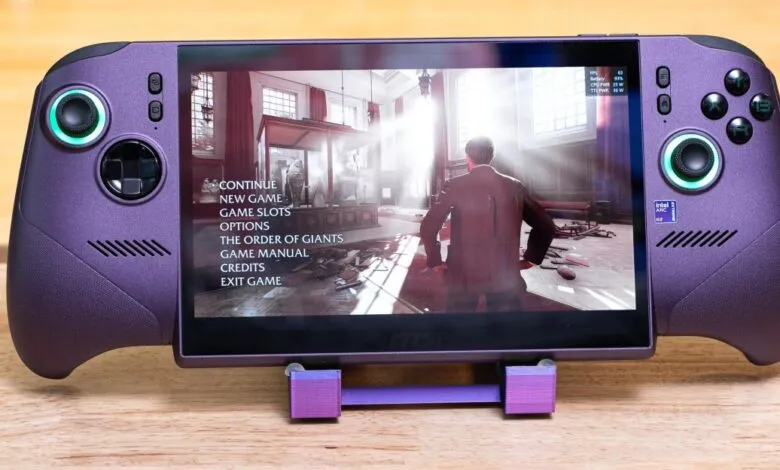
My review shelf is packed with almost every portable gaming PC on the market, and the Claw EX is the one that stands out. Its next-generation Intel processor and refined MSI chassis deliver a combination of performance and portability that no other device can match. It boasts the longest battery life of any handheld I’ve tested and is the first Windows-based system that handles sleep and wake cycles with the same reliability as the Steam Deck. Pressing the power button brings me right back to my game, even after days of hibernation, without a significant drain on the charge.
However, this pinnacle of performance and efficiency comes at a steep cost, both literally and figuratively. This is a review with a major caveat, a Ferris Bueller-style cautionary tale. The Claw EX carries a staggering $1,800 price tag, and even finding one at that price is a challenge, with MSI confirming limited US supply. While it’s tempting to believe you can have it all, the reality is that Intel, MSI, and Microsoft haven’t fully perfected the experience. This is a milestone for the industry, but like a highway marker, it’s something you should pass by rather than park at.
The hardware design is a mixed bag. The comfortable, manta-ray-shaped grips do an excellent job of distributing the 1.73-pound weight, making it feel lighter than the smaller Xbox Ally X during extended sessions. The 8-inch 1920 x 1200 display with its 48-120Hz variable refresh rate is a clear upgrade over the cramped 7-inch screens on the Ally, offering a more immersive view. The primary issue here is glare, as the ultra-glossy screen is difficult to see in bright conditions.
The controls, however, are merely serviceable. The buttons are fine, but the magnetic joysticks require significant tuning to avoid overshooting or undershooting your aim. The fan is audible, though its whoosh is preferable to a high-pitched whine. The speakers also cause a noticeable buzz in the grips at higher volumes, a side effect of the hollow chassis design.
The Claw EX’s true strengths are its performance and efficiency. This is the first handheld where I don’t have to immediately settle for “potato graphics,” the rough and pasty visual quality that comes from low settings, or a “slideshow” frame rate in demanding titles. In my benchmarks at 1080p, the Claw EX consistently outperformed the AMD-powered Xbox Ally X by around 40 percent, and it often beat the previous-generation MSI Claw by an even wider margin. This extra power is the difference between playing a game like Cyberpunk 2077 at native resolution or being forced to compromise.
This performance advantage is most striking when you consider battery life. To achieve a smooth 70fps in Cyberpunk 2077 at 720p, the Xbox Ally X and last-gen Claw require roughly 30 watts of power, draining their batteries in about 2.5 hours. The Claw EX can hit the same frame rate using only 21 watts, granting you a full extra hour of playtime. For 2D indie games, the efficiency is staggering; toggling the Endurance mode and lowering the refresh rate to 48Hz can drop total system draw to just 6.5 watts, enabling a 12-hour session. It’s rare to find a single chip that delivers both epic battery life for indie games and high performance for triple-A titles.
Yet, this strength has its own flaws. When the battery dips below 15 percent during a demanding game, performance takes a nosedive, with the system silently dropping from its 25W performance mode to a 15W mode. This degradation doesn’t immediately reverse even after plugging the device back in. Furthermore, Intel’s graphics drivers are still not fully mature. I encountered several games that would stutter, freeze, or even hang the entire system. In Star Wars Jedi: Survivor, certain areas were inexplicably stuttery, and a recent update was needed to fix graphical corruption in Expedition 33. The benchmark numbers for Returnal should be taken with a grain of salt, as many of its visual effects are entirely missing on Intel hardware.
While the Claw EX’s sleep and wake functionality is a welcome first for a Windows handheld, it doesn’t excuse the platform’s other persistent issues. I’ve lost count of how many times a game launched with a black screen, only to reveal it was running in the background. I’ve had to wrestle with the Task Switcher to fix full-screen launch issues and manually navigate to the desktop to update drivers, which the system should handle automatically. A particularly frustrating moment came when Windows informed me that the Quick Settings control panel required administrator privileges, a problem that only a reboot could fix.
I reach for the Claw EX before any other device because it’s on loan from Intel, not because I paid for it. At $1,800, I would be far less tolerant of its idiosyncrasies. It’s a fantastic showcase of what the future holds for handheld gaming, but for now, it’s a brilliant, expensive experiment that most people should admire from afar.
(Source: The Verge)