Hut 8 Signs $9.8B Texas Lease for First Phase of AI Data Centre
▼ Summary
– Hut 8 commercialized the first phase of its Beacon Point campus via a 15-year, 352 MW triple-net lease with a confidential investment-grade tenant for AI workloads, with initial data-hall delivery expected in Q3 2027.
– The lease has a base-term value of $9.8bn, and including three five-year renewal options, the cumulative value could reach approximately $25.1bn.
– With this deal, Hut 8’s total contracted AI capacity rose to 597 MW and aggregate base-term value to $16.8bn, completing its pivot from Bitcoin miner to AI landlord within 18 months.
– Key risks include an aggressive Q3 2027 delivery timeline, tenant concentration, and potential moderation of hyperscaler AI capex.
– The lease is part of a wider trend favoring Texas for AI infrastructure due to faster grid interconnection and permissive zoning, with the company’s remaining ~650 MW at Beacon Point available for future commercialization.
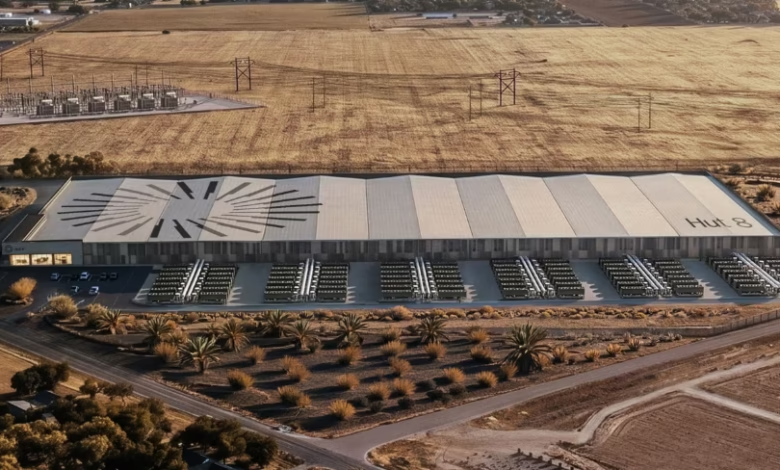
In roughly 18 months, Hut 8 has accomplished a corporate transformation that typically takes years. On Tuesday, the company announced the commercialisation of the first phase of its Beacon Point campus in Nueces County, Texas, through a 15-year lease covering 352 megawatts of IT capacity. The base-term contract value stands at $9.8 billion, with three five-year renewal options potentially pushing the cumulative value to approximately $25.1 billion.
The tenant, described as a confidential high-investment-grade company, will use the facility for AI training and inference workloads. The lease is structured as triple-net, meaning the tenant covers operating expenses, taxes, and insurance in addition to base rent. Initial data-hall delivery is expected in the third quarter of 2027.
This deal ranks among the largest individual data-centre leases announced this year, but the deeper story lies in what Hut 8 has become over the past two quarters. The company’s pivot from Bitcoin miner to AI landlord has been accelerating. In December 2025, it signed a 15-year, 245 MW lease at its River Bend campus worth $7 billion over the base term. With the Beacon Point addition, Hut 8’s total contracted AI data-centre capacity now reaches 597 MW, with aggregate base-term value of approximately $16.8 billion. That revenue line, before any renewals, exceeds the combined market capitalisation of most Bitcoin-mining competitors.
The speed of this shift is striking. Bitcoin-mining infrastructure has been repurposed for AI training, but the customer base is fundamentally different. Bitcoin pays in volatile cryptocurrency, while hyperscalers commit to 15-year triple-net leases backed by investment-grade balance sheets.
The Beacon Point lease covers the first phase of a planned 1 GW campus, with the remaining ~650 MW available for future commercialisation. The renewal options are what produce the $25.1 billion ceiling. Three successive five-year extensions at pre-agreed terms would extend the lease to 30 years. Whether those options are exercised remains a long-term question, but the locked-in renewal pricing is already considered attractive by Hut 8.
The announcement coincided with Hut 8’s Q1 2026 results, which showed the transformation visible at the financial-statement level. AI data-centre lease revenue is becoming the dominant line, while Bitcoin mining contributes a steadily smaller share of forward earnings.
The geographic choice reflects a wider trend. Texas has emerged as one of the most accommodating US jurisdictions for AI infrastructure, with faster grid interconnection processes than most coastal markets and more permissive zoning than Northern Virginia. This pattern is evident elsewhere. Meta’s $13 billion El Paso data-centre financing announced last week concentrates capacity in the same state, and Blackstone’s BXDC data-centre REIT IPO explicitly identifies Texas as a top-tier market.
The broader AI-infrastructure context tightens the logic. Thailand’s $29 billion data-centre approval cycle led by TikTok describes Southeast Asian capacity scaling at hyperscaler-equivalent commitments. Samsung Electronics crossing $1 trillion on AI memory demand on the same Wednesday Hut 8 announced is the supply-side signal that the AI compute build-out is still tightening rather than slowing. Hut 8’s Beacon Point lease is the operator-side outcome of the same dynamic. Tenants want capacity now, are willing to commit for 15 years, and will pay investment-grade premiums to anyone who can deliver megawatts on the timeline they need.
However, risks exist. The Q3 2027 initial data-hall delivery is an aggressive timeline given construction, permitting, and grid-interconnection cycles. Slippage is a real possibility. Tenant concentration is another concern. A confidential investment-grade tenant locked into a 15-year lease is a structural strength only as long as the tenant remains creditworthy and committed. If the underlying workload economics change, the same lease becomes a liability.
The broader AI-capex durability question also looms. If hyperscaler capex moderates from current $725 billion-plus annual run-rates, lease pricing on subsequent Beacon Point phases could compress. None of this is fatal. The 15-year base term insulates Hut 8 from short-cycle volatility, and the triple-net structure pushes operating-cost risk onto the tenant.
What changes for Hut 8 over the next 18 months is whether the remaining ~650 MW of Beacon Point capacity attracts comparable terms, and whether the company can maintain the construction velocity its 2027 delivery commitment requires. On Tuesday’s evidence, the pivot from Bitcoin miner to AI landlord is no longer a strategic intent. It is a contracted, nine-figure-revenue reality.
(Source: The Next Web)


