Samsung and IKEA Launch $6 Matter Smart Bulbs Without a Hub
▼ Summary
– Samsung SmartThings and IKEA announced 25 new IKEA smart devices can connect directly to a SmartThings hub using Matter over Thread, eliminating the need for IKEA’s own DIRIGERA hub.
– This integration leverages Thread border routers already built into millions of Samsung TVs and appliances since 2022, providing hidden infrastructure for these devices.
– IKEA’s new product prices are highly competitive, with smart bulbs starting at $5.99 and an air quality sensor at $29.99, significantly undercutting rival brands.
– The Matter standard has matured, with over 1,000 certified devices and a projected 800 million Matter-compatible devices in use by the end of the year.
– This partnership tackles key market barriers by combining a universal protocol (Matter), low-cost devices (IKEA), and pre-existing hardware infrastructure (Samsung).
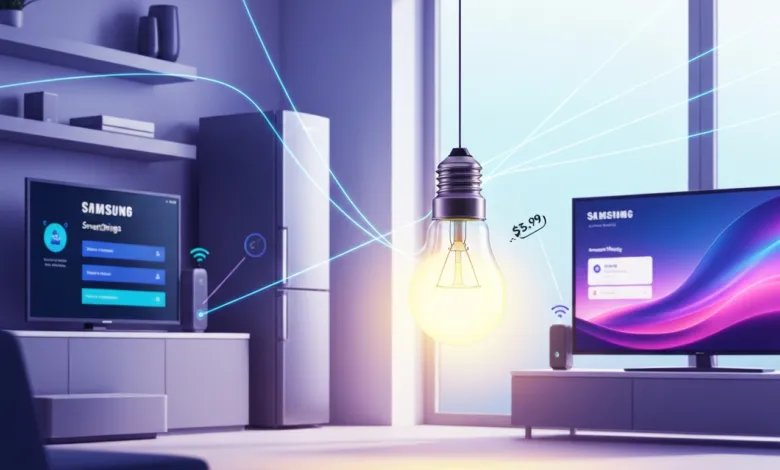
A new collaboration between Samsung SmartThings and IKEA is poised to dramatically lower the barrier to entry for smart homes. The partnership enables 25 new IKEA devices to connect directly to a SmartThings hub using Matter over Thread, bypassing the need for IKEA’s own DIRIGERA hub. This integration is significant because it leverages Thread border routers already built into millions of Samsung televisions, soundbars, and appliances sold since 2022. For many consumers, the necessary infrastructure for a robust smart home is already sitting in their living room, enabling the use of IKEA’s new smart bulbs starting at just $5.99. This move arrives as the industry anticipates 800 million Matter-compatible devices by the end of this year, signaling a major shift toward accessible, interoperable home automation.
The announcement means that a six-dollar smart bulb can now seamlessly join a network controlling Samsung appliances and electronics. All communication occurs locally via the Matter protocol, which also ensures compatibility with Apple HomeKit, Google Home, and Amazon Alexa. After years of promises about smart home interoperability, this partnership demonstrates a working model at a price point that requires no special justification for the average consumer.
IKEA’s new lineup includes the KAJPLATS smart bulbs in 11 variants, GRILLPLATS smart plugs, scroll wheel remotes, and smart buttons. Sensors include a MYGGSPRAY motion sensor for $9.99, a MYGGBETT door sensor for $7.99, a KLIPPBOK water leak detector for $9.99, and an ALPSTUGA air quality sensor for $29.99 that monitors CO2 and PM2.5 at a fraction of the cost of competing models. While the bulbs, plugs, and remotes connect directly via Matter, the sensors still require a hub, which can be IKEA’s DIRIGERA or a compatible third-party device. Support for blind and shade controls is scheduled for later this year.
Technically, this represents a substantial simplification. Previously, integrating IKEA devices required both a DIRIGERA hub and a SmartThings hub, with the DIRIGERA acting as a bridge. The new devices use Matter natively over Thread, a low-power mesh networking protocol that allows direct communication with any Matter controller. Samsung and IKEA conducted extensive validation to ensure stable connectivity and built a dedicated setup experience within the SmartThings app.
The core innovation lies in the protocol stack. Matter serves as the application layer for device commands and status, while Thread forms the networking layer, creating a self-healing mesh. SmartThings was the first platform to adopt Thread 1.4, which enables cross-brand network unification. This means a SmartThings hub can join an existing Thread network from another brand or invite a third-party border router into its own mesh, effectively creating a single, unified network from all compatible routers in a home.
Samsung has embedded Thread border routers into a wide array of products. Every Samsung smart TV from 2022 models onward contains one, as do many of its soundbars, refrigerators, and washing machines. This strategy means millions of households already possess the hidden infrastructure for a Matter-over-Thread ecosystem. IKEA’s aggressively priced bulbs provide those users with an inexpensive entry point to activate that capability.
Pricing is arguably the most strategic aspect of IKEA’s move. The $5.99 smart bulb undercuts major competitors like Philips Hue, Nanoleaf, and Aqara by half or more. Similarly, the $29.99 air quality sensor competes with devices often priced above $100. IKEA’s stated goal is to make smart technology “easy to use, easy to understand, and within reach for the many,” a mission directly reflected in these costs.
This pricing is part of a comprehensive overhaul. IKEA announced 21 new Matter-compatible products late last year and has committed to making Matter and Thread its default protocols. Its DIRIGERA hub has evolved from a Zigbee controller into a full Matter controller capable of onboarding devices from other brands. IKEA is not merely adding support, it is rebuilding its entire smart home lineup around the new standard.
Jaeyeon Jung, executive vice president of SmartThings at Samsung, highlighted the focus on accessibility, stating the partnership allows “even first-time smart home users” to enjoy easy connectivity “without financial burden.”
The Matter standard has matured significantly since its launch in late 2022. Early reliability and setup issues have been addressed, and over 1,000 devices have now been certified. The latest version, Matter 1.5, added support for cameras, soil moisture sensors, and energy management. A certified device now works across Apple, Google, Amazon, and Samsung ecosystems simultaneously without extra configuration. Competition has consequently shifted from basic compatibility to software quality, AI integration, and overall user experience.
With 430 million users and integration into Samsung’s vast array of hardware, SmartThings is positioned as a platform with uniquely broad hardware integration. Meanwhile, Apple is expected to intensify its smart home efforts this year, and Google and Amazon continue to expand their Matter support. Users now increasingly choose a platform based on its software and intelligence features, secure in the knowledge that Matter ensures control over the same hardware.
The global smart home market is projected to grow to $537 billion by 2030. The historic barrier to adoption has been market fragmentation: incompatible systems, multiple hubs, and uncertainty over future compatibility. Matter solves the protocol problem. IKEA solves the price problem. Samsung solves the infrastructure problem by embedding the necessary hardware into products people already own.
The convergence of a six-dollar bulb, a universal standard, and a television that already contains the needed router brings the industry closer to mass-market adoption than ever before. The constraint is no longer the technology itself, but making it affordable and simple enough that households do not need to understand terms like Matter or Thread to benefit from them. Together, IKEA and Samsung appear to have addressed both challenges in a single move.
(Source: The Next Web)