Claude AI Z80 Assembly Programming Guide
▼ Summary
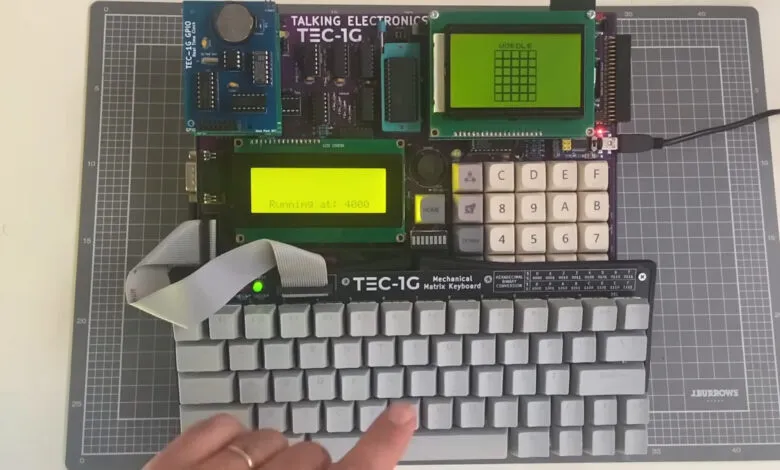
– A hobbyist successfully used the Claude LLM to create a working Wordle game in Z80 assembly for a retrocomputer, despite the AI’s training data likely lacking such old opcodes.
– The project was built on the TEC-1G, a single-board computer inspired by a 1980s design, and Claude initially knew about its original hex keypad interface.
– The LLM demonstrated overconfidence by generating incorrect instructions, though it corrected itself when the user provided specific, step-by-step guidance.
– The user approached the task by meticulously explaining each code section’s function, rather than asking for a complete program, which was compared to managing a summer intern.
– The final game worked, but the hobbyist had the skill to write it alone, and using the AI may have felt faster without necessarily improving actual efficiency.
The idea of using a modern large language model to write code for a decades-old microprocessor seems improbable. Yet, with expert human oversight, a developer successfully guided Claude AI to produce a playable version of Wordle for a Z80-based system. This achievement is surprising, given that the training data for models like Claude is unlikely to have prioritized obscure, 40-year-old assembly language opcodes.
The project centered on the TEC-1G single-board computer, a modern homage to a classic 1980s design originally published in an Australian hobbyist magazine. Interestingly, the AI demonstrated some awareness of this specific retro hardware, correctly noting its original hex keypad interface. When the developer, known as Ready Z80, clarified he was using a QWERTY keyboard add-on, Claude expressed confidence in its programming ability. This interaction highlights a common trait of generative AI, where the system often projects assurance regardless of the task’s complexity.
True to form, the model’s initial attempts included several nonexistent Z80 instructions. It did, however, accept corrections without argument. The developer’s methodology was key. Instead of asking for a complete program, he provided step-by-step specifications, explaining the precise function required for each code segment. This iterative, guided approach is less like issuing commands to a tool and more akin to supervising a keen but inexperienced collaborator.
The final result was a functioning game, though that outcome was never the sole point. Throughout the process, Ready Z80 demonstrated he possessed the skill to write the code independently. The real question becomes one of efficiency. Did employing the AI coding assistant accelerate development? Research into programmer productivity with LLMs suggests users often feel faster, even when the back-and-forth corrections and verifications might extend the total time invested. The project ultimately serves as a fascinating case study in blending historical computing knowledge with cutting-edge artificial intelligence, proving that with enough domain expertise, even an unlikely pairing can yield tangible results.
(Source: Hackaday)