Nvidia CEO Defends DLSS 5 Against AI Slop Criticism

▼ Summary
– Nvidia’s DLSS 5 reveal faced widespread criticism from gamers concerned it would make games look like generic “AI slop.”
– CEO Jensen Huang expressed empathy for these concerns, stating he also dislikes homogenized AI-generated content.
– He defended DLSS 5 by explaining it is “3D conditioned” and guided by the original artistic geometry and textures.
– Huang clarified the technology does not change the game’s core structure but enhances each frame based on that foundation.
– He emphasized DLSS 5 is an integrated tool for artists, not a post-processing effect that flattens a game’s visual identity.
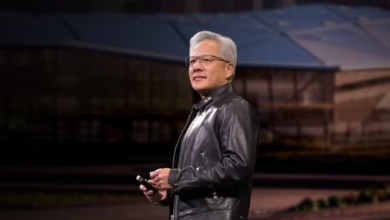
Nvidia CEO Jensen Huang has directly addressed recent criticism from the gaming community regarding the company’s newly announced DLSS 5 technology. In a recent podcast appearance, Huang sought to clarify the intent behind the feature, distinguishing its AI-powered graphical enhancements from the generic “AI slop” he acknowledges has become a common complaint.
During a lengthy interview, Huang was asked about the online backlash from gamers concerned that DLSS 5 would make titles look artificial and homogenized. He expressed empathy for that perspective, stating he shares the dislike for content where “all of the AI-generated content increasingly looks similar.” However, he argued that DLSS 5 operates on a fundamentally different principle. The core of his defense hinges on the technology being 3D conditioned and artist-guided. According to Huang, game developers provide the essential “ground truth structure” of geometry and textures. The AI then works from this foundation to enhance each frame without altering the original artistic vision, acting as a sophisticated tool for creators rather than an independent post-processing filter.
The primary concern among players is not that DLSS 5 will generate entirely new, bizarre content. The fear is that its application could push a wide variety of visual styles toward a single, bland standard of homogenized photorealism, erasing the unique artistic identity of different games. Huang countered this by emphasizing the collaborative nature of the technology. He explained it is not a blanket effect applied after a game is finished. Instead, it is designed to be integrated into the development pipeline, providing artists with a new generative AI tool to execute their specific vision with greater fidelity and performance. The goal, he stated, is to empower artists, not replace them or steamroll their creative direction.
(Source: Ars Technica)