Apple’s M5 Pro & Max: A Major Silicon Shift
▼ Summary
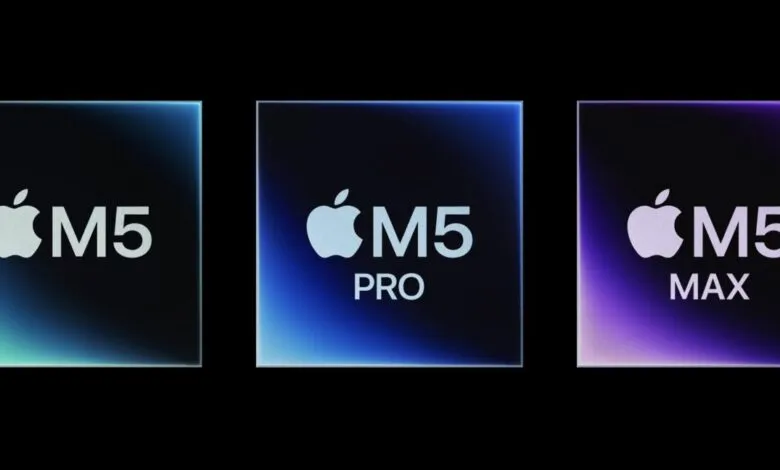
– Apple has introduced the M5 Pro and M5 Max chips alongside its updated MacBook Pro.
– These new chips represent a significant architectural departure from previous generations in both CPU design and packaging.
– They utilize a new “Fusion Architecture” that combines two separate silicon chiplets into one processor.
– In this architecture, one chiplet contains the CPU and I/O controllers, while the other is primarily dedicated to graphics.
– The first chiplet is consistent across both models, housing an 18-core CPU, a 16-core Neural Engine, and SSD/Thunderbolt controllers.
The latest MacBook Pro refresh introduces the M5 Pro and M5 Max chips, marking a significant architectural departure from Apple’s previous silicon designs. Rather than simply scaling up the core configuration of the base M5, these new processors implement a fundamentally different approach to chip construction and core design, promising notable advancements in performance and efficiency for professional workflows.
Traditionally, Apple’s Pro and Max variants have followed a predictable pattern: take the foundation of the standard chip and add more CPU cores, GPU cores, and memory bandwidth. The M5 generation breaks this mold entirely. The changes are substantial, encompassing both the underlying CPU architectures and the novel method used to package the silicon together. While real-world performance benchmarks will require hands-on testing, the disclosed technical specifications reveal a major evolution in Apple’s chip design philosophy.
A cornerstone of this shift is what Apple terms an “all-new Fusion Architecture.” This system bonds two separate silicon chiplets into a single, cohesive processor package. While Apple has previously used chiplet technology to combine two Max dies into an Ultra chip, the application here is entirely new. The M5 Pro, for instance, is not merely two standard M5 chips fused together. Instead, the architecture dedicates one chiplet primarily to the central processing unit and input/output operations, while a second chiplet is focused almost exclusively on graphics processing. Both chiplets are fabricated using TSMC’s advanced 3-nanometer process.
In every M5 Pro and M5 Max chip, the first silicon die remains consistent. This universal die houses an 18-core CPU, a 16-core Neural Engine for machine learning tasks, and the essential controllers for the solid-state drive and Thunderbolt ports that manage external displays. This standardized base ensures core functionality and connectivity are uniform across the Pro and Max tiers, with differentiation primarily occurring in the second, graphics-focused chiplet.
(Source: Ars Technica)