Beta Technologies Soars on NYSE Debut, Raises $1 Billion

▼ Summary
– Beta Technologies raised $1 billion in its NYSE IPO, pricing shares at $34 and closing at $36 after a strong debut.
– Founder and CEO Kyle Clark took an unconventional approach, avoiding Silicon Valley and venture capital while raising $1.15 billion from institutional investors like Fidelity and Amazon.
– The company proceeded with its IPO during a government shutdown using SEC guidance that allows filings to become effective automatically after 20 days without staff review.
– Beta Technologies designs two electric aircraft models and operates an EV aircraft charging business, with Archer Aviation as a customer.
– The company reported $15.6 million in revenue for the first half of 2025 but incurred $183 million in net losses, showing growth but not yet profitability.
The electric aviation sector witnessed a significant milestone as Beta Technologies successfully launched its initial public offering on the New York Stock Exchange, securing a substantial $1 billion in capital. The Vermont-based innovator saw its shares priced at $34, exceeding the anticipated range of $27 to $33. By offering 29.9 million shares, the company achieved a valuation of $7.4 billion. Trading activity saw an initial dip, but the stock recovered to close at $36 by the end of the session.
This public debut marks a major achievement for founder and CEO Kyle Clark, who has pursued an unconventional strategy in building his aviation enterprise. A Harvard graduate and former professional hockey player and flight instructor, Clark established Beta Technologies in 2017. He deliberately avoided the typical startup ecosystem of Silicon Valley, choosing instead to base operations in his Vermont hometown. Rather than relying on venture capital, the company secured $1.15 billion in funding from institutional powerhouses such as Fidelity and the Qatar Investment Authority. Notable backers also include corporate giants Amazon and General Electric.
In another departure from standard procedure, Beta moved forward with its IPO filing during a government shutdown. The U.S. Securities and Exchange Commission had issued guidance allowing companies to declare effective registration statements, including share prices, automatically after a 20-day period even without staff review. This rule enabled Beta and other firms like Navan to proceed with their public offering plans despite the regulatory pause.
Clark described to TechCrunch how this approach involved a 20-day roadshow with investors. He recalled that banking advisors warned him about the risks of such an extended engagement. Clark’s response was to embrace the opportunity, believing that deeper investor examination would ultimately benefit the company. He stated that as potential backers delved into the technology and strategic vision, their confidence grew, leading to significant oversubscription for the offering. Clark expressed his preference for steady, measured stock growth rather than a dramatic, unsustainable surge.
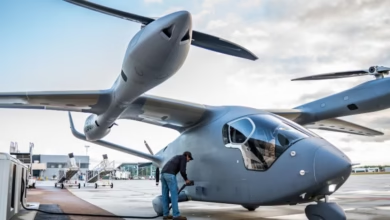
With the IPO complete, Clark’s attention has returned to core company objectives, notably achieving Federal Aviation Administration certification for its electric aircraft. Beta Technologies aims to operate as an original equipment manufacturer for the aviation industry. Its portfolio includes two distinct aircraft designs: the Alia CX300 eCTOL, a conventional electric plane intended for regional travel, and the Alia A250 eVTOL, an electric vertical takeoff and landing model developed for urban air mobility.
Beyond aircraft manufacturing, Beta has established an electric aircraft charging infrastructure business, with Archer Aviation counted among its customers. Financial disclosures from the IPO reveal that while Beta is generating revenue, it has not yet reached profitability. The company reported $15.6 million in revenue for the first half of 2025, doubling its earnings from the same period in 2024. However, net losses expanded by approximately one-third to $183 million during the same six-month timeframe.
(Source: TechCrunch)