Why your brand misses the AI recommendation list
▼ Summary
– Most generative engine optimization (GEO) advice focuses on making content structured, authoritative, and easy to extract, but it often overlooks the initial step of brand qualification.
– AI systems determine which entities are eligible for consideration before any selection occurs, creating two distinct thresholds: qualification (clarity and relevance) and selection (credibility and extractability).
– Brands can rank well in Google search but fail to appear in AI-generated answers because AI selects entities, not pages, and may find the entity ambiguous or poorly associated with a topic.
– The correct optimization sequence is clarity, relevance, credibility, and extractability; fixing qualification first is essential because selection tactics are ineffective if the entity is not clearly identified.
– To test AI visibility, ask if the AI can describe the brand (tests clarity and relevance) and whether it recommends the brand for a category query (tests selection); if not, prioritize name consistency, an About page as a fact sheet, and schema markup.
We’ve been flooded with generative engine optimization (GEO) advice over the last couple of years. Checklists for AI citations, signal frameworks, and technical guides all promise to show you how to structure content for large language models. Most of this guidance converges on the same core idea: if you want to be visible in AI-generated answers, you need to be structured, authoritative, and easy to extract.
In my opinion, while this information is extremely valuable and valid, it remains incomplete , especially for brands already positioning themselves for a future where AI-generated answers dominate search. What this entire layer of advice assumes is that your brand is already eligible for consideration if it ticks those three boxes. But most brands overlook a critical reality: they aren’t even eligible to be considered in the first place.
The invisible layer most GEO advice skips
Traditional SEO conditioned us to think of visibility as a function of ranking. The objective was to position a page as high as possible for a given query, operating under the assumption that higher visibility leads to more clicks and, ultimately, better business outcomes. As AI-driven search experiences evolved, many adopted this thinking, simply replacing “ranking” with “being cited” or “being included in answers,” without questioning whether the underlying system still operates the same way.
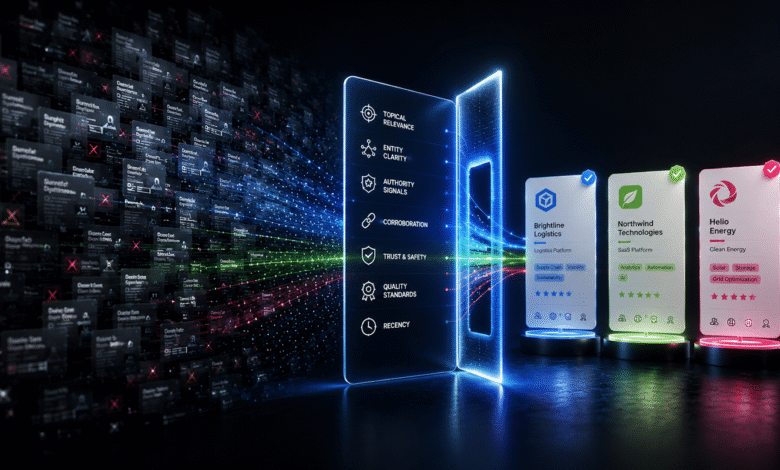
AI systems do much more than rank and summarize information. They filter, reduce, and select entities based on four basic signals. Before any comparison of options takes place, the system first determines which entities are eligible for consideration. That layer is almost entirely missing from GEO discussions , and it’s where many brands risk exclusion.
The result is a false optimization sequence: brands invest in extractability before clarity, and build credibility signals while their entity identity remains ambiguous. For instance, they write FAQ content for a stage they haven’t qualified for yet.
In practice, this creates two distinct thresholds:
- Qualification, where an entity becomes eligible to enter a candidate set.
- Selection, where only a subset of those entities is actually included in the final answer.
From pages to entities: The measurement of competition has changed
While traditional SEO optimizes pages for ranking, AI systems select entities for inclusion. Entities are the named products, ideas, concepts, and brands that form the underpinning for Google’s Knowledge Graph , the way its search understands relationships between things.
Once we accept that entities outweigh pages in AI’s final decision, we see this is a structural shift, not an incremental one. It changes the unit , or “metric” , of competition. A page can rank well in search results and still fail to represent a clearly defined, consistently understood entity. From a search engine’s perspective, the page meets the criteria for visibility. From an AI system’s perspective, the entity behind that page may still be ambiguous, weakly associated with a topic, or insufficiently confirmed across the web.
This is why it’s increasingly common to see companies that perform well in Google fail to appear in AI-generated answers for the same queries.
Let’s look closer at qualification vs. selection and what each threshold requires.
Qualification: Can the system identify and associate you?
At the qualification stage, an AI system is effectively asking two questions:
- Can this entity be clearly identified?
- Is this entity strongly associated with the topic?
If a brand is inconsistently defined , using different descriptions across platforms, appearing under slightly different name variants, or only loosely connected to a subject area , it will struggle to pass this first threshold. The system may “know” it exists in some form, but that knowledge is too ambiguous or poorly defined to include in a candidate set.
Clarity: Are you identified as a distinct entity?
Clarity means that any machine , be it a search engine or an LLM , can look at your name and clearly establish a relationship between you and the business or topic you are associated with. It’s actually an easy problem to fix, but one many brands overlook.
Let me use my own case as an example. I have a common name, shared by hundreds , if not thousands , of other women, most of whom have some online presence and some of whom are relevant in their fields. As an SEO and GEO consultant, this was an issue for my brand’s visibility. My problem was never a lack of presence online, but a lack of distinction. With so many people named Mariana Franco, both search engines and AI systems were repeatedly mixing signals from different individuals, making it difficult to consolidate a single, coherent entity.
I noticed, however, that the “Maryanna” spelling variant of my name was uncommon. Changing my professional spelling from Mariana to Maryanna became an unavoidable disambiguation strategy so that my brand could be understood by search engines and LLMs. The change created a clearer, more distinctive identity that could be consistently recognized across systems. But beyond the spelling change, I also had to apply that spelling consistently across my website, profiles, and external references, so that all signals pointed to the same entity rather than competing variations.
The results became visible in seven days for search engines and 10 days for LLMs. The system no longer had to reconcile multiple similar identities, making it easier to associate the correct signals with a single person. Me!
In this case, the limiting factor was clarity , not content volume, links, or a lack of activity. The entity itself was too easy to confuse with others. Once that ambiguity was reduced and the signals became consistent, the system could process and reinforce the entity more effectively.
Relevance: Are you associated with your topic?
Relevance asks whether the system associates your brand with the topic being queried. Not whether you have a page about it (typical ranking for keywords), but whether the broader web connects you to it consistently. This comes from:
- Topic clustering , what entities and subjects is your brand mentioned alongside on the web.
- Content depth , does your brand demonstrate deep knowledge of your topic through specialized articles and web mentions, or are you scattering your content thinly across several sources.
- Context signals , whether your brand appears consistently alongside recognized names in your field, which then transfer relevance to you.
Selection: Can the system confidently recommend you?
Once qualified, a brand enters the candidate set for search engines and LLMs. This is where the GEO advice most people are already following finally applies.
Credibility: Do other sources corroborate you?
Having a powerful About page is a great first asset for getting your brand properly positioned. But how can Google or ChatGPT be certain you are telling the truth? The answer: credibility.
Credibility asks whether sources beyond your own website confirm what you say about yourself. Any brand can write a compelling About page and make claims about itself, but AI systems need corroboration. They look for multiple independent sources that say consistent things about you.
This is where PR strategy, social media, and SEO converge to produce your brand’s AI visibility. Press coverage, podcast appearances, industry reports, award listings, and analyst mentions become corroboration signals that move you from the recognition set to the selection set. I’ve found that podcast appearances seem particularly undervalued here. That’s because most podcasts are transcribed and published. That transcript becomes indexed content that mentions your name, your company, and your specialization in a context that signals expertise, independent of anything you published yourself.
Extractability: Can your content be used to generate an answer?
Extractability determines whether you get cited once you’re in the candidate set , or whether a competitor does instead. It basically asks: Can an AI system isolate a piece of your content and produce a confident, useful answer from it?
A lot of brand content is optimized for human engagement , with long intros, buried answers, hedged claims, and dense paragraphs that rely on surrounding context. That type of content is hard for AI to contextualize, so AI will instead use non-branded content, which you have much less control over.
The fix is reformatting your branded content to be more AI-friendly:
- Put the answer first, not after a three-paragraph introduction.
- Use proper heading hierarchy to make the structure easy and apparent.
- Write short, self-contained paragraphs that make sense when lifted out of context.
If a sentence could appear word-for-word in an AI response and still make sense, that is extractable. If it only makes sense within the full article, it won’t travel.
Testing a query in Google and AI
When testing a query containing the word “best” , such as “best ecommerce PPC agency UK” , we can clearly see the gap between search and AI-generated replies. In Google, the results typically include a mix of agencies, directories, and editorial content. A company like Lever Digital can rank high if it has strong landing pages and relevant supporting content.
However, when testing the same query in an AI tool like Perplexity, the answer is much narrower. Only a handful of agencies are mentioned , such as Impression, Genie Goals, or Brainlabs , while Lever Digital, despite its visibility in search, isn’t included.
Google typically distributes visibility across pages that match the query and intent. When the query or intent is ambiguous, Google explores the topic with the user, showing different brands and types of pages that fulfill different intents. Google distributes visibility and has space for everyone as long as they are indexed and somehow match the search.
LLMs, on the other hand, select entities that not only match the topic but also match the intent and are verified. An AI system will not evaluate the entire web and every page that appears in Google’s indexed pages. Their “thought process” starts with a smaller set of entities that have already passed a threshold of clarity and relevance, and only then applies additional signals before deciding what to include in the final answer. If an entity doesn’t make it into that initial group, it’s never part of the comparison at all.
Recognition isn’t a recommendation. Our job is to close the gap.
There is a useful distinction that clarifies where most brands currently stand:
- Does AI simply know what your brand does?
- Or does it trust you enough to confidently suggest you in its answers?
AI systems can recognize far more entities than they are willing to recommend. If you ask a system directly about a specific brand, it may provide a reasonable description if it has some level of knowledge (whether through its learned data or live search). But when asked a broader question , such as “best ecommerce PPC agency UK” , that requires selecting a set of options, that same brand may not appear at all.
So, while recognition (clarity + relevance) gets you into the system, recommendation (credibility + extractability) gets you into the answer.
It’s simple to test whether your brand is being recommended. Ask the AI, “What is [your brand]?” Then follow up with, “What is the best [your category] for [your ideal customer]?” If the first question returns a reasonable answer and the second doesn’t include your brand, you’re recognized but not recommended. The LLM can understand the relationship between your brand and what it does, but you haven’t passed the selection threshold.
The gap between these two states isn’t bridged by producing more content. This is where many brands make a critical mistake that unintentionally decreases their clarity and relevance. They try to tackle too many topics in an attempt to “rank for everything,” which ends up thinning their content. Instead of writing more content, brands should align how they are defined, referenced, and structured across the entire web so that when a system asks not just what exists, but what should be recommended, the answer is already clear.
The right optimization sequence from recognition to selection
Most GEO advice treats entity clarity as an afterthought, if it considers it at all. Often, one of the most important clarity resources is handled by the HR or management team: the About page. And then it’s usually treated as if it’s just a glorified PR press release. When SEO does take it into consideration, it’s usually a low-priority task with little effort behind it.
The typical sequence goes: fix technical foundations, restructure content for extractability, add schema, and build external mentions. This process assumes the system can already clearly identify your brand as a distinct entity. However, for many brands, that assumption is false, and no amount of FAQ schema or press coverage fixes it.
The problem is that selection tactics compound on top of a qualified entity. They do very little if the entity itself is ambiguous or inconsistently defined. The correct sequence is:
Clarity → Relevance → Credibility → Extractability
Clarity and relevance are qualification signals: they determine whether you enter the candidate set at all. If you fail here, you will be filtered out before any comparison happens. Credibility and extractability are selection signals: they determine how likely you are to be chosen once you’re in the candidate set.
Fix qualification first. After that, every PR effort, schema, and FAQ you add compounds faster once the system can clearly identify and associate your entity.
| LLM Response | Qualification | Selection | Priority Fix | |————–|—————|———–|————–| | “Never heard” | ❌ Fail | N/A | Clarity, Relevance | | “Describes you vaguely” | ✅ Pass | ❌ Fail | Credibility/Extractability | | “Recommends you” | ✅ Pass | ✅ Pass | Maintain |
The three questions to audit your brand visibility
Before investing further in selection tactics, run this test across ChatGPT, Perplexity, and Claude. It’s useful for both personal and corporate brands:
- “Who/What is [your brand]?” → Tests for brand clarity.If the first two questions return vague or hedged answers (typically including “possibly,” “might be,” “could refer to”), you have a qualification problem. Start with fixing clarity and relevance before anything else.If the first two return confident answers but the third doesn’t include you, your qualification is working, but your selection signals need strengthening. Focus on credibility and extractability.If all three return strong results, you understand what’s working. Protect it and track it regularly.
How to start getting into the selection pool
If you’re not appearing in AI recommendations for your category, the highest-leverage starting points are almost always the same: name consistency, definition, and your About page.
Step 1: Brand name consistency. Audit how your brand name appears across every platform you control: your website, LinkedIn, Google Business Profile, directories, and press mentions. Choose one canonical version and use it consistently everywhere, with both a short and long version. This may sound trivial, but name inconsistency is the most common clarity failure I encounter , and the easiest to fix.
Step 2: An About page that answers basic questions. Once you choose the canonical version of your name and description, write your About Page as a fact sheet. Answer these five questions in plain, structured language: Who you are, what you do, who you serve, where you’re based, and what makes you distinct. Make it the clearest, most machine-readable description of your entity that exists anywhere on the web. Tip: Run your About page text through a natural language processing (NLP) tool to get the best version possible.
Step 3: Add schema for proper structure. Add Organization schema with sameAs properties linking to your canonical profiles elsewhere. This formally introduces your entity to AI systems and reduces ambiguity across sources.
These three steps are the basis of clarity and the foundation for your brand qualification. Once this is done, everything else builds up.
The future of AI visibility belongs to qualified entities
As AI systems improve, the gap between qualification and selection will likely grow. These systems are getting better at filtering noise, more conservative about what they include, and more dependent on consistent, corroborated signals when generating responses. Producing content in bulk on your own website may have been , and may still be , important for topical authority, but it won’t succeed in this AI environment, especially without clarity.
Success in this environment will come first from aligning how a brand is understood across the web: clearly defined, consistently referenced, externally confirmed, and structured in a way LLMs can use.
(Source: Search Engine Land)