Schema Markup for Agentic Web Optimization
▼ Summary
– Schema markup helps AI agents interpret and act on website content, not just understand it, by clarifying entity relationships, relevance, and trustworthiness.
– Structured data reduces computational costs for AI systems, making sites with clean schema the path of least resistance for agents.
– Microsoft’s NLWeb, built on schema markup, enables websites to become queryable by AI agents, allowing direct natural-language interactions and real-time answers.
– For agentic optimization, prioritize complete schema on key pages, automate markup generation, use JSON-LD, and maintain a coherent site-level entity graph.
– Early adoption of agent-friendly schema creates compounding advantages, as AI systems prefer sources they have already validated and found reliable.
Schema markup has long been a staple of search optimization, but its role is evolving far beyond traditional SEO. With Google and Bing confirming that structured data powers AI Overviews and ChatGPT using it for product recommendations, schema is now a cornerstone of agentic web optimization. As AI systems increasingly interact directly with websites on behalf of users, schema markup is becoming essential infrastructure for this new paradigm.
For AI agents, understanding content isn’t enough. They must also interpret and act on it. Schema markup makes this possible by providing a structured framework that machines can parse efficiently.
The role of schema markup in the agentic web
In traditional search, schema boosts visibility by making content eligible for SERP features and helping search engines understand entities. This feeds the index and knowledge graph, shaping how results appear to users. AI agents, however, go further. They use schema not just to identify entities but to grasp relationships, relevance, and trustworthiness. This determines whether content supports recommendations or enables task completion.
Structured data also reduces computational costs for AI systems. Parsing unstructured HTML is resource-intensive, especially as large language models (LLMs) operate within finite context windows and face growing inference expenses. As these systems scale, websites that simplify content interpretation become the path of least resistance for AI agents.
NLWeb and the infrastructure of the agentic web
Schema markup is the foundation, and NLWeb is built on top of it. Understanding this connection is critical for forward-thinking professionals. NLWeb, Microsoft’s open-source initiative, allows websites to easily add AI-powered conversational interfaces. It transforms any site into an AI app where users can query content using natural language.
Think of it as the difference between a human browsing a website and an AI agent interrogating it directly. An agent can ask questions, retrieve structured answers, and act without human intervention. To be truly agentic, a site must move from being “read” to being queryable. NLWeb facilitates this by enabling natural-language queries and structured responses.
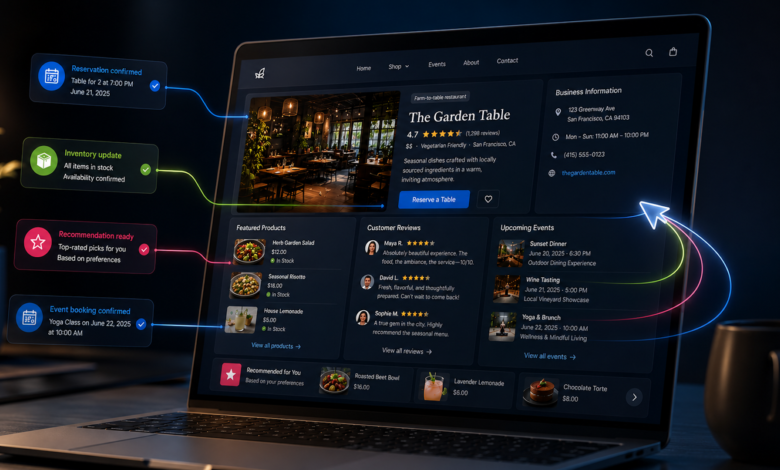
While schema tells an agent what is on the page, NLWeb allows real-time interaction with that information. It’s the difference between an agent reading a static menu and asking, “Do you have a table for four at 7:00 PM tonight?” and receiving a deterministic answer.
NLWeb was conceived and developed by R. V. Guha, now a CVP and technical fellow at Microsoft. Guha created widely used web standards, including RSS, RDF, and Schema.org. The same person who built the vocabulary for structured data on the web is now building the protocol for AI agents to use it. That’s a through-line, not a coincidence.
NLWeb leverages existing structured formats like Schema.org and RSS, combined with LLM-powered tools, to create natural language interfaces for both humans and AI agents. It doesn’t require rebuilding your content infrastructure. It simply asks you to have your schema markup in order so it can take it from there.
5 tips for agentic schema optimization
If you’ve been implementing schema markup for years, here are new considerations for optimizing it for the agentic web.
1. Prioritize completeness over coverage
Fully populated schema markup on your most important pages beats thin markup spread across your entire site. AI agents prioritize properties that help them directly answer user queries. For a product page, that means price, availability, ratings, and specifications, not just a product name. Incomplete schema signals uncertainty, while complete schema signals reliability.
2. Automate where you can
Manual schema management doesn’t scale, especially for teams without dedicated technical SEO resources. Some platforms handle this automatically for key page types like product pages, blog posts, events, bookings, and local business information. This baseline matters for both coverage and consistency. Stale or mismatched structured data works against you. If your schema says one price and your page shows another, agents will distrust both signals. Agents also trust signals more when they appear reliably across a site rather than sporadically.
3. Use AI to scale implementation
Platform automation handles the baseline, but AI can go further by analyzing your content to generate more specific and relevant markup. With AI, you can scale structured data generation, installation, and validation.
4. Use JSON-LD
This isn’t new advice, but it’s more important than ever. JSON-LD is cleanly separated from your HTML, making it far easier for agents to parse programmatically. Google’s official guidance explicitly recommends JSON-LD for AI-optimized content.
5. Think about your schema as a site-level graph
Agents benefit from understanding how your content connects across your entire site. This includes how articles relate to authors, products to categories, and services to locations. Periodically audit your structured data at scale. Take note of which page types have markup and which don’t, where entity definitions conflict across URLs, and whether your Organization or Person markup is consistent. The goal is a coherent, connected picture of your site’s entities that an agent can trust regardless of which page it enters from.
The window for early mover advantage
AI systems increasingly prefer sources they have already indexed, validated, and found reliable. For agentic optimization, early adoption matters. Content that establishes itself as agent-friendly now builds compounding advantages as agents develop preference patterns.
Schema markup has always rewarded teams that took it seriously. In the agentic web, the stakes of getting it right, and the cost of ignoring it, are substantially higher. The agents are already crawling. The question is what they find when they get to you.
(Source: Search Engine Land)