Digg relaunches as an AI-powered news aggregator
▼ Summary
– Digg’s latest reboot failed as a Reddit competitor due to bot traffic and lack of differentiation, leading to its shutdown in March and a return to development.
– The new Digg, previewed in May 2026, is a news aggregator focused on ranking AI news by tracking influential voices on X (formerly Twitter).
– Digg ingests X content in real time, using metrics like views and sentiment analysis to rank stories, not user activity on Digg itself.
– The site ranks the top 1,000 AI people, companies, and politicians, aiming to surface signal from X noise, though its everyday utility is uncertain.
– Digg could drive traffic to publishers hurt by Google’s algorithm changes and AI Overviews, but may struggle expanding beyond AI news, where X discussion is concentrated.
Digg has risen from the dead once more, and this time it’s bringing artificial intelligence along for the ride.
The latest revival comes just months after the previous reboot of Kevin Rose’s once-iconic link-sharing platform was abruptly shut down in March. That version of Digg had been redesigned to compete directly with Reddit, but it failed to gain traction. The team struggled to manage bot traffic and found they hadn’t set themselves apart enough from the massive community forum site to make any real noise.
After laying off staff, the company retreated to rethink its strategy. Rose, a partner at True Ventures, stepped back into a full-time role in April to build something new.
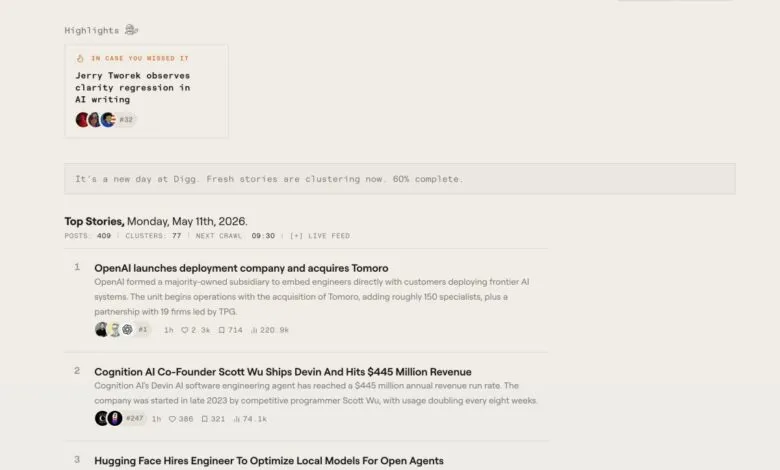
On Friday evening, Rose teased a fresh link to the newly redesigned Digg, and the result looks nothing like a Reddit clone. Instead, it resembles the news aggregator the site was originally known for.
“a little project i’ve been hacking on,” Rose posted on X, warning that bugs were expected and more topics were on the way.
This iteration of Digg is laser-focused on ranking news, with a specific emphasis on AI news to start. In an email to beta testers, the company explained that the site aims to “track the most influential voices in a space” and surface the stories truly worth paying attention to. AI is the test case, but if the concept proves successful, Digg plans to expand into other topics.
The email also cautioned that the site remains raw and “buggy,” describing it more as a preview than a full public launch.
On the current homepage, Digg highlights four main stories at the top: the most viewed story, a story seeing rising discussion, the fastest-climbing story, and one labeled “In case you missed it.” Below that sits a ranked list of top stories for the day, complete with engagement metrics like views, comments, likes, and saves. The twist: these metrics aren’t generated on Digg itself. Instead, the platform ingests content from X in real time to determine what’s being discussed, while also performing sentiment analysis, clustering, and signal detection to identify what matters most.
As Rose noted on X, when OpenAI CEO Sam Altman engages with a story about AI, it almost always triggers a chain reaction of deep discussion and widespread propagation across the platform. The new Digg tracks that increased engagement.
For data enthusiasts, this could be fascinating. The site exposes the impact of X-based engagement with charts and graphs, offering a way to cut through the noise and find genuine signal. But it remains unclear whether everyday users will find enough underlying value here beyond the novelty of watching an @sama tweet spark a viral moment.
Digg also ranks the top 1,000 people involved in AI, along with the top companies and politicians focused on AI issues.
For anyone who lacks the time to scroll through X for breaking AI news, Digg could prove a useful shortcut. Yet it’s not obvious why users would regularly turn to Digg over their preferred news app, RSS reader, or even their X “For You” feed when catching up on trending topics, especially since there’s currently no discussion happening on Digg’s own site.
The platform may also face challenges when it expands into other topics. AI news is one of the few areas where discussion still thrives on X. Other verticals don’t enjoy the same traction, particularly after Elon Musk’s takeover of Twitter gave rise to a wave of competitors, including Meta’s creator-focused Threads. Many non-tech-related conversations have now shifted off X entirely or moved behind private channels.
Still, if Digg does manage to gain momentum, it could become a valuable source of website traffic for publishers whose businesses have been battered by declining clicks. Google’s changing algorithms and the rise of AI Overviews , the AI-generated summaries that appear atop search results and often answer users’ questions before they ever click through , have dealt a heavy blow to many news sites. A successful Digg could help turn that tide.
(Source: TechCrunch)