What’s Replacing Data Studio for SEO Reports
▼ Summary
– Data Studio is criticized for being buggy with large datasets, having low row/field limits, and breaking when adding dimensions or joining data sources.
– The platform requires slow, manual updates and clicking for every change, making iteration and debugging reports inefficient.
– Data Studio’s weak API creates bottlenecks by preventing external tool management, unlike modern API-first platforms.
– AI-driven coding tools like Claude Code and OpenAI Codex enable fast, programmatic SEO reporting by connecting to data via APIs and automating multi-step workflows.
– These agentic tools allow for flexible, custom reports and real-time data interaction, significantly speeding up tasks like pre-meeting analysis and ad-hoc requests.
Imagine preparing for a critical meeting to present your SEO results, only to have your reporting dashboard fail at the last minute. This frustrating scenario is becoming all too common for teams relying on legacy platforms like Data Studio for SEO reporting. While such tools were once the standard, the landscape has fundamentally shifted. The limitations of rigid, dashboard-dependent workflows are now starkly apparent, creating bottlenecks that hinder efficiency and strategic insight. A new paradigm is emerging, one powered by AI-driven coding tools and programmatic reporting that offers unprecedented speed, flexibility, and control.
The core issue with platforms like Data Studio isn’t just occasional outages, it’s a foundational rigidity. These tools were designed for a different era of data analysis. Users often confront restrictive row limits and fragile data connectors; adding a few dimensions or merging sources can cause an entire report to collapse. Every adjustment requires manual, time-consuming clicks through a slow interface, and debugging becomes a tedious exercise in guesswork. Furthermore, the platform’s weak API support creates significant bottlenecks, preventing integration with external tools and automated workflows. This lack of agility is a critical handicap in a field that demands rapid iteration and deep, custom analysis.
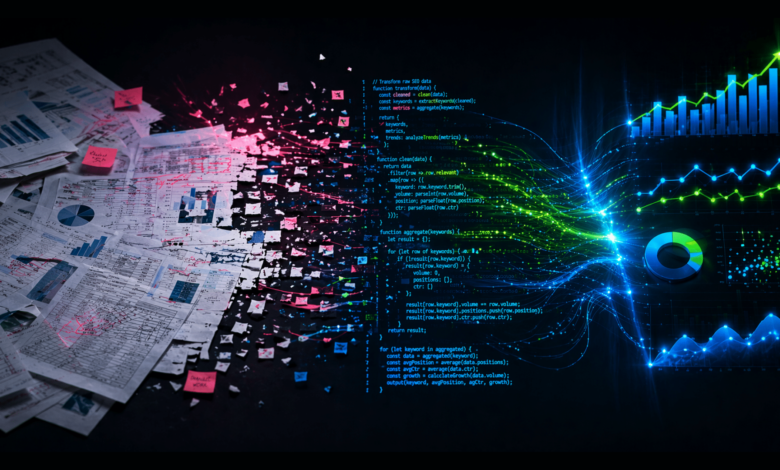
The catalyst for change is the convergence of advanced large language models and widely accessible APIs. Tools like Claude Code, OpenAI Codex, and Gemini CLI represent a new category of agentic coding assistants. These are not simple chatbots, they are capable of executing multi-step workflows. You describe the report you need, and the agent handles the heavy lifting: pulling data via APIs, transforming datasets, performing analysis, and generating visualizations. This transforms SEO reporting from a manual, template-bound process into a dynamic, code-driven operation. You don’t need to be an expert programmer, but a foundational understanding of data structures unlocks the full potential.
The advantages of this approach are profound. The most immediate benefit is dramatically faster reporting and analysis. Tasks that once required days of developer support or hours of manual compilation can now be completed in minutes. Because data is processed directly, filtering and sorting happen in real time without waiting for dashboard refreshes. This agility extends to custom reporting workflows. You are no longer confined to pre-built templates. If a standard chart doesn’t tell the full story, you can instantly leverage any major data visualization library to create the exact graph needed, from keyword cluster maps to granular technical SEO diagnostics.
This methodology also brings transparent data constraints. When working with code and browser-based charting libraries, you have a clear understanding of your dataset’s size and the system’s processing limits. If you encounter a bottleneck, the issue is identifiable and solvable, preventing the misleading insights that can arise from hidden dashboard errors. For practical applications, consider pre-meeting report generation. An agent can autonomously pull data from Google Search Console and GA4, clean it, segment it, and compile a polished notebook or slide deck in a single workflow. Technical SEO analysis, such as parsing crawl logs, becomes far more efficient, and ad hoc stakeholder requests for specific data slices no longer demand late-night manual labor.
The broader implication is a significant shift in productivity and capability. Research from institutions like Stanford and MIT indicates that access to AI tools can boost workplace productivity by at least 14% on average. In SEO, this translates to faster reporting cycles, more iterative and proactive analysis, and the capacity to handle complex, multi-source data. These AI coding assistants are empowering analysts to become builders, enabling non-technical team members to create and iterate in ways previously reserved for developers. Adopting this technology is becoming table stakes for competitive SEO teams. Businesses that integrate these tools are already seeing nearly double the output from their high-adoption teams.
The path forward begins with a single, manageable step. Start by identifying one repetitive reporting task. Use an agentic assistant to connect to a key data source, like Google Search Console, via its API and build a single, code-driven report. Test and refine this workflow before expanding to other use cases. The future of SEO reporting is unequivocally agentic and code-driven. Teams that embrace this shift will move faster, uncover deeper insights, and gain a decisive competitive advantage. The era of waiting for a dashboard to refresh is over.
(Source: Search Engine Land)