DuckDuckGo Simplifies Its AI-Free Search as Traffic Surges
▼ Summary
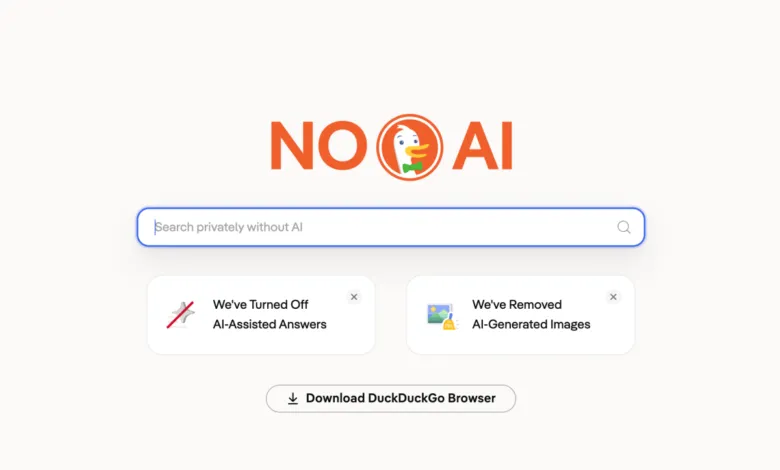
– DuckDuckGo launched browser extensions for Chrome and Firefox that set its AI-free search page, noai.duckduckgo.com, as the default search engine.
– The extensions direct users to a search page with no AI answers, chat prompts, or AI images, and DuckDuckGo browser users keep AI settings even after clearing history.
– Traffic to DuckDuckGo’s no-AI search page rose nearly 30% week-over-week, and U.S. app installs grew 18.1% week-over-week after Google’s AI-first search overhaul announcement.
– Google’s changes prioritize AI-generated overviews, charts, and an AI Mode chat experience, pushing traditional link results further down the page.
– DuckDuckGo is not anti-AI overall, as it offers its own AI chatbot and a subscription plan with AI models, VPN, and identity theft tools.
As its user base continues to grow at a rapid clip, DuckDuckGo is making a bold bet against the rise of artificial intelligence in search. The privacy-focused search engine has rolled out new browser extensions that let users set its dedicated AI-free search page, noai.duckduckgo.com, as their default search engine , a direct response to the shifting priorities of the broader search market.
Once the extension is active, users are routed to a search experience that deliberately avoids AI-generated answers, chat prompts, or AI-crafted images in results. The extensions are available now for Chrome and Firefox. DuckDuckGo notes that users of its own web browser already retain their AI settings even after clearing their browsing history, ensuring a consistent experience without interruption.
The company frames these tools as a way to preserve a no-AI search experience at a time when such options are becoming increasingly scarce. That scarcity became more pronounced after Google’s developer conference in May, where the search giant unveiled its most aggressive AI-first overhaul of search in over two decades.
Since that announcement, DuckDuckGo traffic has surged. Last week, the company reported that visits to its AI-free search page jumped nearly 30% week-over-week. U. S. app installs rose 18.1% over the same period, with iOS installs peaking at an eye-popping 69.9% weekly growth.
These numbers follow Google’s decision to fundamentally reshape its search results page. Instead of traditional links at the top, Google now prioritizes AI-generated overviews that can produce charts, graphs, visualizations, and even mini applications. Follow-up queries push users into an AI chat mode. The classic “10 blue links” that defined Google’s early identity have been pushed down the page, buried beneath layers of AI-driven content.
Not everyone is thrilled with this direction. A growing number of users are seeking alternatives like DuckDuckGo, Kagi, and others that offer a more traditional, AI-free search experience.
DuckDuckGo says traffic to its no-AI page hit a new record on Thursday, May 28, 2026 , three times the normal level and the highest since Google’s announcement. The growth does not appear to be a temporary spike. The company reports that daily visits are averaging roughly 84% above baseline, suggesting a more permanent shift in user behavior.
Beyond the new no-AI extensions, DuckDuckGo plans to update its original Privacy Essentials extensions for Chrome, Firefox, Edge, and Opera to include controls for AI search settings in the near future.
It’s worth noting that DuckDuckGo is not outright rejecting artificial intelligence. The company continues to offer its own AI chatbot with access to multiple popular models, as well as a subscription plan that includes the latest AI tools, a VPN service, identity theft restoration, and personal information removal. But for users who want to keep AI out of their search results entirely, the message is clear: DuckDuckGo is making that choice easier than ever.
(Source: TechCrunch)