AI Content Is Failing: Here’s How to Fix It
▼ Summary
– 60% of Google searches now end without a click to any content, making volume an ineffective strategy for AI-generated content.
– AI-assisted copy tends to become generic because it confirms user biases and mirrors competitors, requiring human taste and risk-taking to differentiate.
– Every piece of B2B marketing copy should be tested against four questions: whether it produces expected outcomes, who it’s for, how to identify those people, and how the insight scales.
– Effective personalization uses simple signals your stack already collects, such as new vs. returning visitors, avoiding overly ambitious programs that stall on complexity.
– Rather than focusing on detecting AI content, brands should compete for the AI answer layer through GEO and AEO, as AI summaries are absorbing organic traffic.
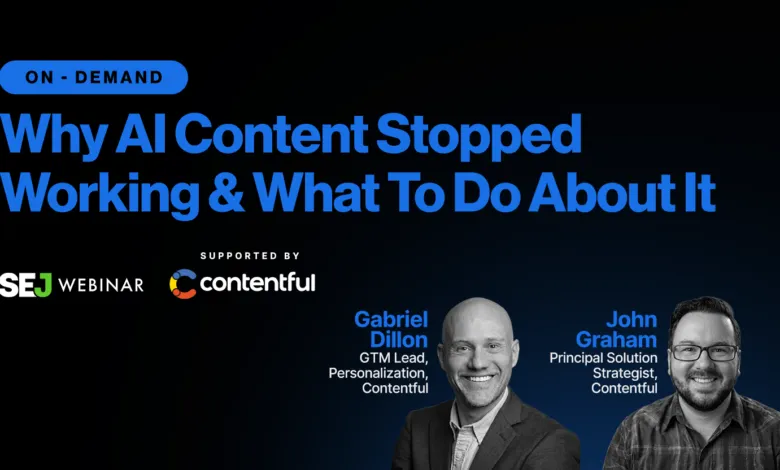
60% of Google searches now end without a single click to any content. That startling statistic framed the central argument from Gabriel Dillon, Go-to-Market Lead for Personalization at Contentful, during a recent SEJ webinar. When AI makes content nearly free to produce, volume stops being a viable strategy. The only content that truly earns attention is content held accountable to a business outcome, built for a specific human, and measured against real data.
Alongside Contentful Principal Solution Strategist John Graham, Dillon explored why AI-assisted copy tends to drift toward generic output, the four essential questions he runs on every marketing piece before it ships, and the personalization signals that work without overcomplicating your tech stack. The session also addressed where the human fits in an AI-assisted workflow, and how experimentation and personalization combine into an accountability loop for content performance.
Your AI writing assistant acts as the ultimate yes man, and your own assumptions feed that loop. That’s Dillon’s explanation for why every brand’s AI-assisted copy converges on the same output. “Our biases as we write content using the robots ends up eating the content that we produce,” he said. “We end up in this cycle of creating content that we think is good but doesn’t actually do what we think it does.” The copy that comes back either confirms what you already believed or mirrors every competitor’s blog in the tool’s training data. Both outcomes fail the reader. Dillon’s counterweight is taste, defined beyond cliché: discernment and intuition, plus the risk-taking to make a claim no AI tool would volunteer, based on what you actually know about your market.
Dillon runs the same four questions on every piece of B2B marketing copy before it ships. The first is whether the copy produces the outcomes you expect. The other three cover who the content is for, how you identify those people, and how the insight scales. “If we don’t have data that proves that our content is good, then we can’t really think about the way to scale it out or make it more effective,” he explained. Experimentation and personalization are two halves of the same coin in this model. The full walkthrough diagrams the accountability loop and the experiment dimensions beyond variant A vs. variant B.
The signals your stack already collects are the ones that work. Dillon’s diagnosis of why B2B personalization has underdelivered for years: teams tackle programs that are too ambitious, then stall on complexity. He laid out three signal tiers, starting with the simplest: new vs. returning visitors. A first-time visitor and a repeat visitor carry different intent, and serving them the same hero copy wastes the distinction. The second and third tiers use signals your ad campaigns and loyalty program generate today. Dillon called the current handling of one of them “such a missed opportunity.”
Detection is the wrong problem to solve, Dillon argued. Whether Google can identify AI content matters less than what happens to clicks. Contentful’s clients are already reporting a crash in organic traffic as AI summaries absorb clicks. The practical response is to compete for the AI answer layer. GEO and AEO determine whether the AI summary at the top of the results page reflects your brand at all. His conclusion cut through the humans-vs-robots debate: one kind of content performs in AI summaries and on-page conversion simultaneously.
During the Q&A, Dillon addressed several pressing questions. On Google removing AI-written content after the spam update, he called identification a fight “Google won’t win,” urging focus on a different target as zero-click search grows. On critical thinking about bias in AI content, he noted bias enters through prompting and training data, with mitigation starting before generation. For leadership demanding mass AI content without quality control, he advised: “Show them through data that you can create better content that drives the business outcomes that you want by creating fewer but better pieces of content.” On whether SEO service pages need a unique voice, Dillon separated voice from effectiveness, noting that even rote pages serve visitors with different goals.
The on-demand recording includes the full accountability loop walkthrough, a live demo of building differentiated experiences in Contentful, John Graham’s field perspective, and session handouts.
(Source: Search Engine Journal)