Mad Scientist Traps Lightning in a Bottle Using Mercury and Neon
▼ Summary
– Drake Anthony’s second-channel video features him building a plasma tube that uses mercury to generate light via the triboelectric effect, a phenomenon discovered by astronomer Jean Picard in 1675.
– Anthony struggles with glassblowing due to a lazy eye but successfully constructs an evacuated glass bulb, adds mercury, and seals it with a blowtorch.
– The mercury’s glow is subtle in darkness because Anthony’s mercury is impure, unlike Picard’s original observation.
– By adding noble gases like neon or krypton to the mercury tube, Anthony creates vivid, lightning-like flashes when shaking the tube or using a Tesla coil.
– The video demonstrates different noble gases produce distinct colors—neon yields red, krypton blue—and warns viewers not to replicate the experiment at home.
If you think life’s only guarantees are death and taxes, you haven’t been paying attention to YouTube scientist Drake “Styropyro” Anthony. His content reliably delivers two things: jaw-dropping science and a healthy dose of danger. His latest video proves the point, even if it landed on his second channel instead of the main one,where he was last seen hooking up a massive array of car batteries.
Don’t mistake the channel change for a softening of his style. This project involves trapping lightning in a bottle using mercury and neon, which is about as far from tame as it gets.
Anthony begins by tracing the device’s history back to 1675, when astronomer Jean Picard experimented with mercury inside an evacuated glass tube. Shaking it produced a strange, ethereal glow,a phenomenon now known as the triboelectric effect. It’s essentially a primitive light bulb, but the science behind it is anything but simple.
The first half of the video shows Anthony struggling with glassblowing, a process he admits doesn’t come naturally,partly due to a lazy eye. Once he assembles the glassware, he carefully pours in mercury, connects it to a vacuum pump, flushes out the air and toxic vapors, then seals the bulb with a blowtorch.
Picard’s original glow was subtle, visible only in near-total darkness. Anthony explains that the effect depends heavily on mercury purity, and his supply is “pretty dirty.” But that’s where modern science steps in. Unlike Picard, Anthony has access to noble gases like neon and krypton, which are famous for their use in tube lighting. Passing an electric current through a low-pressure tube filled with these gases ionizes them, producing vivid colors.
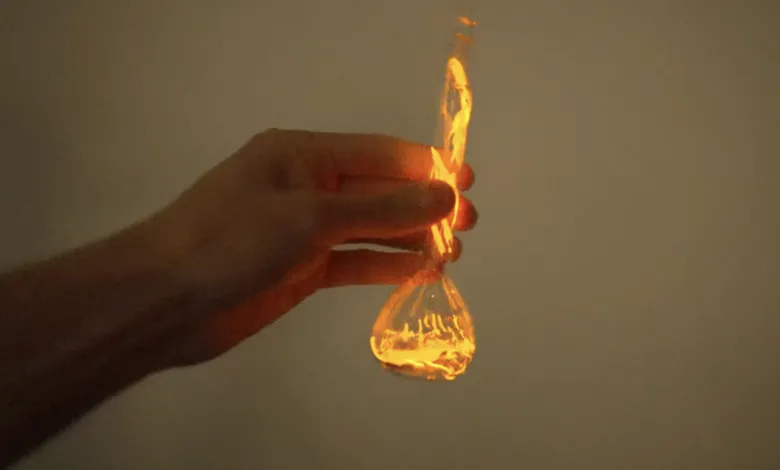
When Anthony brings his mercury tube near a Tesla coil, the same ionization effect kicks in. But the real magic happens when he combines the two ideas. He adds mercury to a flask, pumps out the air, then introduces a small amount of neon before sealing it. A shake later, and the result is lightning captured inside glass,a crackling, glowing spectacle that looks otherworldly.
The video continues with Anthony building different tube shapes and testing various gases. Krypton produces blue flashes instead of neon’s red, and bringing the tubes back into the Tesla coil’s field creates even more stunning visuals.
The moral of the story? Don’t try this at home. But watching it? That’s pure, electrifying entertainment.
(Source: Gizmodo.com)