BrainCo Debuts Brain-to-Robot Platform at WAIC 2026
▼ Summary
– BrainCo demonstrated a brain-controlled robot arm at the World AI Conference in Shanghai that responds to the user’s thoughts without any physical action or voice command.
– The Brain-Controlled Robot AI Platform uses an EEG headset to read brain signals, which AI decodes into control intents and translates into robot commands in under 200 milliseconds.
– The platform works with off-the-shelf robots, including humanoids, robotic arms, and four-legged robots, requiring no special hardware.
– BrainCo also introduced an Embodied AI Data Collection Solution that uses a wheeled rig, a precision glove, and EEG recordings to capture human demonstrations and brain signals for training data.
– Founded in 2015, BrainCo built its expertise on BCI for medical rehabilitation and is now expanding into robotics amid China’s push for brain-computer interfaces and embodied AI.
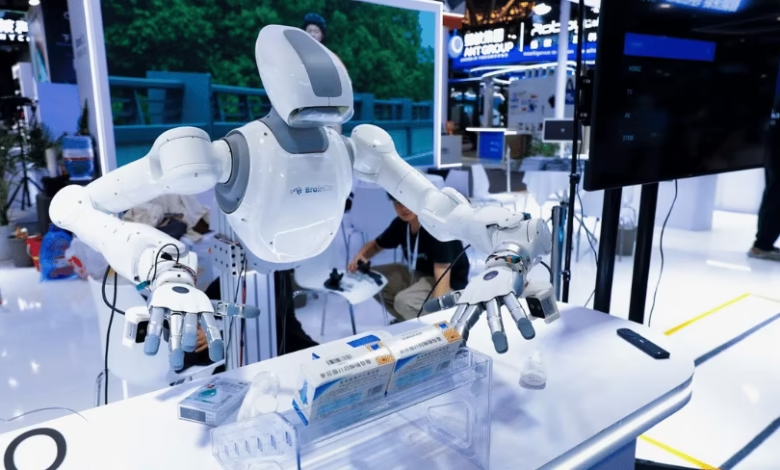
At the World AI Conference in Shanghai, a crowd gathered around a quiet but striking demonstration. A person wearing a lightweight headset simply thought about picking up a cup, and a robot arm reached out and completed the task. No buttons, no voice commands, no physical movement were involved. BrainCo drew significant attention with this display, as reported by the South China Morning Post.
The company is calling its Brain-Controlled Robot AI Platform the world’s first fully integrated brain-to-robot system. That is BrainCo’s own claim, but the technology behind it is undeniably compelling.
The platform operates in three distinct steps, according to BrainCo. An EEG headset captures the wearer’s brain signals. AI then decodes those signals into a control intent, such as “grab that.” Finally, the system translates that intent into commands for the robot. The entire loop completes in under 200 milliseconds.
During the live demo, a mind-controlled arm successfully grasped a cup and picked up an apple. BrainCo says the platform is compatible with standard off-the-shelf robots, including humanoids, robotic arms, and four-legged “dogs.” This compatibility allows it to integrate into existing robotics labs without requiring specialized hardware.
Beyond the direct control demo, BrainCo addressed a major bottleneck in embodied AI: the shortage of high-quality training data. Teaching a robot to fold laundry or handle fragile objects demands enormous datasets.
To solve this, BrainCo introduced its Embodied AI Data Collection Solution. It uses a wheeled, dual-arm rig and a precision glove to capture human demonstrations. Crucially, it also records the operator’s EEG. This logs not only what the hands do but also what the brain tells them to do. The goal is a more reliable and steady supply of real-world training data.
BrainCo was founded in 2015 and built its reputation on BCI for medical rehabilitation. Its prosthetic hands and legs read nerve and muscle signals. This new push into robotics marks a significant expansion of its core technology.
“A decade of BCI research has given us the ability to decode what a person intends to do and translate that into machine action,” said Nyx He, a partner and senior vice president at BrainCo. The launch arrives as companies race to develop both brain-computer interfaces and embodied AI, and as China intensifies its focus on both fields.
(Source: The Next Web)